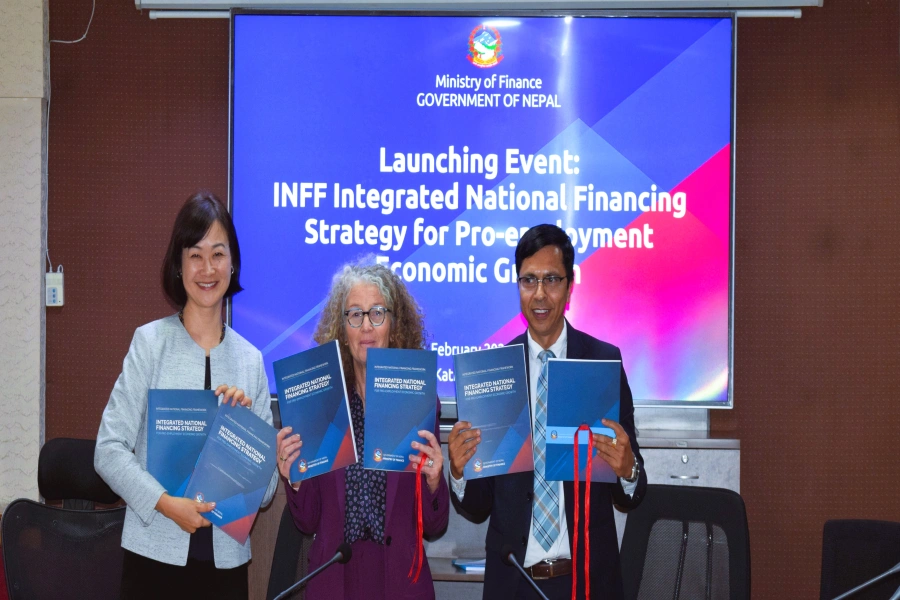
KATHMANDU, Feb 12: The Government of Nepal on Thursday formally launched the Integrated National Financing Strategy for Pro-Employment Growth, a central component of Nepal’s Integrated National Financing Framework (INFF), aimed at aligning public and private finance with national development priorities and accelerating job creation.
The Strategy was unveiled at the Ministry of Finance by Joint Secretary Dr Dhani Ram Sharma at the International Economic Relations Division, alongside UNDP Resident Representative Kyoko Yokosuka, in the presence of senior government officials, development partners and other key stakeholders. It provides a coordinated, results-oriented roadmap to mobilise and align all sources of finance for sustainable, inclusive and employment-focused growth.
Introduced globally at the Third International Conference on Financing for Development (FfD3) in Addis Ababa, the INFF offers a structured approach for countries to mobilise diverse financing sources to achieve the Sustainable Development Goals (SDGs). It is built around four interlinked components: (i) assessment and diagnostics; (ii) financing strategy; (iii) monitoring and accountability framework; and (iv) governance and coordination arrangements.
Nepal endorses Integrated National Financing Framework Strategy...

Nepal’s INFF Financing Strategy places jobs and livelihoods at its core, with a strong focus on youth, women, micro, small and medium enterprises (MSMEs) and communities vulnerable to climate and economic shocks. Amid low private investment, high reliance on remittances, under-execution of capital expenditure, and coordination challenges across federal, provincial and local levels, the Strategy proposes coherent and integrated reforms to promote pro-employment economic growth.
Speaking at the event, Dr Sharma said, “This strategy reflects strong national ownership and is the result of eighteen months of rigorous consultations. It is a country-led approach to align public and private finance with national priorities—placing jobs and livelihoods at the centre of financial decisions. We call on all ministries, development partners, the private sector and civil society to align their programmes and resources with the Strategy to advance employment generation, SDG progress and Nepal’s smooth transition from LDC status.”
UN Resident Coordinator Lila Pieters Yahia congratulated the Government of Nepal on the launch of the INFF, noting that it strengthens the country’s ability to mobilise and manage the resources needed to achieve national development goals. “Nepal’s leadership in co-facilitating the Fourth International Conference on Financing for Development was commendable, and the INFF offers a nationally led platform to align public and private, domestic and international financing under a single strategic framework—enhancing planning, allocation, monitoring and accountability,” she said.
Reaffirming UNDP’s support, Yokosuka said, “Nepal’s INFF Financing Strategy provides a powerful platform to align public and private finance around a shared priority—creating productive employment at home. UNDP remains committed to supporting the Ministry of Finance in translating this Strategy into effective implementation, strong coordination and measurable job outcomes.”
The Strategy is structured around six pillars: (i) fiscal policy and public finance; (ii) monetary policy and private finance; (iii) public-private partnerships (PPP); (iv) financial inclusion and digital finance; (v) climate and disaster risk finance; and (vi) skills development and just transition.
Together, these pillars aim to incentivise private sector employment, expand access to finance for rural and underserved enterprises, strengthen microfinance and digital financial services, mobilise climate-aligned investment, and invest in skills development—particularly in agriculture and other climate-sensitive sectors.
UNDP Nepal reiterated its commitment to supporting the Government of Nepal in implementing the INFF Financing Strategy and advancing inclusive, employment-focused and sustainable development across the country.