When the dust settles on the sudden death of Nepali Congress President and former Prime Minister Sushil Koirala, he is likely to be remembered as a politician who punched above his weight. Sushil didn't have the charisma of BP or Girija Prasad, his two cousins who served as the prime ministers of Nepal before him. To complicate things, a tongue operation to remove a cancerous growth had made his speech nearly incomprehensible. It could be argued that Sushil became the head of Nepali Congress (and subsequently the prime minister of Nepal) largely because of his surname, Koirala, worth its weight in gold within the Congress party. This was why many believed Sushil was undeserving of such high honors.But although this reading of Sushil Koirala is correct, it is also incomplete. It overlooks how Koirala was able to outwit the canny Sher Bahadur Deuba in the race for party president in 2010. It underestimates his contribution to Congress, a party whose formidable organization he helped build and a party that he led to a resounding success in the second Constituent Assembly elections in 2013. Most importantly, this reading ignores the undeniable fact that it was under his watch that a new constitution through the mechanism of an elected Constituent Assembly—a 70-year-old dream of democratic forces in Nepal—became possible.
Born to Bodh Prasad and Kumudini Devi at Dumja of Sindhuli on August 12th, 1938, Sushil Koirala started his political career with Nepali Congress in 1950. After serving the party in various capacities, Koirala was elected a member of parliament in the general election following the 1990 political change. But he repeatedly refused ministerial posts, saying that he rather preferred to work to strengthen party organization. Koirala was among that rare breed of Nepali politicians who led simple, Gandhian lives. But circumstances changed and as did Koirala's beliefs in power politics.
On the eve of the second Constituent Assembly elections in 2013, Sushil was able to successfully cash in on the legacy of Nepali Congress as the oldest running democratic party and its leadership of all the major democratic changes in Nepal. Sushil's image as a clean and simple politician was a sharp contrast to the larger-than-life person that Maoist chairman Pushpa Kamal Dahal—under whose leadership the Maoist party had emerged as the single biggest political party in the first CA elections in 2008—liked to portray. Wary of Dahal's authoritarian streak after the unexpected success of the Maoist party in 2008, people in 2013 plumped for Koirala and Congress, making it once again the biggest political party in the country. Koirala then went on to become the 37th prime minister of Nepal.
Again, Sushil Koirala's biggest contribution to the country has to be the new constitution, made possible under his reign after 10 years of a painful political transition. Even Maoist Chairman Dahal has acknowledged that the new constitution would not have materialized without Koirala's conciliatory presence. Koirala was someone trusted across party lines, in contrast to the sharp-tongued KP Oli, the CPN-UML chairman and Koirala's successor as prime minister who was mistrusted by Madheshi parties. Having an honest and reliable leader like Koirala at the top, says Dahal, helped the Maoist party join the pro-constitution NC-UML alliance. It was thus disheartening to witness a trusted leader like Koirala later get greedy and renege on his earlier promise to hand over government leadership to UML post-constitution. It was a big blunder on Koirala's part to take part in a prime ministerial contest against KP Oli, a contest Koirala was sure to lose.
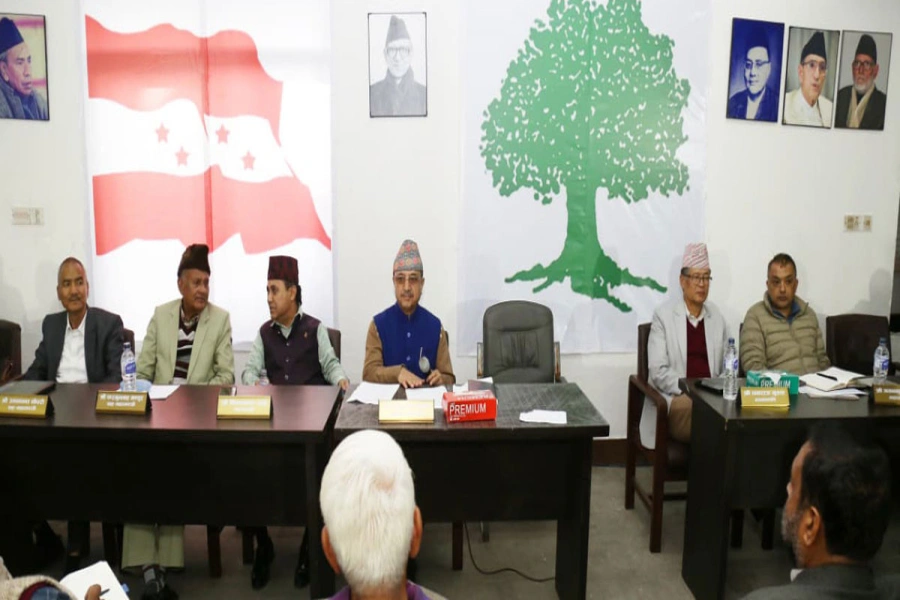
Koirala had other failings, too, one of which was his inability as Congress leader to clearly articulate a vision for his mother party, a vision in keeping with the party's social democratic roots. But to be fair to Sushil, his predecessor as Congress president, Girija Prasad, was as clueless about the party's ideological orientation. On the eve of its 13th general convention in March, the party is desperately trying to find its ideological moorings. Now that we have a constitution, what development agendas does Congress have for Nepal? How does the party answer its critics who accuse it of selling out to market forces? Or can it simply go on, ad infinitum, by cashing in on its past legacy? During his five years as president Koirala did little to raise these important issues within the party.
Sushil Koirala also failed to unite the party as Nepali Congress, nine years after the merger with Nepali Congress (Democratic), continues to effectively operate as two parties under one umbrella. Koirala was also thought of as indecisive and thus prone to persuasion by a small coterie of his close advisers. Most significantly for the country, it was under his watch that India imposed a crippling economic blockade on Nepal. Although Koirala was able to take the big forces in Nepal into his confidence, he had clearly failed to assure the big southern neighbor that its interests would not be compromised in the new constitution. And when the blockade was imposed, Koirala was unable to either take the protesting Madheshi parties into confidence or to persuade the Indians to lift the embargo. During the 20 months of Koirala's premiership, it was also alleged, it was actually his junior coalition partner, CPN-UML under KP Oli, which was calling the shots. There is some substance in all these criticisms.
But on the balance of things Koirala deserves to be remembered as someone who devoted his whole life to the cause of democracy and the one who ensured, after 70 years of wait, the passage of a constitution through the CA mechanism. His spotless image even after 50 years in active politics is no less remarkable. The redoubtable Girija Prasad, under whose shadow Sushil was happy to serve for such a long time, would perhaps have been surprised at what his unassuming protégé has been able to achieve. Above all, the life of Sushil Koirala is a potent reminder to other politicians in Nepal that you don't need to compromise on your ideals for political success.
Related story
'Spider-Man: No Way Home' Gets Special Hardcover Making-Of Book