Anand, who turns 15 on Laxmi Puja on the first day of Tihar this year, may have been born devoid of hands and a right leg, but he was born with a talent – the talent to draw, despite having no fingers to hold the oil pastels he uses.[break]
He takes a rest from drawing – a strenuous exercise that consists of bending his upper body for the most part. Those who were milling around him few minutes back have all gone about their businesses.

“Some days I make upto 300 Rupees and other days I collect around a hundred. It all depends,” Anand shares, as he carefully counts the money he made this day. He calls out on to the guy attending the mobile toilet right across him and exchanges all the coins for notes.
“People can give whatever they wish, I don’t make demands,” puts in the 14-year-old, as he adjusts the handwritten note in Nepali requesting people to buy his drawings.

“When I was little, I used to sit and beg for money in the streets,” says Anand, who has had no formal schooling. With nothing to do, he began drawing and learned to write with the help of passersby. “Some taught me to write my name and some helped me write about myself and my condition,” smiles the friendly teen who is never bothered by people’s questions.
Anand has been drawing and selling his colorful sketches in the streets for more than six years. Out here, on the pavement, is where he makes his living and where he spends the day, including Saturdays. For him, there are no day offs.

At around 5 pm, when the street vendors start laying out their evenings’ bargains, Anand collects his drawings in a nylon bag, folds the shawl he sits on, picks up his crutch and prepares to head home. A friend from his neighborhood meets him at Sundhara, as he returns from school, and they walk back together.
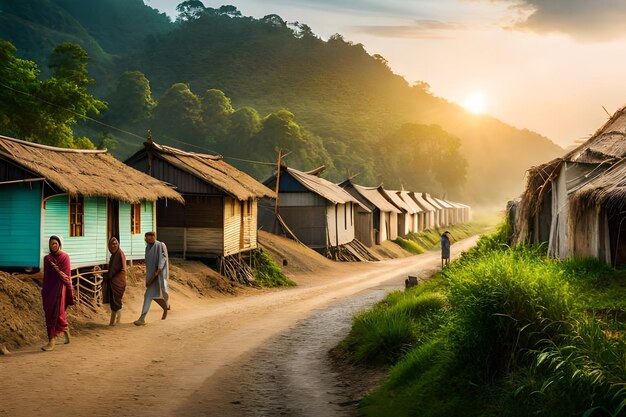
Past the busy roads of Khicha Pokhari, they take a left turn, before entering Jhochhen, into Om Bahal. Anand has been living in this locality with his mother and elder brother for the past six to seven years.

The corridor leading to the single rented room on the first floor is dark, dingy and musty. “I need the torchlight,” Anand yells in an Indian dialect to his mother, Chameli Devi.
For a rent of Rs 2,500 per month, this room is all they have in Kathmandu. It is cluttered with kitchen utensils, water containers, a bed and everything else. The windows at the end of the room bring in the fading evening light.
Anand and his family – father, mother and two elder siblings – moved to Kathmandu from Samastipur in India, then Raxual which borders with Birgunj in the central part of Nepal, 11 years back, with hopes of a better life.
“There was a foreigner who came here and promised to take him to America but never came back,” harshly speaks up Anand’s sister, refusing to tell her name. Already married and with a child, she is on a visit to Kathmandu and lives in Birgunj with her husband.

“But I don’t want to go anywhere. I like it here,” Anand adds with a shy grin as he climbs up on the bed. He pulls out a stack of drawings, stored neatly in a My Clear Bag, from under the mattress. His drawings are vibrant in color and many of them are of Hindu goddesses. However, his personal favorites are of the Rajkumari (princess) and Meethu (his former parrot).
“I used to use wax crayons before but they didn’t stay well on the photocopy paper,” shares Anand, as he shows the oil pastels he uses. It is a whopping Rs 250 for a box. Because he can’t walk too far, he purchases them from a stationery in the locality where he has little options.
 “I don’t draw at home because people will think that I didn’t make them myself,” reveals Anand, who tried to use watercolors but found it difficult to hold a paintbrush. Although he is eager to learn more, Anand is deprived of opportunities, given his physical and monetary constraints.
With his father’s death in March this year, Anand has been solely supporting his mother. His elder brother picks up plastic bags and hardly makes much.
“I haven’t been well lately, but even then he doesn’t want me to work,” Chameli Devi says of his youngest son as she walks to Sundhara to bring him home. In about a week, mother and son will be heading to Samastipur to celebrate the Chhat Parva.
Since vendors occupied the pavements all day long during Dashain, Anand spent the entire time indoors – praying.
“When Anand was around three years old, he used to watch me while I prayed and ask, ‘Will I get hands if you light incenses to the Gods?’” Chameli Devi narrates.
“But he came out of my womb as he is today,” she adds, pulling up her sari to cover her head. And even as she says this, Chameli Devi is as cheery as Anand, who is already picking up his shawl when she arrives at his spot in Sundhara at half past five.
Related story
Seven people arrested for defrauding individuals at Christian ‘...