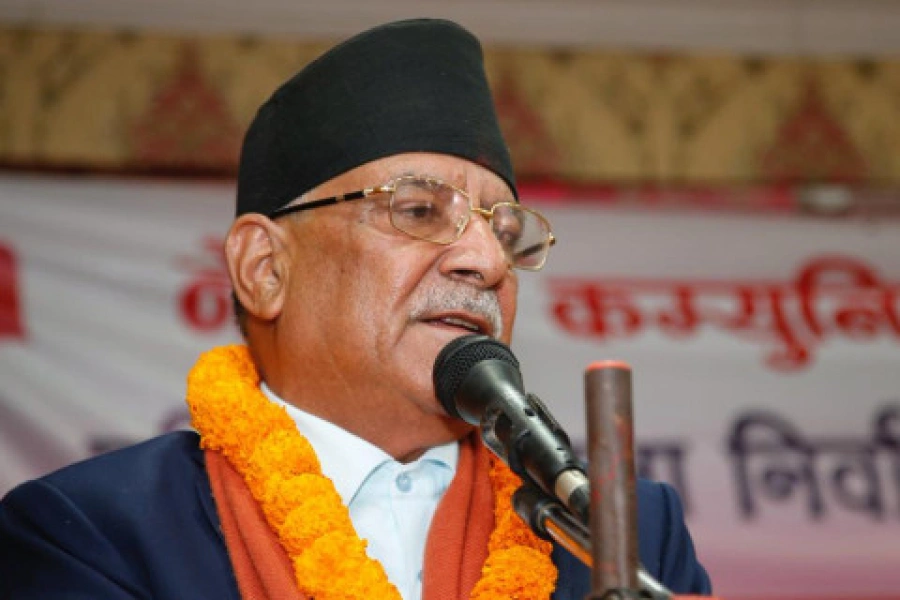
As the first nomination of its kind for a Nepali leader, this is good news. However, the question that arises is whether or not the nomination is based on merit? Or if it was a decision forced on a weak coalition government that relies on GPK’s support? Let us examine.
Prior to the restoration of democracy in 1990, GPK was revered as someone who made great sacrifices for the sake of democracy. His timeless struggles and tireless efforts to bring democracy have few parallels in history. The then Panchayati authorities were forced to release him from his seven-year-long imprisonment only when he was nearing death resulting from his hunger strike that lasted over three weeks. His saga includes long exiles as well, besides several attempts on his life. Moreover, he had been the most energetic, active, organized and cadre-based leader in NC, capable of mobilizing the party cadres more than anybody else.
Unfortunately, during the post-democracy era, his name became synonymous with factionalism, nepotism, power, corruption and personal interests and ambitions. He also demonstrated poor intellectual and moral capabilities. In fact, the greatest share of blame for the ever-deteriorating condition of our nation during the past 20 years goes to his greed and mediocrity as it was he who ruled the country more than anybody else during these two decades.
GPK will warrant the Nobel Peace Prize only when the Maoists transform themselves into a completely peaceful and civilian political party that believes in and adheres to the universal norms of democracy, human rights and rule of law.
It is true that GPK took initiatives and went to great length to bring the Maoists into mainstream and peaceful politics in which he became successful to a large extent. But it is also equally true that he never tried nor was capable of diagnosing the root cause, intricacies and methodologies of the bloody rebellion. At first, instead of trying to counter it politically, he wanted to crush the insurgency through an armed offensive. It was only when the then King Birendra – also the supreme commander of the armed forces – declined his request to mobilize the army that he decided to play the Maoists against his opponents that ranged from Birendra’s predecessor Gyanendra to Sher Bahadur Deuba of his own party.
At first, the underground Maoists needed his support to acquire legitimacy; they later needed it to expand and consolidate their organizational base. The Maoists constantly cashed in on his weaknesses such as personal interests/ambitions and nepotism, which often came at the cost of his own party. The Maoists successfully used GPK in their triumphant journey to Singha Durbar from their hideouts in remote mountains via the ‘Delhi Durbar’ route. However, once after establishing themselves as the most powerful party, the Maoists disregarded many of their commitments that formed part of the peace accord signed between them and GPK, among others.
The Maoists make no secret of their acts of instilling fear, intimidation, extortion and property seizes. Every now and then, they publicly oppose the universal tenets of democracy and threat to seize power to establish a one-party rule. They own a large private army, albeit within the UN-‘monitored’ cantonments. They also possess a great deal of concealed arms and a significant number of armed combatants. They encourage acts of anarchy and promote the culture of impunity. They hardly recognize the right of their opponents to go among the people, nor do they respect the right of skeptics to speak against them—they are annihilated or silenced through violent attacks or intimidation. Thus, the very peace process for which GPK has been nominated for the award is incomplete, uncertain and dangerously heading towards derailment. Therefore, should GPK deserve credit for bringing Maoists to the peace process and mainstream politics, he should admit the moral blame as well for any delay or derailment of the peace deal.
GPK will warrant the Nobel Peace Prize only when the Maoists transform themselves into a completely peaceful and civilian political party that believes in and adheres to the universal norms of democracy, human rights and rule of law and when they do away with their military, militia and the muscle-over-mind mindset. If and when that happens, Pushpa Kamal Dahal, the Maoist supremo who signed the peace deal, could be jointly nominated for the award along with GPK.
Yes, had GPK chosen soon after co-leading the successful uprising of 2006 against the monarchy to become a moral leader, like Mahatma Gandhi or Jaya Prakash Narayan chose to become, instead of battling for power, his nomination for the award would have been fully justified irrespective of the manner in which the Maoists conducted themselves thereafter.
jeevan1952@hotmail.com
Related story
Trio wins physics Nobel for quantum mechanical tunnelling