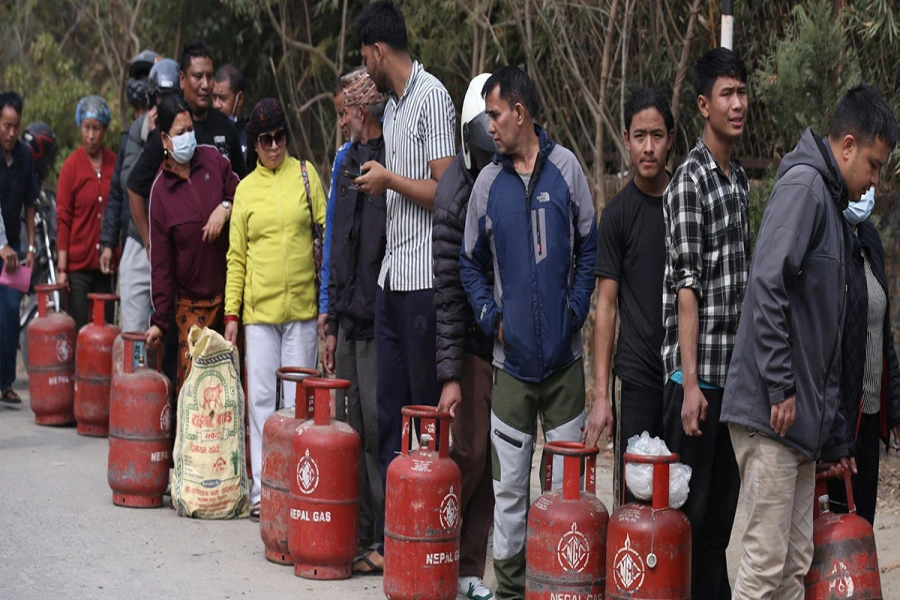
The government has imposed a fine of Rs 300,000 on a gas depot in Lalitpur for storing LPG at a time when people are facing difficulties in procuring cooking gas. Officials found more than 6,300 cylinders stored at Shree Ram Gas Bhandaran in Harisiddhi. The action comes as households queue for days, sometimes weeks, just to get a refill. The shortage has been linked to the Middle East crisis, which has pushed up demand and strained supply. The state has tried to respond by asking bottlers to sell half-filled cylinders so that more households can access some gas. It has also urged the public to report black marketing and other irregularities. The fine is part of that effort and sends a message that hoarding will not be tolerated. Still, one fine will not fix a system that is already under stress. The shortage is not caused by one depot alone. It is a mix of limited supply, weak monitoring, and public panic. Traders hoard to make quick profits, while people stockpile gas out of fear. Between the two, the market is disrupted. The decision to fine the depot is justified, as it shows the government is willing to act.
Revised interest rate corridor system introduced
However, enforcement cannot be selective, nor can it be occasional. If one depot is penalised while others continue the same practice, the message may not be effective. Inspections need to be regular, not just reactive raids after shortages become acute. Monitoring must go beyond storage points. Transport, bottling plants, and distribution networks all need oversight. Leakages often occur in these gaps. If cylinders are diverted or delayed along the way, shortages will appear even when supply exists on paper. The half-filled cylinder policy is a short-term fix. It spreads limited supply across more households, but it also requires strict supervision. If bottlers misuse it or charge unfair prices, the policy will backfire. The government must ensure that the measure remains fair and temporary. Public behaviour also plays a role. Panic buying worsens the situation. When families try to keep extra cylinders at home, others are left without any. The government’s appeal to report black marketing is useful, but it must be backed by swift action. People will only report if they believe action will follow. To ease pressure, the government should publish clear and regular updates on LPG stock and supply. When people know what is available, panic tends to subside. Authorities should also coordinate closely with importers and suppliers to avoid sudden gaps. Even small delays can trigger fear in the market.
Promoting alternative energy sources where possible is a sensible approach. Electric cooking, although not always feasible, can help ease pressure on LPG supplies. It is not a complete solution, but it can be effective, especially in urban areas where electricity supply is more reliable. Local authorities also have a role to play. Ward offices must be able to monitor supplies where it matters most—at the ground level. They are closer to the people and can spot anomalies and respond more quickly than a distant central authority. Ensuring a steady and adequate supply of LPG and other daily necessities must remain a priority. The fine in Lalitpur is a step in the right direction. It shows intent. However, intent must be followed by a robust system. Without that, the cycle will continue—and it is ordinary citizens who will suffer again.


-1200x560-1774606010.webp)
-1200x560-1783685616.webp)