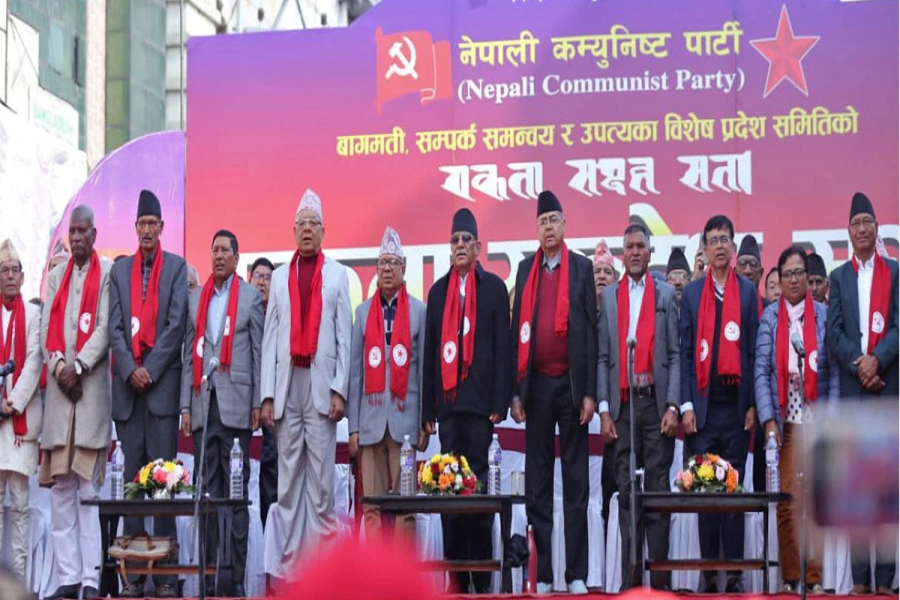
Expect physical assaults and violent clashes between cadres of CPN-UML and UCPN (Maoist) on the eve of the upcoming CA election, whenever it may take place. The escalating war of words between Maoist Chairman Pushpa Kamal Dahal and top UML leaders are bad omen. UML leaders have resorted to name calling: While Jhalanath Khanal bet that CA polls would sweep Maoists off the scene in such a way that one will have to search for their remains with a torch, Madhav Kumar Nepal declared Dahal insane and recommended that he consult a psychiatrist in Ranchi. UML rank and file label the Maoists ‘betrayers’ of communist revolution, enemies of the people, and curse of the nation. They promise to push the former rebels into irrelevance and occupy the political space hitherto monopolized by the Maoists. The animosity between these leftist parties should not have reached this level, given their shared communist identity. [break]
Ideally, the two forces should have enjoyed a greater degree of camaraderie. Maoists should have been more wary of Nepali Congress, once its “principal enemy”, and which it still accuses of being a traditionalist, status-quoist force. In contrast, Maoists have much in common with UML, at least principally.
Both are communist forces, both believe in multiparty system and open market capitalism, both are in favor of empowering Dailts, Madhesis, the marginalized, and the poor and the excluded people. Why the rivalry then? Of course, Dahal had started the hate war with his infamous statement earlier in May that UML won’t exist after CA polls. But this is only part of the answer. There are political, psychological, ideological and philosophical factors surrounding the rising hostility between the reds.
Of late, the main cause of hostility has been growing similarity between UML and Maoists. Through its general convention in February, UCPN(Maoist) adopted the political line that UML has practiced since 1990. The convention transformed the Maoist party into a parliamentary force. Maoist hardliners have a point when they accuse the leadership of walking on UML’s path (or continuing with Emalekaran). UML has felt its space being encroached by this Maoist transformation. Until February, the UML had some strategic advantages over the Maoists. It could label the Maoists a party that still believes in violence. It could accuse the Maoist of not transforming into a loktantrik force. In doing so, UML could project itself as a more democratic communist party. The Hetauda conclave challenged this notion. Now that the Maoists have come close to UML’s path, UML has had to battle an identity crisis. It cannot make a complete rightward shift, though this is precisely what the party seems to be doing. Nor can it recognize the Maoists as a like-minded force it can work with. It cannot officially give up its communist identity either. (Reportedly, UML had made efforts towards this end long ago. The story goes that UML office bearers had taken the photos of communist ideologues—Karl Marx, Friedrich Engels, Vladimir Lenin and Mao Zedong—off their office walls during a visit by a US ambassador sometime in the 1990s.The goal was to show to the western world that they are communists only in name).
Today, UML is in a big ideological dilemma. It must retain its hold among the poor and the marginalized while it must also feign commitment to communism. But it also cannot stop its rightward shift. In a way, it has become a force comprising of what German sociologist Andre Gunder Frank calls lumpenbourgeisie (the comfortable middle and upper-class which support status quo and ruling elites) and what Karl Marx calls lumpenproletariats (the working class that is of no use in revolutionary struggle and an actual impediment to the realization of classless society). This was not a matter of concern for UML so long as UCPN (Maoist) stuck to its hardcore communist ideology. But now there is a big number of Maoist followers who have turned into lumpenbourgeisie and lumpenproletariats themselves. In recent years, the party has started to cater to the people of this class, thus erasing its differences with UML.
What is frustrating for UML is that the Maoists have still been able to pull influential UML leaders into their fold. If disgruntled UML leaders had joined other parties, perhaps UML would not have taken it so badly. But they joined a party that increasingly toes UML line. Ramchandra Jha, Urmila Aryal and Ashok Rai’s defection has shaken UML to the core. UML has given the defectors deeply demeaning names: bamboo husk, dirt on elephant’s body, festering boil, stinking garbage, to name a few. Such demeaning remarks have prepared the ground for other UML leaders to defect. UML defector Ashok Rai told this scribe that UML leadership’s tendency to insult will prompt even committed UML cadres to leave. Ramchandra Jha claims that thousands of UML leaders and cadres will defect the party and join UCPN (Maoist) in the days to come. Unable to stop this surge of defection, UML can only vent its anger on the Maoists.
As a result, UML feels defeated even before the polls. What if Dahal’s prediction comes true and it is truly swept aside in the coming polls? A streak of defeatism is palpable among the Maoists as well. They know they have become unpopular since the last CA polls, that they have deeply disappointed the people. They are aware that people could easily choose UML over them. This insecurity leads the Maoists to attack their ideological ally. Maoists know that their vote base is UML supporters and their success in the upcoming poll hinges on how they can dismantle this UML support base.

Republica
The two forces are in a fierce existential struggle now. In the words of Jean Paul Sartre, for human beings continued existence takes precedence over everything else—nature, features, and ideological leanings are all secondary. The problem, says Sartre, arises when the man realizes he could die one day. He then starts to experience existential angst, the dread of losing existence. Sartre’s philosophy applies perfectly to UML-Maoist relation. Each fears its end; and each wants to eliminate the other to prolong its own existence. This struggle for existence is likely to intensify in the days ahead. The rivals will do all they can to ensure continued existence. After all, to borrow from Sartre again, existence precedes essence.
mbpoudyal@yahoo.com
Related story
Fragments launch ‘Angst’