

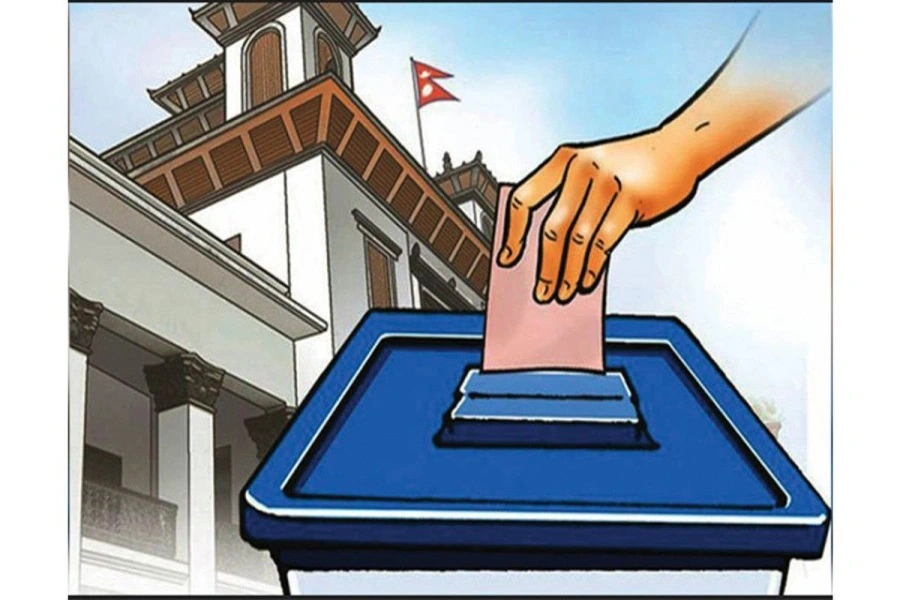
The upcoming House of Representatives (HoR) election scheduled for March 5, 2026 is being held in a changed context as a consequence of the Gen Z protests of September 8, followed by anarchy and vandalism, which were instigated, propagated, and violently inflicted upon Nepal by invisible hands. On September 9, 2025, public properties, including courts, parliament, and government installations, were affected throughout the country. The private homes of political leaders, business leaders, and their corporate entities and business outlets were also reduced to ashes. Interestingly, while burning down the prominent leaders' houses, stacks of cash, including Nepali and US dollars, were found burnt and looted by the hooligans. The political leaders were badly humiliated and forced to hide from public appearances until normalcy was restored.
Downplaying the rule of law and the constitution, the burning of public properties and houses of leaders, as statelessness, has outrageously humiliated the nation with arson and vandalism all over the country at the same time, with the same intensity and wickedness, by the clichés of invisible hands inflicted upon us crookedly to derail the infant democracy.
In such a situation, from a political point of view, two major turns of events are likely to take place in Nepal. Apparently, blaming the steps of the President to appoint the present government as an unconstitutional act, if established by the court verdict, will further push the country into democratic backsliding, falling into a vicious cycle of anarchism and instability. Secondly, a decisive and deterministic comeback with political actions is needed to stabilize the dwindling political situation toward revitalizing credible democratic governance and government through conducting fresh elections with the people’s mandate to govern. In both conditions, either on the announced date of March 5 by the present government or a later date announced by the new government, the election should be the precondition and essential to regain the lost confidence of the people, reinstate the democratic system of governance, and steer the development endeavor to fulfill the long-cherished aspirations of the people.
Ensure election integrity

The legitimacy of this government, however, is questioned; it is tacitly accepted by all parties and leaders under the principle of necessity, a vague term that applies whenever there is no apparent and legitimate constitutional way to handle the contingent situation. Many variables try to interplay during the transition period to destabilize the nation and meet wicked and veiled interests. A power void appears in the transition period, which demands a credible leader to fill the power vacuum with the people’s mandate to govern. Lingering and dilly-dallying on any pretext to transfer power to the legitimate government of an elected body will exacerbate and create grounds for calling unscrupulous political elements or a junta to fill the power vacuum, as seen in other least developed countries.
The global and regional power centers always want to see democracy in their front and backyard and periphery not take root and become stable, so that they can impose their interests upon them. Obscure attempts through campaign finance and the use of media and social sites interfere in elections.
In this context, the elections for the federal parliament are going to be held in March. Unlike previous elections, this one will be seen from a different perspective since youngsters have come forward with open eyes, holding their grievances toward the old established leaders. Money factors that set the rules of the game are probably downsized this time around, since leaders are frightened by being exposed for their living standards, with money from corruption in their possession. Still, those with more money can do better in elections through the disproportionate use of influence on voters, use of social sites, and media, etc.
Since campaign finance refers to money and in-kind donations used for election campaigns, the chances of big cats extracting more money into their coffers from different legitimate and illegitimate sources and spending it on election campaigns are high. This creates disproportionate access to funds in the hands of candidates and affects their ability to participate in elections. When electoral integrity comes into question, the legitimacy of the election is also questioned; therefore, the election management body needs to come forward and fix campaign contribution and expenditure limits and ensure disclosure, which is essential for creating and ensuring a level playing field.
According to studies, money played a significant role in the previous elections in 2017 and 2022. The Election Commission also issued an election code of conduct and campaign contribution and expenditure limits. However, there was a flagrant violation of the set legitimate limits, and most candidates who won the elections with money power crossed them. In some cases, the sources of contributions were obscure and unknown. Receiving donations from obscure sources and high spending on elections have a negative influence on electoral integrity in Nepal. This was because of unequal access to funds among candidates and parties. It was noticed that those who spent more money in elections were more likely to win.
A free and fair election requires electoral integrity and transparency, wherein people can fearlessly participate in voting for their representatives, which ultimately not only supports but also consolidates democratic values and institutions. This time, in a changed context, the probability of exposing money power has some constraints due to environmental causes; therefore, we have to closely observe political activities and election campaigns to assess the outcome. Election finance is also an opportunity cost, as observing how political parties and candidates use this opportunity to their advantage depends on the future of democratic transition and its stability.


