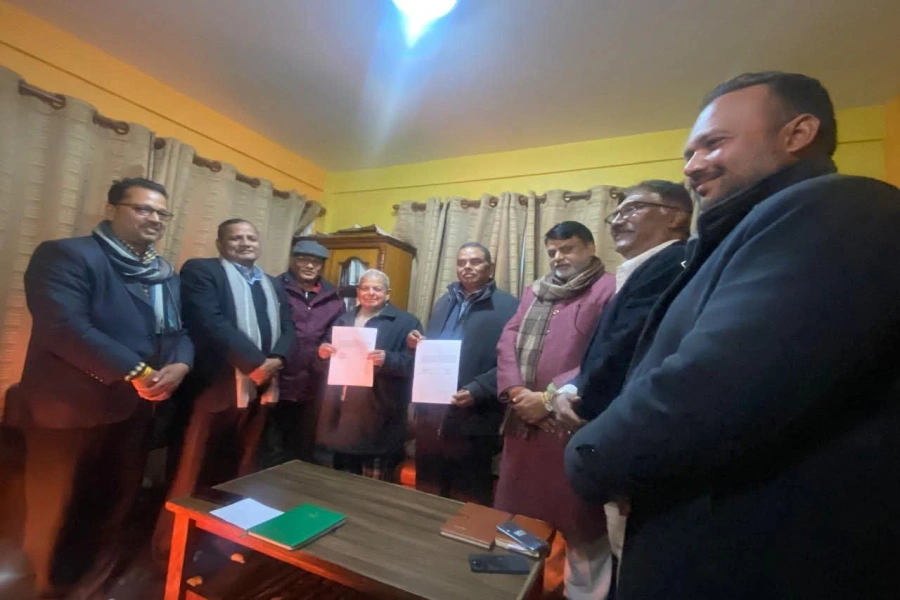
The ruling coalition’s intention of forming a separate alliance in favor of identity-based federalism comes at a wrong time. The polarization it would cause could jeopardize ongoing consensus building efforts. The latest endeavors come at a time when the major parties are yet to find consensus not only on the contentious issue of modalities of federalism but also on the need for a government of consensus. The ball for such an alliance was set rolling when on Monday when the ruling coalition of UCPN-Maoist and United Democratic Madhesi Front (UDMF) decided on an alliance of forces in favor of identity-based federalism. The very next day, caretaker prime minister Baburam Bhattarai took a similar initiative to convince indigenous and ethnic leaders and activists. The latter, including leaders from Nepali Congress and CPN-UML, have even agreed in principle to form such an alliance to counter the anti-federalism forces. The leaders floated their proposal to the prime minister, concluding that it was important to counter growing unity of ‘anti-federal’ and ‘anti-secular’ forces. But the alliance is yet to take a formal shape.
The initiatives should instead focus on overcoming the trust deficit between the parties to find a workable solution to current political and constitutional crisis. What is desperately needed is constructive dialogue, not another debate. The useless debates are more often than not platforms for each participant to prove the other wrong; whereas the need is for a collaborative dialogue where the participants work towards common understanding. The need now is to start a dialogue to explore new possibilities amidst the differences. There is no doubt that Nepali society is divided over the issue of identity-based federalism, but if the issue is not dealt with judiciously, it could further damage the atmosphere of trust between the two sides. But one thing is for sure: the identity of minority communities has become among the most contentious issues in a society which has traditionally been discriminatory on the basis of caste and ethnicity.
It is a welcome step that the country’s political forces and the Nepali society as a whole have begun contemplating a federal model that recognizes the identities of the communities that have historically been deprived of their rights and one which could be a step towards true devolution of power. The centralized governing system has failed to reach out to majority populations; and federalism could provide a basis for the much-needed decentralization of power, thereby providing opportunities to the people at large. But this would not be possible through greater polarization between pro- and anti-federalist forces. The parties, who have failed to formulate a constitution in the last four years, do not seem to have realized their past mistakes. Their negotiations within the four walls of party leaders’ homes failed to address the grievances of the minorities. Therefore, the parties should now change their working style and reach out to the people. For this, the prime minister’s all-out effort to cling on to his chair has to end in order to create an atmosphere where the parties could take their agenda to the people for a fresh mandate. It is hard to see how an alliance of pro-identity-based federalist forces would help achieve this goal.
Related story
5 home remedies to stop hair fall