KATHMANDU, Dec 30: Former Minister for Home Affairs Ramesh Lekhak’s admission of moral responsibility for the September 8 incident has placed then Prime Minister KP Sharma Oli in an uncomfortable position. Lekhak said he was emotionally shattered by the loss of many young lives and that the trauma compelled him to resign on moral grounds. His statement has since put Oli under mounting moral pressure.
Lekhak accepted moral responsibility before the probe commission formed to investigate the incidents of September 8 and 9. After appearing before the commission and recording his statement on Monday, pressure on Oli intensified. While Oli has publicly stated that he will not appear before the commission, preparations are underway to formally write to him next week. Even if the letter is sent, the likelihood of his appearance remains low.
Earlier, commission representatives had said Oli would be brought before the panel “by any means” if he failed to appear. However, commission officials have recently grown cautious and are reluctant to speak openly on the matter.
After Lekhak returned from his testimony, commission spokesperson and former AIG Bigyan Raj Sharma said preparations were underway to correspond with Oli. “Ramesh Lekhak’s statement is still being recorded, and once it concludes, a letter will be sent to former Prime Minister KP Oli to record his statement,” Sharma said, without specifying a date.
Lekhak told the commission that he had already presented everything from his side and expressed willingness to appear again if required. “I have shared my views. If there is any confusion, I will come again when called,” he said.
The commission said further questioning may be required after reviewing Lekhak’s written responses. Lekhak, who has already submitted a written statement, is scheduled to travel to Kanchanpur in the coming days. He also questioned claims that his passport had been seized and that movement restrictions had been imposed on him, asking for whom such narratives were intended. The commission has not responded to the issue.
Oli, too, has repeatedly raised concerns about movement restrictions. One of the reasons cited for shifting the UML’s 11th General Convention from Pokhara to Kathmandu was the restriction on Oli’s movement, amid fears of possible clashes and disruption. UML leaders and cadres have not taken the restrictions positively.
Probe commission to summon former PM Oli for statement
During a meeting at the President’s residence involving Prime Minister Sushila Karki and top leaders of three parties, UML Chair Oli said elections could not be held under movement restrictions. Following the December 27 meeting, the government appeared to soften its stance on the restrictions imposed on Oli and also signaled flexibility regarding how the commission would record his statement.
In line with that signal, the commission team is now preparing to visit Oli’s residence in Gundu. “Most likely, the commission team will go to Gundu to record Oli’s statement,” a commission source said. Oli had earlier remarked that if the team came to his residence, he would offer them tea and send them back. “If they come, we’ll talk. I’ll serve tea and send them back,” Oli had said.
After the remark went public, the commission reportedly agreed to visit his residence. Oli had also said he would rather face bullets than go to give a statement.
The commission has sought legal advice on possible steps if Oli refuses to appear at its Singha Durbar office. Officials are considering provisions that allow statements to be recorded at a person’s residence. Another option—producing Oli through police—was also discussed, with arrest possible if that failed.
Under the Inquiry Commission Act, 2026 BS (amended 2075 BS), the commission holds powers equivalent to a court and may issue an arrest order. However, it is unlikely to pursue that route, considering the risk of disrupting the election process.
“Neither the government nor the commission is in the mood to escalate tensions with the UML at this point,” a commission source said.
If Oli neither gives a statement nor can be produced due to security concerns, a third option is to prepare a report imposing a fine. Section 6 of the Act provides for penalties related to contempt. If found guilty, the commission may impose a fine of Rs 500 and finalize its report. Another option under discussion is to base conclusions on Oli’s public statements in the media.
What did Lekhak say before the commission?
While giving his statement on Monday, Lekhak said the human toll of the September 8 and 9 incidents had shaken him deeply. In his written submission, he said his conscience did not allow him to remain in office.
“The tragic events of September 8, in which promising young lives were lost and many were injured, not only devastated me but tore me apart internally,” Lekhak said. “In such an unimaginable situation, I decided to resign immediately, accepting moral responsibility as Home Minister.”
He recalled that his resignation letter explicitly stated that he was stepping down on moral grounds, emphasizing that morality is the most valuable principle in politics.
Lekhak also said he had downplayed his personal suffering, including the arson attack on his house and the death of his ailing mother. “The pain of seeing ancestral property reduced to ashes is known only to those who endure it,” he said, “but when the entire nation was burning, I considered my personal loss secondary.”
A long-time advocate of democracy and civil liberties, Lekhak told the commission he never ordered the use of force against citizens and never could.
Speaking to journalists after his testimony, Lekhak said he could not save his mother due to the attack on his home during the Gen Z protest. “She was critically ill and needed oxygen frequently,” he said. “On the 9th, we had to protect her from protesters’ attacks and hide her for some time without oxygen. When we finally took her to the hospital, pneumonia had already developed, and she passed away a few days later.”
He said he revealed these details only after the commission inquired about his personal losses. Lekhak said two houses in Mahendranagar were destroyed and his Kathmandu residence rendered uninhabitable. He also expressed concern over the loss of historical notes, documents, and nearly 5,000 books collected during the peace process and constitution-drafting periods.
Reiterating that he never ordered the use of force, Lekhak claimed the protest had been “hijacked.”
“As Home Minister, I clearly instructed the security agencies: first, ensure there are no casualties; second, manage peace and security through coordination; and third, remain alert against possible infiltration,” he said. “I did not issue any written or verbal order to open fire or suppress the protest.”
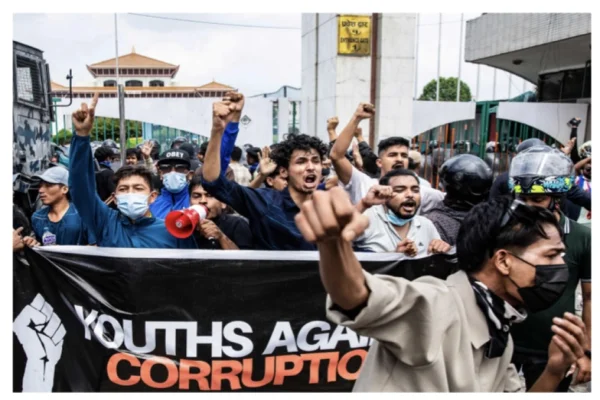
Lekhak acknowledged that the demands raised by the Gen Z group were legitimate but claimed that anti-democratic elements hijacked the movement and turned it violent.






-1200x560-1783336185.webp)