

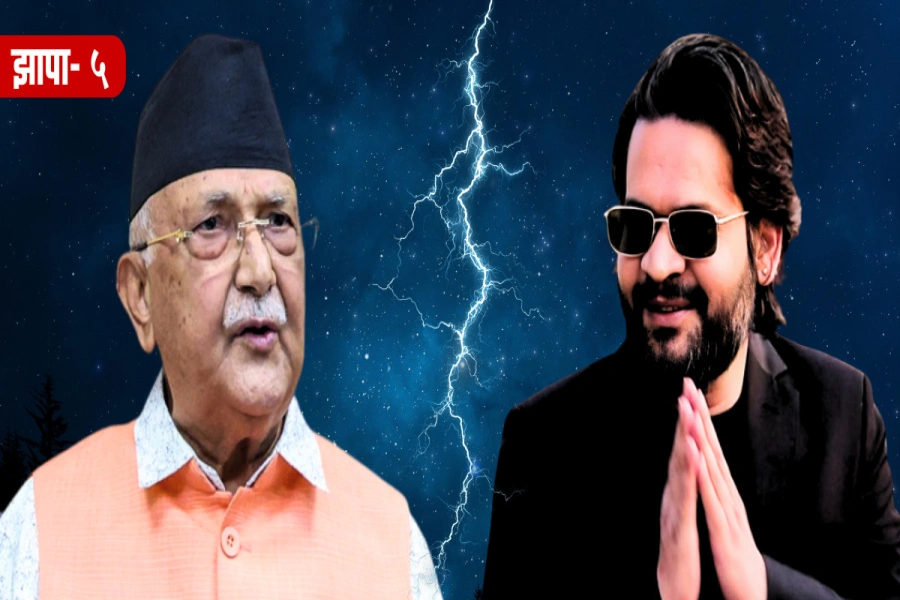
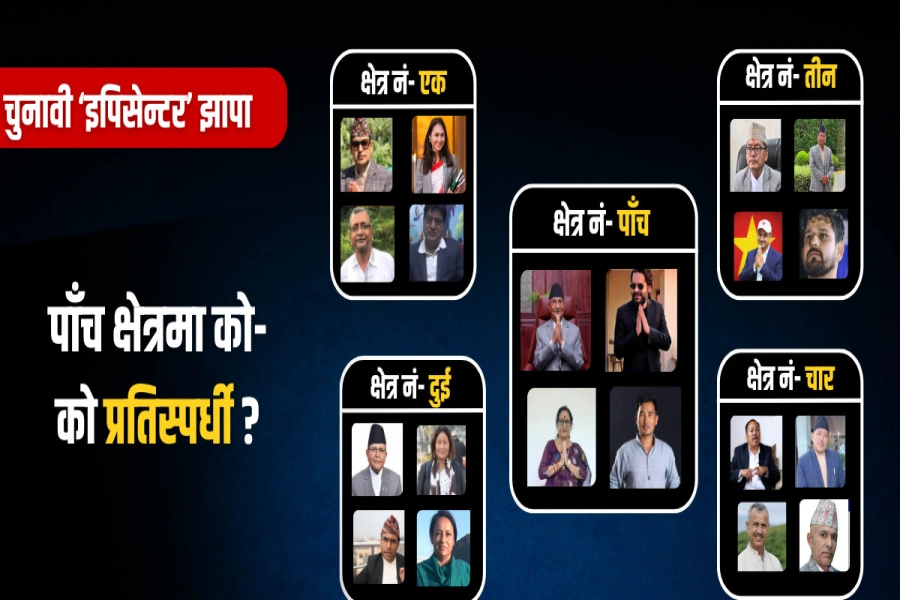
KATHMANDU, Feb 27: Jhapa-5 is shaping up to be more than just another electoral battlefield. It is a test of legacy versus change. In the constituency where former Prime Minister and CPN-UML Chair KP Sharma Oli has long maintained a commanding presence, Balendra Shah (Balen) — projected by the Rastriya Swatantra Party (RSP) as a future prime ministerial face — has stepped in as a formidable challenger. And voters are watching closely.
Shah has managed to generate buzz, but sustaining that momentum is proving to be the real challenge. As polling day approaches, voters in Jhapa-5 appear cautious, weighing both the seasoned heavyweight and the ambitious newcomer. UML, which has traditionally drawn strong backing from lower middle-class families in the constituency, is working hard to preserve that base. Oli, for his part, has been actively reaching out to middle- and upper-class voters as well. This time around, every candidate seems intent on securing the lower middle-class vote, aware that it could tilt the balance.
Despite his growing popularity, Shah has yet to leave a strong mark on larger political issues. In his manifesto, he promises to play a key role in ensuring constitutional delegation of authority to local and provincial governments.
However, critics have pointed out that while serving as Mayor of Kathmandu Metropolitan City (KMC), Shah did not cast his vote in the National Assembly election held on January 25. He had also skipped voting in the Provincial Assembly election earlier. For some voters and intellectuals in Jhapa, that contradiction raises questions about consistency.
Shah has highlighted infrastructure — particularly the completion of the Damak–Rabi–Chisapani road — as a key agenda. Had the road already been completed, it might have strengthened his position considerably, given the significant voter presence from Panchthar, Ilam and Taplejung in the area. His manifesto also calls for the timely completion of the Postal Highway and bridges, and envisions Damak as a future smart city equipped with modern infrastructure. Yet, because these projects are already under construction, many voters do not see them as fresh or game-changing promises. Opinion remains divided over whether these commitments are meaningful or merely reiterations of ongoing work.
One project that continues to stir emotions is the Damak View Tower. Built with billions of rupees in investment, the structure became a flashpoint during the Gen-Z movement when it was vandalized. While some residents near the tower see its potential benefits, the controversy surrounding it has fueled public resentment and internal disagreements within UML. Interestingly, Shah’s pledge to bring the tower and other local infrastructure into effective operation may have indirectly helped UML consolidate its support base. In his manifesto, Shah promises to operate Damak’s convention hall, view tower and related facilities to ensure maximum public benefit.
Gagan faces tough challenges in Sarlahi 4
On land reform, Shah has proposed forming a commission within 100 days of leading an RSP government and resolving land-related issues within 1,000 days. However, voters point out that previous governments have already formed multiple land commissions, which seem less innovative. Some argue that earlier UML-led administrations made noticeable progress on squatter issues within six months. While such debates are active behind closed doors, many voters remain hesitant to voice their opinions publicly.
There is undeniably a strong undercurrent of demand for change in Jhapa-5. UML has framed the contest as a battle between those who would “burn the country” and those who would “build it.” Meanwhile, Shah’s supporters have been invoking the events of September 8 and 9, linking them to decisions made during Oli’s tenure as prime minister and using the emotional narrative to mobilize voters. UML, however, is pushing back just as forcefully.
Casual conversations at public squares suggest that roughly four out of ten people openly express support for Shah, while others prefer to stay neutral or silent. Online, though, Shah’s presence appears significantly stronger.
Squatter families are expected to play a decisive role in the outcome. Both Oli and Shah are courting their support. Yet discussions within squatter settlements reveal lingering skepticism toward Shah, partly stemming from his handling of squatter issues during his time as KMC mayor and partly because he is still perceived as a relatively new political figure.
Oli, on the other hand, is banking on decades of political experience. Since 1991, he has contested elections from Jhapa, building both a personal brand and a strong party organization. Jhapa remains a UML stronghold, and past election results show the party’s victories are largely rooted in its disciplined organizational network. In the previous election, UML secured the highest proportional votes in Jhapa, underscoring its continued dominance.
Shah’s task, therefore, is not just to win votes — it is to break into a well-entrenched vote bank. Compared to UML’s extensive grassroots network, RSP’s organizational structure in Jhapa remains relatively weak. Limited open endorsement from intellectual circles and his image as a newcomer add to his challenges. Still, Shah is banking on public dissatisfaction with traditional parties, the appeal he holds among younger voters, and his powerful social media presence. Oli, as a veteran parliamentarian, is equally skilled in electoral maneuvering.
Sampang also challenges Shah
Adding another layer of complexity is Harka Sampang. After the Gen-Z movement, Sampang had traveled from Dharan to Kathmandu with ambitions of becoming prime minister — aspirations that did not materialize. He reportedly holds Shah and RSP Chair Rabi Lamichhane partly responsible and has since maintained a distance from them. Sampang’s Shram Sanskriti Party, contesting under the “soil in cupped hands” symbol, is challenging UML in Koshi Province, and Sampang himself is running from Sunsari-1.
Though based in Dharan, Sampang’s influence extends into Jhapa-5, particularly among Janajati voters who migrated from the hills to Damak. His public statements expressing a desire to see Oli in Parliament do not bode well for Shah. Complicating matters further, Shah, being registered as a voter in Kathmandu, cannot cast his own vote in Jhapa-5. There is also local chatter about Shah opening his election contact office in the home of an individual accused of involvement in arson during the Gen-Z movement — a detail that has raised uneasy questions among some residents.
Silence on the Rs 300 billion industrial park
Meanwhile, a notable silence surrounds the proposed Nepal–China Friendship Industrial Park in Kamal, Damak and Gauradaha — a massive Rs 300 billion project envisioned as one of South Asia’s most advanced industrial hubs. The plan covers an area one kilometer wide and nine kilometers long, spanning 2,200 bigha within Jhapa-5. Chinese operators are slated to manage the park for 40 years before handing it over to Nepal.
The Investment Board has already approved Rs 64 billion, and groundwork, including the Detailed Project Report for the Damak Clean Industrial Park, is underway. China’s Lhasa Economic and Technological Development Zone Jingping Joint Creation Construction Project Development Company Limited has been approved to invest.
Former Prime Minister KP Sharma Oli laid the foundation stone for the project on February 28, 2021, describing it as Nepal’s largest and South Asia’s model industrial park under the Belt and Road Initiative (BRI). At least 100 industries were projected in the first phase. UML leaders allege that Shah omitted the project from his manifesto because of its association with the BRI framework. RSP has not clarified its stance.
As the campaign intensifies, Jhapa-5 remains a constituency where history, identity, development, and emotion intersect. For Shah, the path forward demands more than momentum — it requires winning the confidence of voters who have long stood with Oli. Whether the call for change outweighs decades of loyalty will soon be decided at the ballot box.







-1779842101.webp)






