Why could not the Mahasamiti meet take any concrete decision on issue of federalism?
Let there be no doubt. NC is committed to federalism and institutionalizing republic. As for the nature and number of federal provinces, we will make our stand clear in our election manifesto. We have also formed a committee to deliberate the issue. Even if we take a decision now, it won’t be final. The number and nature of federal provinces will, ultimately, be determined by the nature of the composition of new CA.
Other parties like UCPN (Maoist) and CPN-UML seem to be clear on the issue. On the other hand, your 7-13 province models are rather vague.
Of course people will want to know how many provinces NC endorses and on what basis. We will make public our final verdict on federalism before the polls. We are rigorously discussing the issue within the party.
Isn’t that a roundabout way of admitting that NC is plagued by indecisiveness?
Not really. If you remember, we had agreed on a 11-province model on May 15 last year. We decided that Kailali and Kanchanpur would remain part of Seti-Mahakali province and in case of objection from the people we had decided to settle the issue through a referendum. We had also decided that Jhapa, Morang and Sunasri would form a different province and there would be two provinces in Tarai. Everyone had agreed to this proposal—UML, UCPN (Maoist), everyone. The Madheshi leaders had also agreed; they had only declined to sign the agreement. But in the next few days, everything changed. I still believe the CA is the final body to decide on federalism issue. As for the name of the provinces, I believe the federal legislatures of the respective provinces should settle them. Leadership in Kathmandu cannot force them to adopt certain names.

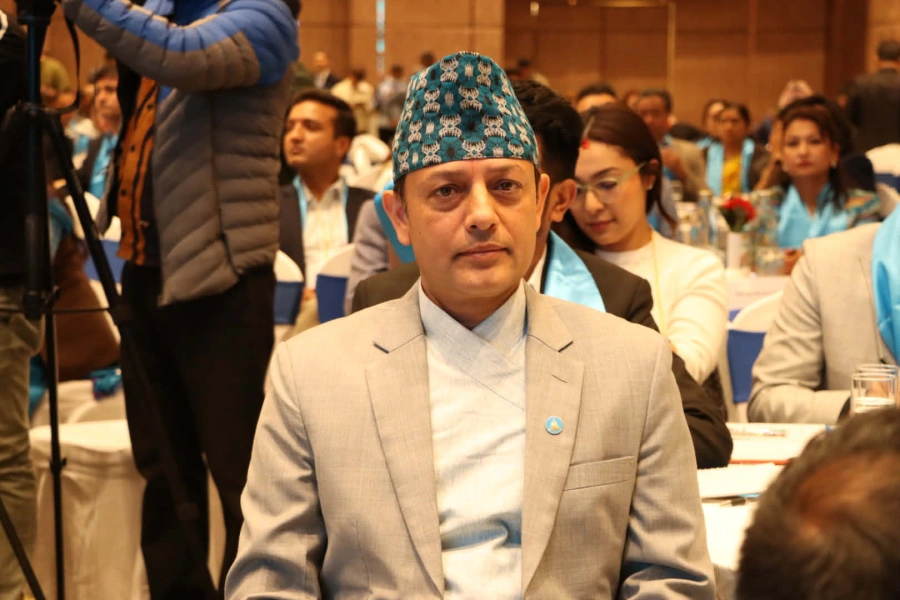
PHOTO: CHANDRA SHEKHAR KARKI
The Congress had earlier agreed on a directly elected ceremonial president and an executive head elected by parliament. But consensus during the Mahasamiti meeting seemed to emerge on the parliamentary system. Why did you backtrack?
Back then that—a directly elected ceremonial president and a parliament-elected executive head—was a document of compromise. NC is for parliamentary system in which the President is the titular head and power is exercised by the prime minister. This is our official stand.
Janajati groups have strongly objected to definition of “indigenous groups” in Mahasamiti’s political paper.
Perhaps it was a mistake. There are several definitions of adibasi people. I am not sure whether the point of time at which certain groups inhabit certain locations has anything to do with determining their adibasi status. The issue of whom to call indigenous nationality, tribal nationality and ethnicity is open to deliberation. That said, we should also address the concerns of those who have opposed our definition.
Some Mahasamiti members had also objected to NC’s endorsement of secularism.
NC has already endorsed secularism. There is no going back. The fundamental principle of secularism is that a state cannot protect one religion; every religion is equal for the state. Of course, everyone has a right to follow the religion of his choice. But a state has no religion of its own. NC is committed to this fundamental principle of secularism.
There does not seem to be strong unity in the party yet, a concern which was raised time and again during the Mahasamiti meeting.
Yes, there are problems from the district level to central level. There are several aspects to it. First, the present-day Nepali Congress is comprised of two parties (NC and NC-D). Second, any party that practices internal election at all levels, from the village to central level, will have these problems, which is natural. Naturally, in an election, some achieve victory while others do not. But all belong to the same party. My point is the victors need to take into consideration the voices of the other side and those who do not get victory need to coordinate with the winners at all levels. We should not see party members as winners or losers. They are all NC members. We should maintain a balance between two factions; this is the key to forging strong unity within the party. Third, intra-party election in Nepal is a relatively new phenomenon. Internal democracy has not yet been institutionalized in any party. Yet, if we fail in this regard, it could do the party great harm in the election.
President Sushil Koirala has recently taken up the leadership of High Level Political Committee. Will he be able to bring the agitating parties on board?
We must persuade the agitating parties, especially Mohan Baidya and Upendra Yadav, to join the election bandwagon. But first we need to create a favorable environment for them to come on board. I believe the party president will be able to do so.
But they are opposed to whole process of formation of CJ-led government and HLPC.
I understand that they have strong reservations. But when we sit for dialogue, I believe we can still reach a meeting point.
Do you believe we can have CA polls by December?
Why can’t there be an election? The country is relatively at peace. There are no big problems like widespread violence during the Maoist insurgency. Even the places reeling under insurgency are successfully holding elections. Take Kashmir, Northeast India and Sri Lanka, which are all conducting elections. Even when Rajib Gandhi was assassinated in 1991, election was not deferred in India. I see no obstacles to holding polls in Nepal.
Some parties have raised concerns over the allocation of fewer seats under PR component in the proposed CA polls in comparison to the last polls. How do you see this debate?
When we adopted the 601-member model in the last CA, there had been widespread criticism that a small country like ours did not require such a huge assembly. There had been fierce criticism in the press and other media. So the number has been brought down a little this time. I hope they will understand this reality. There is no reason why people should object to a smaller CA.
What will be the central electoral plank for Nepali Congress?
Democracy. We will try to convince people that democracy is still in danger; that it has not been fully institutionalized; that NC is the right party to do so.
Is there any prospect of forging electoral alliance with other parties?
It’s a universal norm not to forge election alliance with main rivals. Thus there will be no alliance with the likes of UCPN (Maoist), CPN-UML and Madhesi parties. Yes, there could be some talmel (a level of coordination) among likeminded forces, but I see little possibility of an alliance.
There is a voice in UML that it should forge an alliance with democratic forces like NC.
Like I said, there could be some sort of talmel. We are yet to discuss this issue within the party. But I don’t believe there will be a formal alliance.
How do you evaluate NC’s prospect in new CA polls? And how hopeful are you that the new CA will be able to promulgate the national charter?
The situation now is largely fear and intimidation-free. I am sure NC will do much better this time. As for the prospect of a constitution, it all depends on the composition of the new CA. If NC gets most seats, we will surely have a democratic constitution in the next few years.
Related story
Early setback for left alliance as Bhattarai decides to quit