In its election manifesto unveiled jointly by General Secretaries duo Prakash Man Singh and Krishna Prasad Sitaula amidst a special function held at party headquarters, Sanepa on Thursday, the NC has also pledged to draft a new constitution within one year of the fresh CA poll. [break]
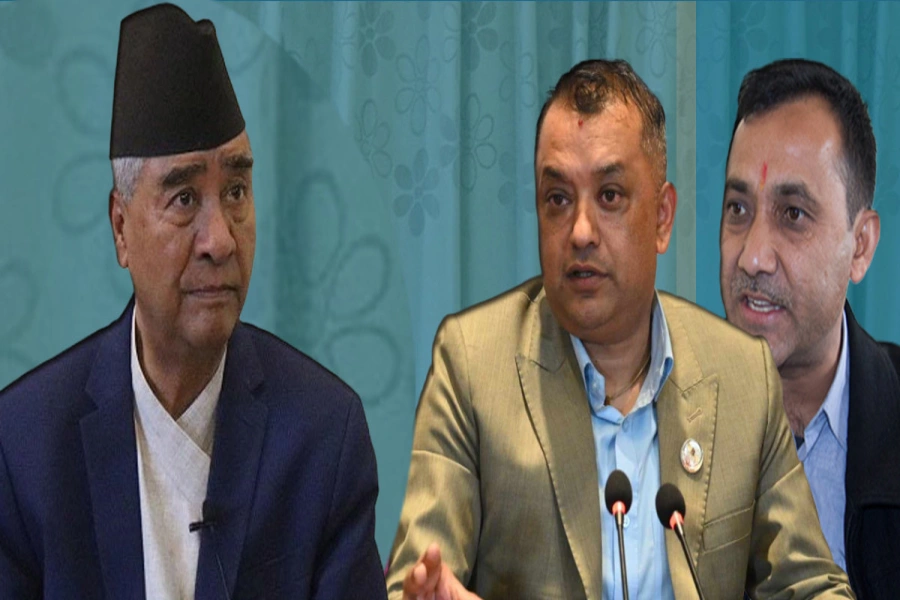
NC President Sushil Koirala, senior leader Sher Bahadur Deuba and Vice-president Ram Chandra Poudel were absent from the manifesto unveiling function due to ´prescheduled´ commitments in various districts outside Kathmandu Valley.
The NC has proposed owning up to all the agreements reached in the erstwhile CA through a special resolution at the first meeting of the new CA. The party has proposed to settle some thorny issues of national importance through ´people´s verdict´ should the political parties in the CA fail to arrive at any consensus. It has conspicuously avoided using the term ´referendum´.
As in the erstwhile CA, the NC has proposed taking identity and economic viability as the main bases for delineating the federal states. While considering ethnicity/community, language, culture, geography and history as the bases of identity, the party has taken economic interdependence and viability, the status of infrastructure development and its potential, administrative accessibility and availability of natural resources and means as the main bases of economic viability for the purpose of carving out the new federal states.
The party has proposed naming the federal states in such a way as to reflect multiple identities and ensure strong local government. While the elected provincial assembly is to be given authority to pick the name of the federal state concerned, the NC has proposed the formation of a separate Dispute Resolution Council to settle disputes that may arise between the federal and provincial governments and between two provincial governments over issues related to their powers and other matters.
The NC has expressed its commitment to a secular state, constitutional supremacy, the independence of the judiciary and other constitutional bodies, guarantee of civil liberties, the right to property, autonomous local governments and sovereignty vested in the people, among other things.
The party has proposed a three-tier government, including federal and provincial governments, and stood against the idea of preferential political rights for particular groups in the federal states.
On other contentious issues of the new statute, such as electoral system and system of governance, the NC has maintained more or less the same positions as in the previous CA. It has decided to uphold a mixed electoral system, a parliament-elected executive prime minister and a ceremonial president. The party has remained firm in its previous stance on the mixed electoral system.
The NC has also separately unveiled various sectoral programs for health, energy, education, infrastructure development, irrigation and watershed conservation, tourism, road transport, good governance and corruption control, among other things. Likewise, it has unveiled special programs for the development of Tarai-Madhes, Karnali, the Eastern Hills Region, the Far-Western Region and Madhesi, as well as the indigenous nationalities.
Major highlights of the party´s populist programs include reducing the proportion of the population dependent on agriculture from the existing 68 percent to 55 percent in the next five years. Development of infrastructure related to agriculture, establishment of a fertilizer industry through public-private partnership, promotion of commercial farming as well as a ´One Village, One Product´ concept are also among the NC´s plans for developing the agricultural sector.
The NC has announced an ambitious plan to declare Nepal a load-shedding free country within the next three years. While committing itself to adding 5,000 megawatts of electricity to the national grid within the next five years, the NC has also announced it is to make the capital city and industrial corridor areas free of power outages within the next two years.
The party has set a target of bringing in 2.5 million tourists annually in the next 10 years. This would be done, according to the NC, through the development of necessary infrastructure and additional tourist destinations in various parts of the country, including a Buddhist Circuit for Lumbini.
While pledging to complete construction work on a Postal Highway, a Mid-Hills Highway and the Kathmandu-Nijgadh Fast Track within the next five years, the NC has also stated that a four-lane Kathmandu-Pokhara Fast Track and five North-South Highways linking with both India and China will be developed in five years and three more North-South Highways in the next 10 years.
Likewise, the party has announced it is to develop one alternative international airport in five years and upgrade existing airports in Pokhara, Janakpur, Bhairahawa and Dhangadhi to handle direct flights to various South Asian countries. Among other things, NC has also pledged to complete one-fourth of the construction work on the East-West Railway in the next five years while laying the ground work for a North-South Railway linking up with Kathmandu in the next 10 years.
Related story
Settle VAW cases within 3 months: CJ