For a minute, it sounded absurd. But for someone who hasn’t left his home for the past 20 years, it is very natural to not know the latest developments in his neighborhood. [break]
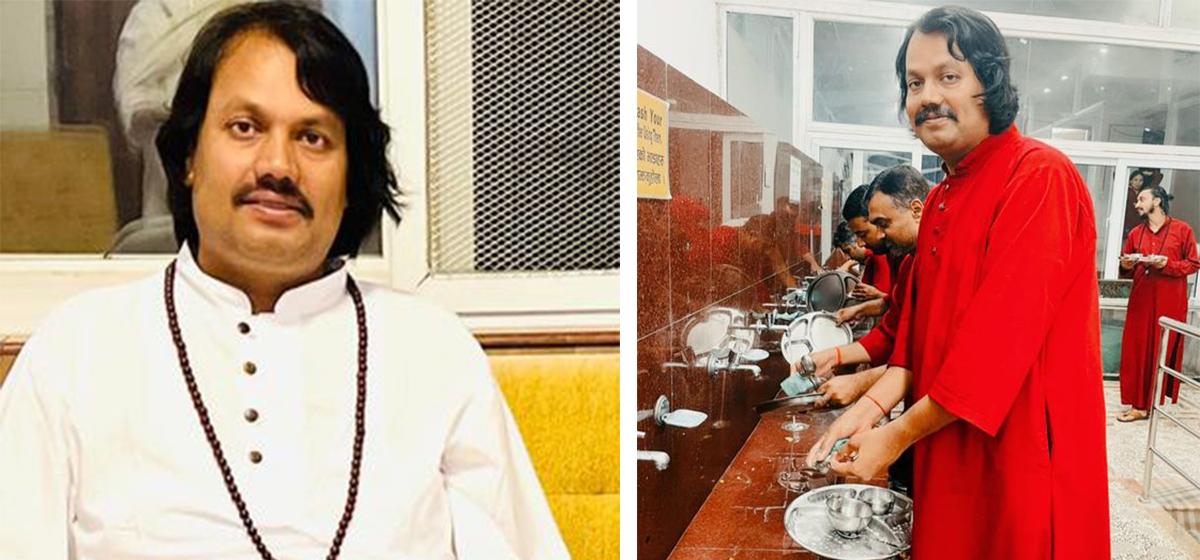
Owing to the political developments of the country, the 74-year-old decided to remain in seclusion in 1990 and has been living and working in a quarter separate from his main house at Boudha in Kathmandu ever since. Rumors afloat that he won’t leave his house until monarchy is restored.
Standing within the green gates of his ‘Hermitage Art Cottage’ to welcome his guests, by 10:30 a.m., half of Manuj Babu’s day has already passed by. The nocturnal artist sleeps at 5 p.m. and wakes up at 2 a.m. to work till the wee hours of dawn.

“When I’m working, I don’t let anyone in here,” he led the way into his studio and study. The load shedding was on, and with all the curtains closed, it was dark inside. But one hardly needed much light to notice the walls of his studio filled with paintings—big and small, his drawing pads scattered on the sofa, the hundreds of books in his personal library, and his collection of odd artifacts dispersed all over the place.
Manuj Babu has many mirrors in his space. Next to each one is a set of handmade reed pens and a bottle of black ink.
“I like to make caricatures of myself as satire to the current political situation because that way I’ll not be offending anyone else,” shared the artist, sipping water from a long pipe attached to a bottle. Sometimes, he draws himself with ears and horns like a cow, sometimes he has the body of a bird, and sometimes he is hugging Mona Lisa against a backdrop of the Himalaya.
At first sight, Manuj Babu’s drawings appear comical, but after a laugh or two, the social commentaries inherent in his images begin to surface. His works are anything but bizarre, ominous or feverish.
“People always focus on the lighter aspect of things, but I like to depict the dark because without black, white has no meaning,” he elucidated.

“I feel a little disheveled right now because I’ve been continually signing books sent in yesterday,” said the diabetes patient who has collectors of his works all over the world, from America to Europe. “I won’t be going to the opening but my wife will be there to represent me.”
Authored by the curator of Siddhartha Art Gallery (SAG), Sangeeta Thapa, the second book written on the veteran artist’s life and works was publicized on Friday, January 8, at SAG, along with the opening of an exhibition showcasing the artist’s rare early works.
The exhibition is not only a must-see to understand the range of mediums Manuj Babu is adept at, from ink and pen and lithographs to watercolors and oil paintings, but also to seek inspiration from a person who is very aware of the current happenings of the country while remaining confined. It is a reminder of the importance of drawing as the core foundation of fine arts, especially to the community of Nepali artists who prefer to paint ‘directly’ on canvas without dedicating any time to making studies or preparatory sketches.
Above all, the power of Manuj Babu’s simple, fluid and spontaneous line drawings puts several contemporary Nepali artists—who claim to make grand statements through their paintings dedicated to ‘global warming’, ‘discrimination of women’ and ‘corruption’—to shame.
“Art, to me, is like my own shit. That’s it!” laughed Manuj Babu on the phone to feminist artist Ashmina Ranjit on Thursday afternoon. The conversation ended.
“She wants me to write something on art. But I don’t have anything to say.”
Well, that’s Manuj Babu Mishra for you.
Related story
Veteran artist Manuj Babu passes away

-1200x560-1772467693.webp)