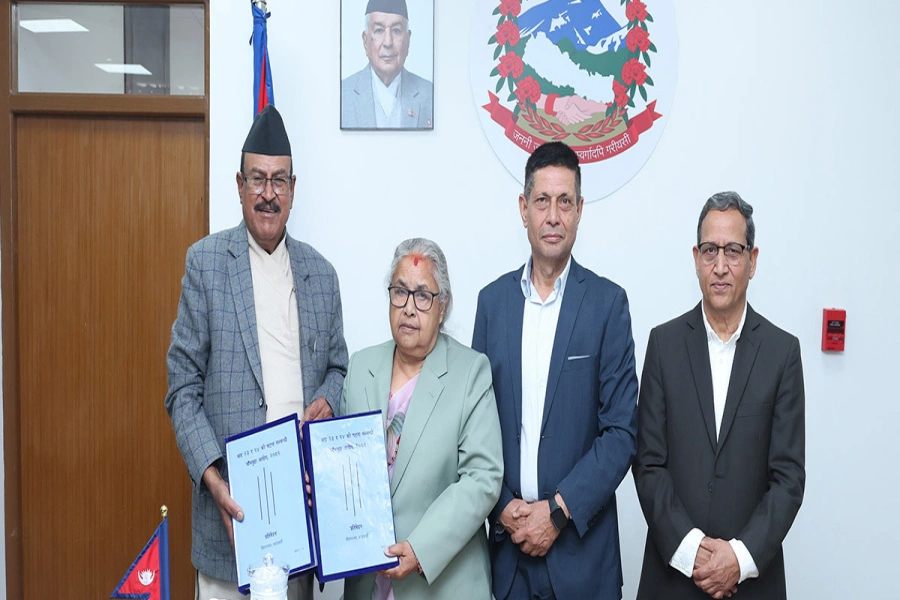
KATHMANDU, March 19: The commission formed to investigate the Gen-Z protests submitted a report to the government that found only the Nepal Police and Armed Police Force (APF) guilty for incidents during the movement, without recommending any action against senior officers of the Nepali Army above the rank of colonel. The commission had investigated violence and destruction that occurred during the protests led by Gen-Z on September 8 and 9, submitting the report about a week and a half ago.
The report showed Nepal Police and APF personnel under the security apparatus as responsible for incidents during the protests, while senior army officials were exempted. Sources said the commission recommended action only against army officers below the rank of chief colonel. It also recommended disciplinary action against officials of the National Investigation Department under the Prime Minister. The report, particularly focused on September 8, made no explanation regarding the role of the army, Nepal Police, APF, or the National Investigation Department in the events of September 9. It did, however, praise the Chief of Army Staff for taking a role in collecting incident details and facilitating the formation of a new government.
Sources claim the report remained silent on who orchestrated the Gen-Z movement, who initiated the Discord platform, and who shut it down after the protests. “The preliminary report mentioned shortcomings of senior Nepali Army officials. Later, commission members removed those names. Only officers below the rank of chief colonel were recommended for action. Police and APF personnel deployed in the field, and those who deployed them, were recommended for measures ranging from criminal charges to departmental disciplinary actions,” said a source connected to the commission. “The commission showed clear bias against the police and APF.”
Action was recommended against military officers deployed to protect Singh Durbar, the President’s Office, and the Prime Minister’s official residence in Baluwatar, citing failure to safeguard these sites. The commission concluded that negligence by these officers allowed critical structures to be damaged. While the commission recognized that responsibility for protecting key government institutions lies not only with the police and APF but also with the army, it hesitated to name the commanding officers responsible for army command roles.
Protesters had entered and set fire to both the President’s Office and the Prime Minister’s official residence, causing destruction. The President and Prime Minister had already been moved to safety before the damage occurred. The main responsibility to secure these government buildings rested with the Nepali Army. While some military officers were recommended for action for failing to prevent the protesters, the report remained silent on criminal charges or other legal articles.
Similarly, sources said the commission avoided assigning criminal liability to the then Home Secretary, Inspector General of Police (IGP), Additional Inspector General (AIG), Deputy Inspector General (DIG), the Chief District Officer of Kathmandu District Administration Office, the Chief of Kathmandu Police District, field commanders, and police personnel deployed to secure the Parliament building.
Dakshinkali battalion bags best APF battalion award
The report did not comment on the army’s failure to deploy fire brigades when Singh Durbar and the President’s Office were burning, nor did it address the issue that the Kathmandu Metropolitan City did not send fire trucks. A commission official said that the report, finalized while election results were coming in, underwent many last-minute changes regarding recommendations for action. “It is true that the recommendations for disciplinary action were altered at the last moment. But we cannot explain why this was done,” the official said.
“Military officers deployed to protect Singh Durbar, the President’s Office, the Prime Minister’s Office and residence failed to command effectively. Had the army been mobilized properly, Singh Durbar, the Supreme Court, the President’s Office, the Commission for the Investigation of Abuse of Authority (CIAA), the Prime Minister’s Office, and the Prime Minister’s residence could have been secured,” a source quoting the report said.
During the protests, reports had surfaced that the army did not cooperate with other security agencies deployed in the field. During the movement, not only important state structures but also homes and commercial establishments were burned to ashes.
The curfew imposed from the afternoon of September 8 saw poor army deployment, and although the army took security responsibility from the morning of September 9, key structures and police offices were already destroyed by fire. The army only went on duty after 10 PM that night. The commission had taken statements from army officials, including Chief of Army Staff Ashok Raj Sigdel, but the report remained silent about the army’s overall role in security. Army officials who provided statements said they had not received orders from above and acted according to the orders given.
Following questions about the army’s role in the Gen-Z protests, the army conducted its own inquiry in Kartik, investigating some officials, including the commander of the Narsingh Dal Battalion at Singh Durbar. The commission later recommended action against those same officials.
Regarding the Nepal Police, the commission recommended filing charges against the then IGP, Chandra Kuber Khapung, and serious departmental action against other officials. Sources said the report could weaken morale in the police and APF.
Following recommendations for criminal cases against former police leadership, protests arose, increasing dissatisfaction within both police organizations. Police have claimed that if disciplinary action proceeds, no personnel would be able to control crowds effectively.
The commission has been accused of trying to avoid responsibility by blaming only the Nepal Police and APF, failing to identify the main instigators of the protests, remaining silent on who orchestrated the movement, and failing to trace the social media efforts that mobilized students to the streets and to the Parliament building.
Prime Minister Sushila Karki had announced she would make the report public when it was submitted on 8 March, but it has not yet been released. The Cabinet’s Sunday meeting decided to accept the report, but has not clarified whether it will be made public.
Questions on the commission’s credibility
Questions about the morality of the high-level judicial inquiry commission chair, Gauri Bahadur Karki, arose while investigating the Gen-Z protests. During the protests, his social media posts raised doubts about whether the commission could remain impartial. The report submitted amid controversies has sparked further debate.
Karki, a former special court chair, had posted continuously on Facebook and X in a way perceived as biased toward the protests. Screenshots of his posts calling the political leadership “traitors” and “criminals” went viral. The commission proceeded with the investigation by restricting the travel of former Prime Minister KP Sharma Oli, Home Minister Ramesh Lekhak, and IGP Khapung.
Senior lawyer Bipin Adhikari had also raised questions of morality in a writ petition in the Supreme Court against Karki. In the hearing, judges Manoj Kumar Sharma, Nahakul Subedi, and Nripa Dhwoj Niroula of the full bench questioned Karki’s ethical conduct. The bench also issued guidelines directing that future commissions investigating matters of public importance ensure the impartiality and neutrality of their officials.
The order noted that while Karki’s public statements raised questions about his impartiality, there was no legal basis to deem him ineligible for the commission. It concluded that whether to accept responsibility for investigating and submitting a report despite his public statements was a matter of personal ethical judgment, to be decided by Karki himself.