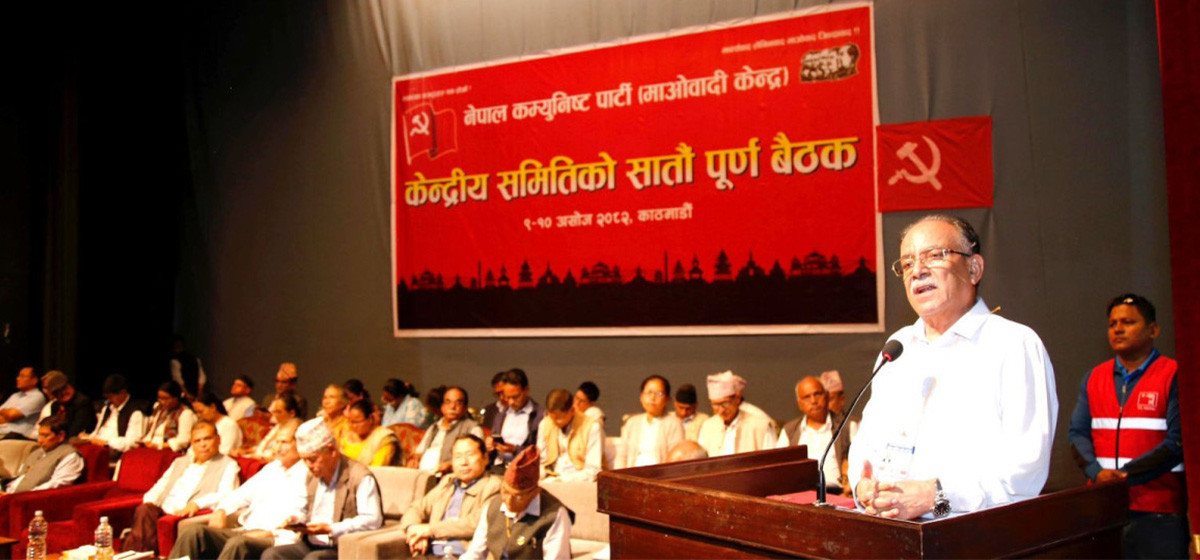
KATHAMDNU, Sept 27: Within the CPN (Maoist Center), central committee members have demanded investigations into alleged financial irregularities during the management of former combatants and into the assets of party leaders who rose to influential positions after the peace process.
At the party’s central committee meeting, member Laxman Datta Pant tabled a proposal calling for internal investigations into the misuse of funds during the peace process. He highlighted reports of embezzlement worth Rs 2.82 billion from combatant camps and sought a detailed probe. Pant also demanded that the wealth of all leaders who assumed key posts after the peace process be investigated.
Pant cited an example from 2008 when then-communications minister Krishna Bahadur Mahara’s government charged Ajay Sumargi’s Hello Nepal Telecom only Rs 49.5 lakh for licensing and renewal fees, while other telecom operators like Nepal Telecom and Ncell paid Rs 20 billion each. Pant argued that this decision provided Hello Nepal with an undue benefit worth nearly RS 20 billion and called for a fact-finding investigation.
Wealth Management

He also alleged that from the salaries of 19,600 verified combatants certified by the United Nations Mission in Nepal (UNMIN), Rs 2,000 per month was deducted under the name of a “PLA Fund” and misused. Over six years, this amounted to Rs 2.82 billion, which, Pant said, should be accounted for by the commanders responsible at the time.
Pant further pointed out that Maoist leaders had repeatedly held powerful ministries such as Prime Minister’s Office, Finance, Home, Energy, Physical Infrastructure, and Forests over the past 18 years. He demanded a fair probe into the benefits they allegedly gained through political appointments, licenses, contracts, promotions, and transfers during those periods.
He also questioned the lavish lifestyle of party chair Pushpa Kamal Dahal and his family, referring to media reports about a Rolex watch worth Rs 6.4 million and a Louis Vuitton bag worth NPR 2.8 million owned by Dahal’s daughter. He suggested that if the reports are false, defamation cases should be filed against the concerned media and Nepali Congress lawmaker Sunil Sharma.
If the items were gifts, Pant proposed selling them and depositing the proceeds into a fund for wounded fighters. If they were received as gifts in Dahal’s capacity as prime minister, he said they should be deposited into the state treasury, citing Pakistan’s case against Imran Khan for profiting from selling official gifts.
In response to the demand for internal accountability, Dahal announced the formation of a party-level commission to investigate leaders’ assets and to make them public. He said party officials, their families, and aides should adopt new work practices and move away from old ways. He stressed the need for transformation not just in organizational style but also in personal lifestyles and cultural practices.
Combatant camp-related corruption case
The Maoists joined peaceful politics after a decade-long insurgency, signing the Comprehensive Peace Agreement with the government on November 21, 2006. It was agreed that combatants and their weapons would be kept in cantonments until the integration process was complete. A separate agreement on arms management was signed on December 8, 2006.
Seven main and 21 satellite cantonments were set up to house the combatants, with UNMIN monitoring the process. On December 27, 2007, UNMIN completed the verification of 19,602 Maoist combatants and 3,475 weapons. Later, Dahal himself admitted during a training session in Shaktikhor camp that the reported number of combatants had been inflated, which raised suspicions of financial misuse.
As the integration process neared completion, former combatants accused party leaders of collecting levies from them and interfering in the distribution of funds they were entitled to. Combatants received monthly allowances of Rs 3,000 until September 2008, which was later raised to Rs 6,000 and eventually to Rs 6,500 in July 2011. Those opting for voluntary retirement were paid up to Rs 800,000 depending on their rank.