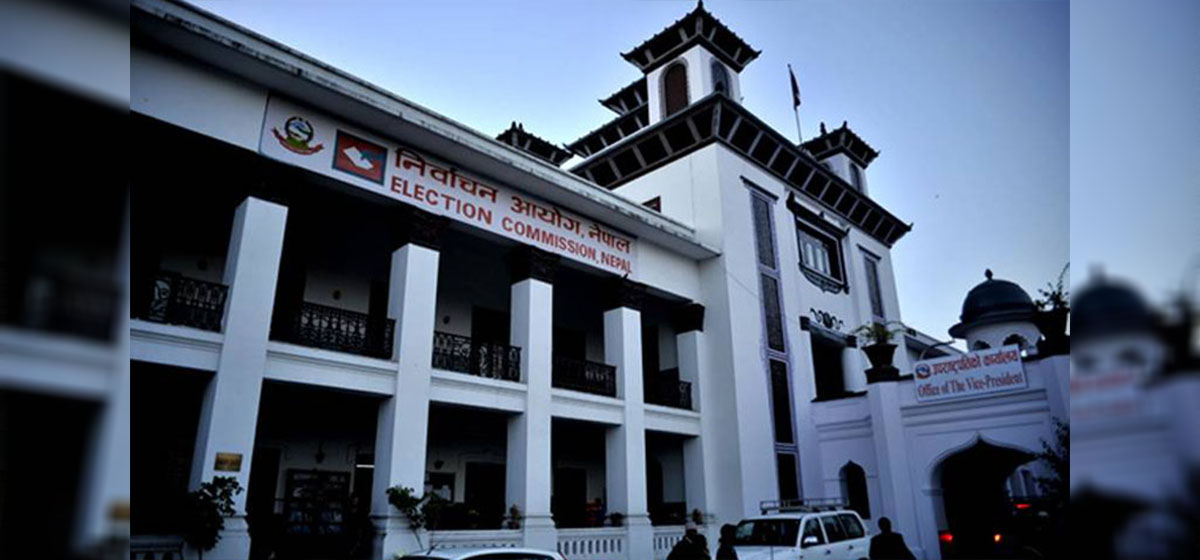
KATHMANDU, June 14: After three months of debate on the issue, the Interim Election Council has announced November 19 as the date for polls for electing a new Constituent Assembly (CA).
A cabinet meeting held at Singha Durbar on Thursday announced that the CA election is to be held on November 19. The government"s decision comes at a time when the Interim Election Council, which has been formed solely for the purpose of holding fresh polls, is being criticized for delay in announcing a poll date even three months after its formation. [break]
According to Minister for Local Development Bidyadhar Mallik, the cabinet meeting also forwarded the ordinance on amending the Election of Members of the Constituent Assembly (CA) Act, 2013 to President Ram Baran Yadav for approval. The president is likely to approve the ordinance on Friday.
At a time when political parties were sharply divided over the eligibility threshold of one percent for seat allocations under proportional electoral system, the Interim Election Council has forwarded the election-related ordinance after removing the proposed threshold provision. “There is no eligibility threshold in the ordinance,” Mallik told Republica.
Though the EC had earlier proposed that a political party must secure 1.5 percent of the total valid vote cast in the election in order to claim seat allocations under proportional representation, the constitutional body reduced the figure to one percent following objections by fringe parties.
The government has also excluded the proposed provision that a candidate should disclose his/her property details and state whether or not he/she is a defendant in any court case filed by the government.
However, the ordinance has barred candidates who have already been handed down final verdicts of guilty by the courts for involvements in criminal cases.
“Those who have been handed down final sentences by the courts for involvement in criminal cases including corruption, rape, murder, passport misuse, money laundering, drug smuggling and human trafficking, among other things, or have been black-listed, cannot file candidacy,” Mallik said about the provision in the ordinance.
The Election Commission (EC) had proposed that persons convicted of criminal offense or accused of moral turpitude should be barred from filing candidacy and be allowed to contest elections only six years after completing the sentences handed down by the courts or other judicial authorities.
According to the proposal, a person who is convicted of murder, theft, robbery, misappropriation of foreign currency, kidnap, rape, corruption, human trafficking, money laundering, banking irregularity, passport misuse, drug smuggling, jailbreak or abetting in jail break, smuggling of protected fauna, flora or objects of archeological importance, illegal trade, and spying, among other illegal activities, or has shown moral turpitude, cannot be a member of any political party if he or she has not completed the sentence handed down by a court or any other judicial authority.
Following failure to forge consensus on these issues, the High Level Political Committee (HLPC) on Monday had entrusted the Interim Election Council with responsibility for settling contentious issues related to elections and announcing the election date.
UCPN (Maoist) and United Democratic Madhesi Front (UDMF), among other political parties, were against the new proposal while Nepali Congress (NC) and the CPN-UML had been sticking to their position on the eligibility threshold.
Constituency Delineation Commission
The Interim Election Council has also formed a five-member Constituency Delineation Commission (CDC) under former justice Tahir Ali Ansari.
Geographer Netra Dhital, sociologist Dambar Chemjong and administrator Madhu Nidhi Tiwari have been appointed as members of the commission while Secretary at the Office of Prime Minister and Council of Minister Raju Man Singh Malla is member secretary of the CDC, said Information and Communications Minister Madhav Prasad Poudel.
According to Article 154 A of the Interim Constitution, the government may constitute a Constituency Delimitation Commission to determine election constituencies for the purpose of election of members of the Constituent Assembly, and the commission shall consist of a retired justice of the SC as chairperson, a geographer, a sociologist and an administrator or management expert as members and a special class officer in the service of the government as member-secretary.
Poudel, who is also the government"s spokesperson, said that the CDC had been given one month to submit its report. The commission will review the existing 240 election constituencies in accordance with the latest census report. Earlier, the political parties had already agreed on a 491-member CA.
Clause 3 (a) of Article 63 in the Interim Constitution states that members to be elected under the first-past-the-post modality will be elected on the basis of one member from each of the 240 election constituencies delimited by the Election Constituency Delimitation Commission in accordance with the population fixed by the national census preceding the CA election, and for this purpose an administrative district will be treated as an election district, with the number of constituencies therein determined on the basis of the population of that district.
The Supreme Court (SC) on April 16 had ordered the Interim Election Council and the Election Commission (EC) to delineate the election constituencies anew before conducting polls for the CA.
´Others´ defined
While the existing election law classifies several caste groups other than Janajati, Dalit and Adivasi as ´others´, the new ordinance forwarded to the president defines ´others´ as Brahman, Kshetriya, Dasnami, etc.
Related story
EC proposing to hold provincial and parliamentary elections in...