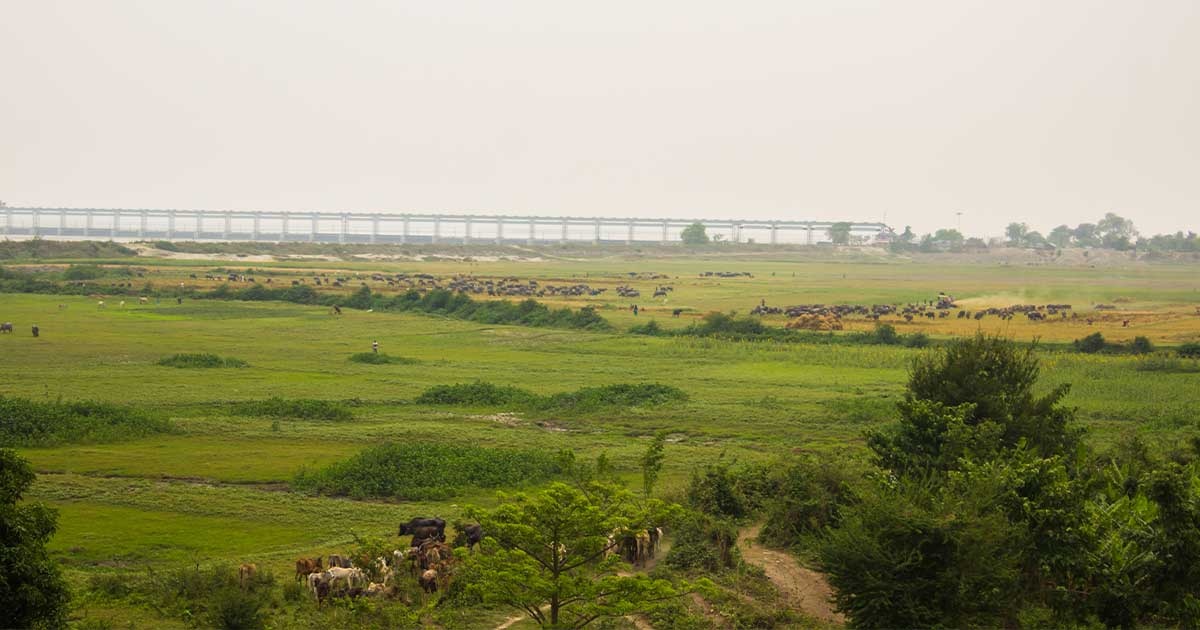
The survey was carried out in April and May of 2012 in the reserve and surrounding areas by a team of wildlife and bird experts, and the report was released Thursday (26 April) in the monthly magazine ´Journal of Threatened Taxa´. [break]
According to Dr Hem Sagar Baral, coordinator of the research, the survey turned up the largest population of Bengal Floricans ever recorded in Nepal. “We found 47 Bengal Flericans in Koshi Tappu area, and if we also consider the areas around about, their number must be more than 60,” Baral said.
“This shows that Koshi Tappu has the densest population of Bengal Floricans in entire South Asia. And it makes for around 10 percent of the species in the world as the current global estimate of the mature Bengal Florican population is around 500,” he added.
According to Baral, each and every species has an essential contribution to make to the ecology and those on the verge of extinction deserve special attention.
“However, Bengal Florican, which is included in ICUN´s red list, has not received adequate attention in Nepali media as compared to the equally endangered vultures,” he remarked.
Bengal Florican was the first of Nepal´s birds surveyed nationwide, in April and May 1982 by Carol and Tim Inskipp, the authors of several books on the birds of Nepal. Since then several studies have been carried out in Chitwan, Bardia and Sukla Phanta protected areas, focusing mainly on populations. All these studies showed that the species is declining throughout Nepal.
The next research survey was carried out by Laxman Prasad Poudyal of the Department of National Parks and Wildlife Conservation, in Sukla Phanta, Bardia and Koshi Tappu in 2007. He had concluded that the total population of Bengal Floricans in Nepal was between 28 to 36 and that this population was declining rapidly.
“The recent survey has given much hope to bird lovers and conservationists. Despite continuing habitat loss and the hunting of these birds, their population seems to be encouraging for now,” said Poudyal, who was also one of the researchers in the newer survey. “But to expand or even retain their numbers we need to make continuous efforts. The challenge is to prevent their habitat loss.”
According to Bed Bahadur Khadka, another research team member, though the bird population in Koshi is remarkable, the same is not the case in Chitwan. “In research done in 2013 we found only 11 Bengal Floricans in Chitwan and this is worrysome. This calls for utmost effort to restore the grassland habitats in Chitwan to bring back the dwindling population,” Khadka said.
Bengal Florican is a bird of the bustard species and the female is the size of a full-grown peacock while the male is smaller. Unlike many other birds that live in the lowland grasslands, this is one of the very few species which shows differences in body size between males and females. Smaller males in adult plumage are mostly black with white wing patches whereas the young and females are brown. In flight, both sexes show large white coloring on the wings.
According to research coordinator Baral, the current estimate of this bird population throughout the country is 100, which is more than 10 to 20 percent of the population globally. “In Nepal, it has been recorded in only four lowland protected areas: Sukla Phanta, Bardia, Chitwan and Koshi Tappu,” he informed.
Meanwhile, Director General of the Department of National Parks and Wildlife Conservation Megh Bahadur Pandey said that additional support would be provided to safeguard the newly discovered Bengal Florican population in Koshi. “We will use all means and take all measures to ensure their sustenance through maintenance of a suitable environment in Koshi Tappu. With this discovery, Nepal has been given extra responsibility,” he stressed.
Related story
Population of wild buffaloes increases to 441 in Koshi Tappu