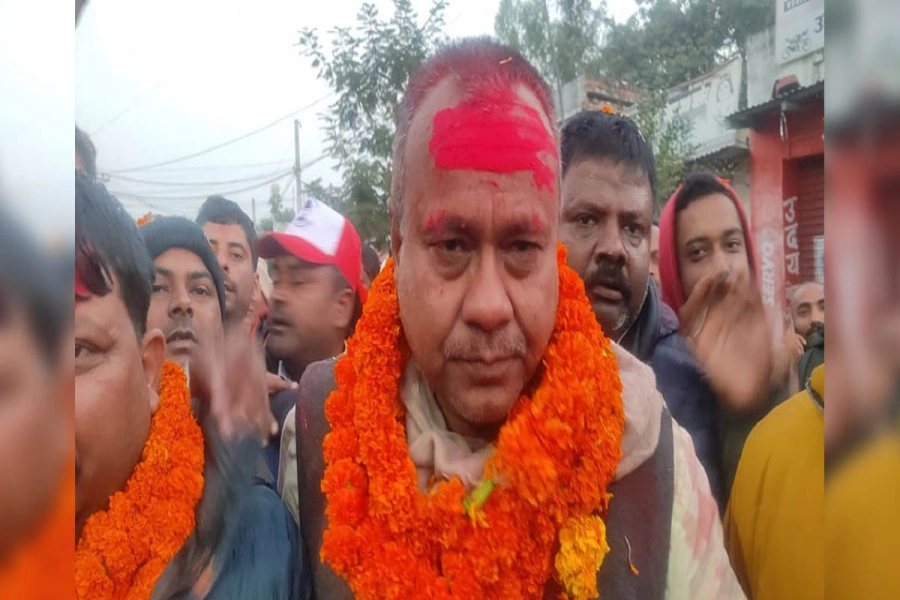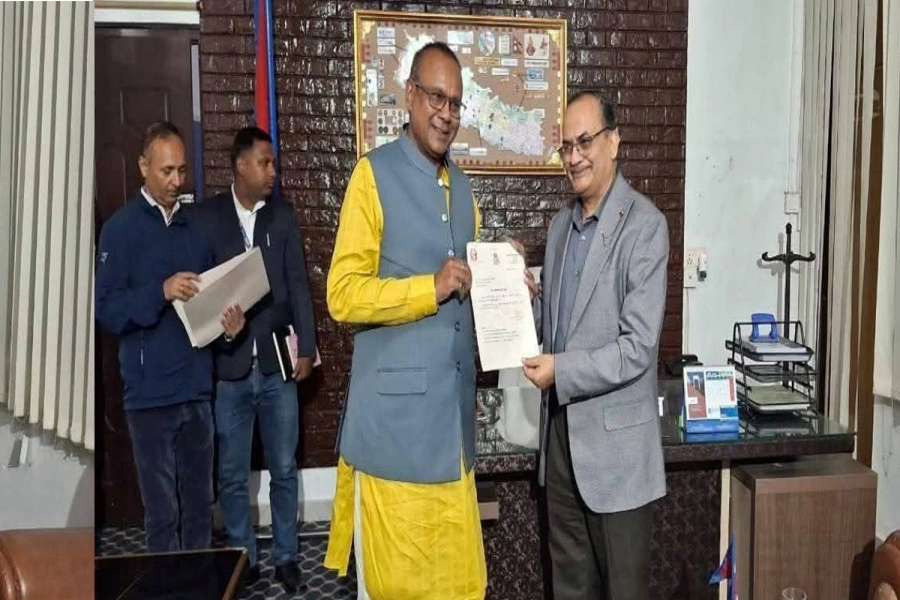
LAHAN, Dec 6: Krishna Prasad Yadav of the Nepali Congress (NC) has been appointed Chief Minister of Madhesh Province. Province Head Surendra Labh Karna appointed Yadav on Friday evening under Article 168 (2) of the Constitution.
Yadav is the sixth Chief Minister of the province. He secured the support of 77 provincial assembly members from the NC, Janata Samajbadi Party (JSP) Nepal, Janamat Party, Loktantrik Samajbadi Party (LSP), CPN (Maoist Center), CPN (Unified Socialist), and the Nagarik Unmukti Party (NUP). The Madhesh Provincial Assembly currently has 104 members.
Earlier, former Chief Minister Saroj Kumar Yadav resigned on Wednesday, after which the Province Head called for the formation of a new government. After prolonged negotiations, the seven-party alliance agreed on Friday to back NC leader Yadav as the next Chief Minister. Yadav said one minister from each coalition party would be sworn in along with him, while the remaining ministers would be appointed after securing a vote of confidence.
A history of unstable governments
The first Chief Minister of the then Province 2 was Lalbabu Raut of the Sanghiya Samajbadi Forum, who took office on February 15, 2018. With the Forum holding 29 seats and the Rastriya Janata Party (RJP) holding 25 seats—making 54 in the 107-member assembly—forming a government was easy. The two parties later merged to become JSP Nepal, and the Raut-led government completed its full term.
Despite frequent changes in federal-level coalitions, Raut’s government remained intact. Except for the CPN-UML, other parties joined and left the provincial government at various times, but Raut continued as Chief Minister. During his tenure, major decisions—such as naming the province based on identity and declaring Janakpur as the provincial capital—were taken, along with significant legislative progress and development planning.
Madhesh province cabinet reshuffled for the sixth time in less...

After the November 2022 elections, the political arithmetic in Madhesh shifted. The UML emerged as the largest party with 25 seats, followed by NC (22), JSP Nepal (19), Janamat Party (13), CPN (Maoist Center) (9), LSP (9), and CPN (Unified Socialist) (7). The Rastriya Prajatantra Party (RPP), NUP, and Nepal Sanghiya Samajbadi Party secured one seat each. One UML, one LSP, and one JSP provincial assembly member are currently suspended.
Given the fragmented numbers, forming a government required at least three parties. The first government of the second term was formed under JSP Nepal, with UML and Janamat Party in the coalition. On January 7, 2023, Saroj Kumar Yadav of JSP became Chief Minister with support from UML, Janamat Party, CPN (Maoist Center), LSP, CPN (Unified Socialist), and others. UML received the Speaker’s post, while Janamat secured the Deputy Speaker’s post.
Chief Minister Yadav, however, had to seek a vote of confidence four times due to shifting federal coalitions. When the governing alliance changed at the center, UML and CPN (Maoist Center) withdrew support on May 13, 2023. Yadav eventually failed his fifth vote of confidence on June 5, 2024, causing his government to fall.
After the fall of the JSP Nepal-led government, Janamat Party leader Satish Kumar Singh was appointed Chief Minister on June 7, 2024, with support from UML, CPN (Maoist Center), CPN (Unified Socialist), NUP, and Nepal Sanghiya Samajbadi Party.
During the Gen-Z protests, Singh announced his resignation on social media but did not formally submit it. Once the situation normalized, he refused to resign despite pressure from his party, which then withdrew its support. However, UML, NC, and LSP continued backing him for some time.
Later, NC, UML, and LSP also withdrew support. In the October 14 vote of confidence, Singh announced his resignation on the floor of the assembly. His government lasted nearly 16 months.
Subsequently, on October 15, LSP provincial assembly member Jitendra Sonal was appointed Chief Minister with support from JSP, Janamat Party, CPN (Maoist Center), LSP, and CPN (Unified Socialist). But on the day of his appointment, internal rifts appeared in Janamat Party, and two provincial assembly members defected to a newly registered party.
On November 16, JSP lawmaker Saroj Singh Kushwaha was suspended after being indicted in a corruption case. In the confidence vote on November 8, two Janamat Party lawmakers were absent, and CPN (Maoist Center) lawmakers defied the party whip. Unable to secure a majority, Sonal resigned.
The formation process then stalled.
Provincial Head Sumitra Subedi Bhandari left for Kathmandu for treatment but unexpectedly appointed UML leader Saroj Kumar Yadav as Chief Minister at 4 AM on November 10 at a resort in Bardibas, which sparked political turmoil. Many parties condemned the move, launched protests, and the federal government dismissed her the same evening.
Seven parties filed a petition at the Supreme Court demanding the annulment of Yadav’s appointment. On Monday, after a final hearing on all related petitions, the court issued a mandamus ordering Yadav to seek a vote of confidence within 24 hours and instructing the Province Head to initiate formation of a new government under Article 168 (2) if he failed.
With opposition lawmakers boycotting Wednesday’s session, Yadav had no possibility of securing support. He announced his resignation in the assembly and later submitted it formally. On Friday, NC parliamentary party leader Krishna Prasad Yadav submitted a claim with the support of 77 lawmakers and was appointed the sixth Chief Minister.
Vows to end irregularities
Newly appointed Chief Minister Yadav said his first priority is to end irregularities in Madhesh Province. “Our first task is to bring the province back on track and ensure good governance,” he said.
Calling poverty and illiteracy major challenges of Madhesh, he said these issues would be addressed with high priority. He added that the coalition was not merely for power-sharing but intended to last until the next election.
“This coalition will go to the polls together. Madhesh will now shed the image of an unstable government and build a narrative of stability,” he said.
He added that his government would work in line with changing public expectations and focus on development, good governance, and restoring order.