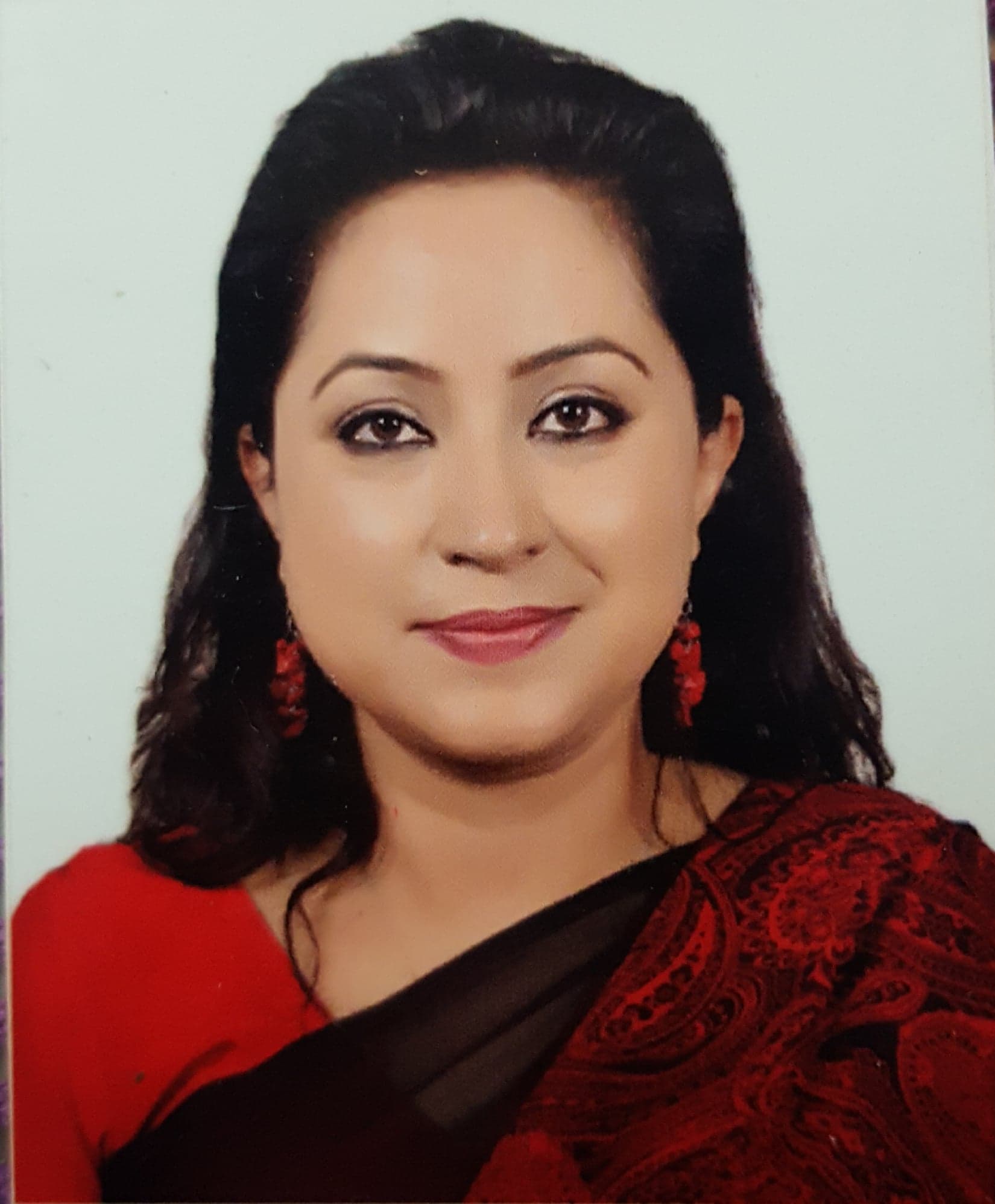
For her next show, which opens today at Siddhartha Art Gallery (SAG) in Baber Mahal Revisited, she presents the works of the Pakistani artist Syyed Iqbal Geoffrey.[break]
What Thapa means by Geoffrey’s works being a far cry is because they are collages – a medium which has yet to sink in the Nepal art fraternity. Collages on paper are often disregarded as ‘fine art’ because of their so-called ‘cut and paste’ appearance.
“Artists suffer due to people’s stereotypical expectations,” comments the 71-year-old artist on the attitude of people who consider painting a much laborious work than
 making a collage, and therefore, more legitimate. “It’s the idea that supercedes the performance. I use ‘thinking’ and not ‘things’ in my works,” furthers Geoffrey, who arrived in Kathmandu with his collages on Monday, October 25.
Geoffrey’s images come together with the personal and the public. Often layered atop letters, envelopes, fingerprints and stamps, most of his collages consist of images of women cut out from various magazines.
“Why women?” he takes the question and replies, rather amusingly, “Well, 51% of India’s and Pakistan’s population are women.” Women and girls, who feed on the latest Elle and Vogue magazines, may find images that they have come across in advertisements.
On the other hand, on the subject of ‘Why collages?’ and not paintings or any other medium, he shares, “Well, I did paint and draw and also did conceptual works. But why draw or paint when what I can cut out the images I need?” A few portraits, here and there, appear in his collages, and they stand for the fact that he is a well-trained artist.

“If I draw, I’ll photocopy it and use it in my collages,” he explains, flipping through the monograph published on his works by the National Art Gallery in Islamabad in 2008. Working on one piece over a period of time, Geoffrey weighs the importance of negative spaces in his compositions heavily. Collage, to him, is definitely not ‘cut/tear and paste’ pieces of paper, one on the top of the other, to the extent that the entire background is covered up.
“Well, I would want people to view my works subjectively, but I don’t agree that everything has to have a meaning,” opines the artist who has a studied Art Criticism and Connoisseurship at PhD level.
Geoffrey is a prolific artist but hardly keeps track of his own works. And even though he had a substantial amount of work by 1960, the year he went to England, many of them have been lost.

Having worked in Chicago, London, Paris, Lahore, and Delhi over a period of three decades, SAG presents his collection, titled ‘The Seven Henry Series: In Search of an Ideal Landscape.’
With his works in the permanent collections of the Tate Gallery and the Museum of Fine Arts Boston, the other side of Geoffrey comes as quite a contradiction to his creative nature.
A graduate of Harvard Law School, Geoffrey has been practicing law since 1957 alongside his art career spanning 51 years.
“My family still disapproves of me being an artist,” he shares, adding that he is not a collector of artworks. “People who spend money on paintings do so to show their wealth, but usually they are just buying used canvases,” opines the artist, who believes that the only two greatest artists that the world has seen are Leonardo da Vinci and Pablo Picasso.
“Everyone’s stuck on that smile,” he says of the famed Mona Lisa. “Well, my art is like putting a nipple (pacifier) in Mona Lisa’s mouth, to remove the smile off her face.”
And to understand that, it is a must to see Geoffrey’s ‘Supracollages’ at the SAG itself.
“I don’t check the dictionary, but I intended ‘supra’ to mean ‘transcendental’,” he smiles. “I’ll check it out later,” he promises.
The exhibition begins today at the Siddhartha Art Gallery, Baber Mahal Revisited, in Kathmandu. It will remain open till November 17.
Related story
Is Critical Thinking Really Critical?