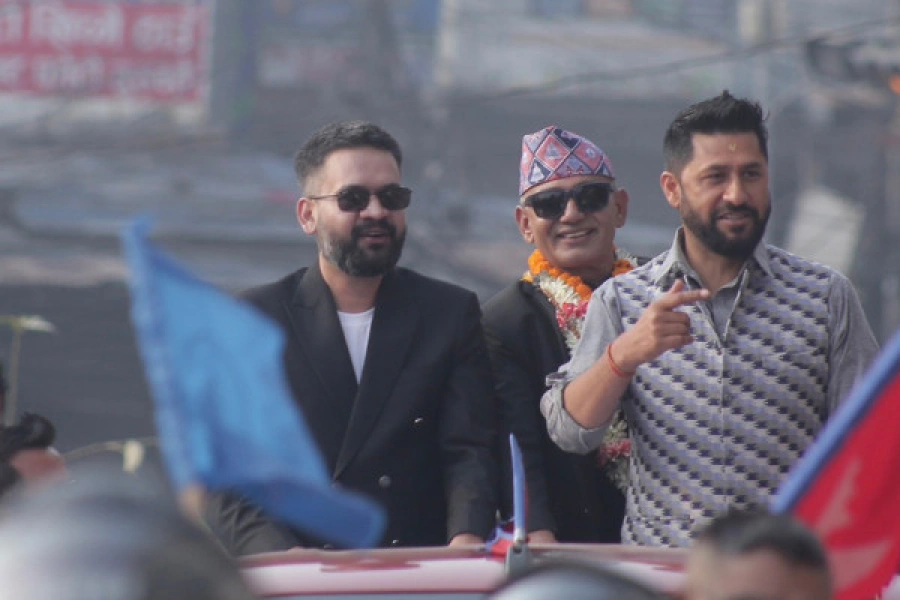
Such was the picture that visitors taking photographs at Basantapur Durbar Square took home in the last three years.[break]
In 2010, Kathmandu Metropolitan City (KMC) and the Metropolitan Traffic Police Division had announced that no vehicles would be permitted within the area with an aim to safeguard the Durbar Square area, which was declared a UNESCO world heritage site in 1979. Only ambulances and other emergency vehicles were allowed in the area since then.
However, visitors have been experiencing trouble while walking around in the same site for the past few months. Motorcycles and cars are seen passing through the paved paths crisscrossing the world heritage site freely. It seems that the vehicle users have forgotten that they have entered a sensitive area, murmured a priest at Kumari Ghar, pointing at vehicles at Basantapur.
Unlike in the past, tourists taking snaps in the area felt continuously disturbed by the ever moving vehicles and their continuous honking.

A motorcycle rider nearly hit a female visitor who was taking pictures. “Don´t you see the bike,” the biker yelled at the lady instead of apologizing.
“I had never seen the Hanuman Dhoka area so mismanaged. Is there no authority to stop it?” said Seema Thakur, who came to visit the area along with her friends.
As increasing number of vehicles enter the area, the heritage site seems filled with smoke and dust.
When asked why he was driving inside no vehicle zone, a taxi driver Sunil Khadka said casually that he was just enjoying the sights like many others.
The responsible officials of the KMC do not have appropriate answer as to why the private two wheelers and four wheelers are plying freely in the area.
“What are the city police at the entrance doing?” said Roshan Shakya, KMC officer deployed at the Hanumandhoka Durbar Square Conservation Program (HDSCP).
Apart from vehicles, political meetings were also banned from the area. But the cultural programs were permitted. The KMC had tried to impose ban on vehicles before 2010 as well, but the attempt failed after locals and other stakeholders refused to cooperate, Shakya said.
Program Manager with the HDSCP Hari Kumar Shrestha said that the authority had allowed vehicles to park 70 meter from the entrance due to the ongoing stone pavements works at Jhochhe.
“We have allowed the vehicles to be parked at both side of the Basantapur entrance until the completion of construction works at Jhochhe,” said Shrestha.
He added that the locals´ protest regarding the KMC´s agreement with private contractors to charge common fee to the tourists coming to visit Basantapur and Dharahara has made it difficult to implement even the existing rules.
“Locals are furious and are ready to violate all the rules and regulations,” said Shrestha, adding, “We don´t want to invite another conflict for now. The ban on vehicles would be imposed once the Dharahara row settles down.”
As per the KMC data, normally around 400 tourists come per day to the world heritage site, whereas the number reaches 800 during the best season.
After the ban, the authorities had also come up with alternative routes for vehicles to ease the traffic congestion as a result of which the locals had accepted the move.
The valid routes for the vehicles were set as the vehicles coming from New Road and Asan would pass through Indrachowk, Suraj Arcade and to Phyphal. Similarly, those coming from the opposite direction would follow the same route to reach New Road.
Right after the implementation of vehicle-free zone in the Hanuman Dhoka area, the KMC also closed the evening market in the area. The market thrived in the same location between 2002 and 2010 amid protest by the locals to end to the evening market.
Nepal Police, Traffic Police, Kathmandu Metropolis and the District Administration Office had jointly agreed to enforce vehicle restrictions in the Hanuman Dhoka area.
Locals, KMC dialogue inconclusive
The meeting held between the locals of Basantapur and the KMC officials on resolving the issue raised following the deal on implementing the common ticket for Basantapur and Dharahara for tourists ended inconclusive on Friday.
According the local´s struggle committee coordinator Shyam Manandhar, the meeting failed as the KMC officials refused to withdraw the arrest warrant issued against him, Ganapati Lal Shrestha and Khagesh Ranjitkar for their alleged involvement in vandalizing the ticket counter of Hanuman Dhoka on Tuesday.
The locals are vexed at the deal signed by KMC with the private contractor Sidewalkers to charge Rs 250 additional amount on the existing Rs 750 ticket for tourists, which would force them to visit Dharahara when they come to the Durbar Square. Sidewalker is the same company that was awarded the contract to develop the Dharahara as tourist place by the KMC in 2004.
However, the contractors have said that the locals have misunderstood the deal. Sanjiv Tuladhar, managing director of Sidewalkers Private Limited said that they had consulted the local people and receive consent of Nepal Tourism Board, Department of Archaeology and the UNDP while applying for the proposal at the KMC.
Related story
UNESCO mission wants Valley heritage in danger list