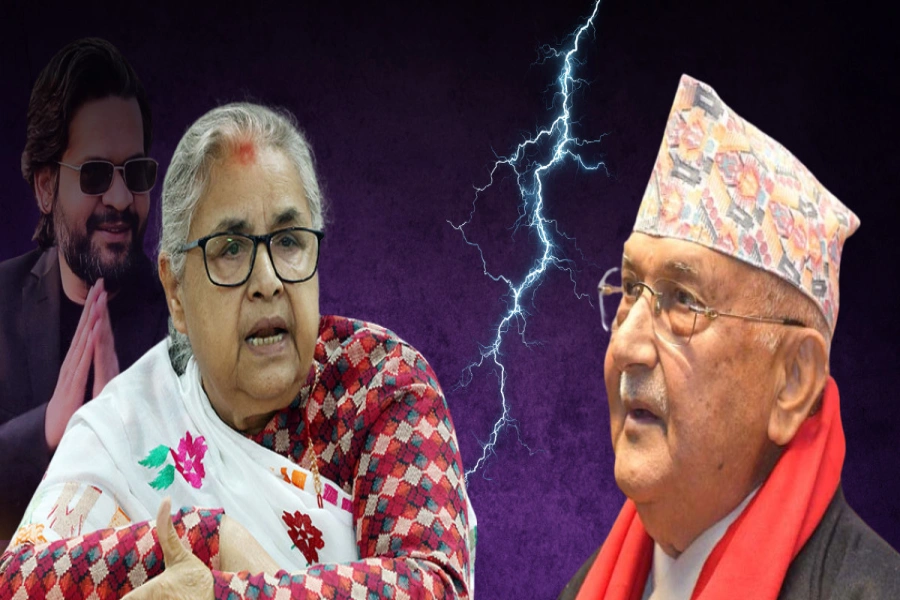
Prateek Pradhan, Prime Minster Sushil Koirala's Press Advisor, was a surprise victim of India's wrath. Pradhan, in an article in Republica, had argued that India was unwise to criticize Nepal's new constitution.
Pradhan wrote "... the elements[read India] that are trying to instigate Nepalis to take up arms against each other are not doing so in the interest of Nepal... They have vested interests in mind: stopping Nepal from standing on its own. They never want Nepal to be a sovereign, peaceful and stable country." Pradhan, under India's pressure, was fired from his job the next day.Looking back at the history of India phobia, such impressions of India's handling of Nepal's affairs are common. Nepal's former envoy to Britain, Murari Raj Sharma, expressed similar sentiments some years ago. In another Republica article in 2012, Sharma poured his ire: "The Nepalis have a long list of grievances with India, including the unequal 1950 treaty, unfair agreements on Gandak and Koshi projects, unilateral construction of bunds [embankments] on rivers at the border to inundate Nepali territories, etc."
Such perceptions of India drummed up by high-profile figures in Nepal are far cry from the ground reality. Common people in Nepal have no such feelings toward Indian transgressions. Especially the natives of Madheshi look to India for support and protection from Nepal's abrasive policy moves and dismissive attitudes. So who do Pradhan and Sharma represent when they speak of India's evil designs?
Rarely have scholars and policymakers in Nepal looked in depth at the source of anti-India feelings, for differences of opinion in most parts are based on a person's group associations, their ethnicity and regional origin in particular. Thus with few exceptions, people critical of India will be those from the hill region or the Pahades, while those having good feelings about India must be from the southern region. More generally, ethnicity overwhelmingly shapes views of India: whether India is looked at favorably or is perceived as a bully.
We can make use of Pradhan's and Sharma's ethnicity to explain their low tolerance for India's criticisms of Nepal. Both these men are well educated, have a high level of international experience, and are capable of taking a reasonable stand on issues of national interests. But when it comes to Nepal-India relations, they are swayed by their ethnic biases.
In the case of Pradhan, it appears that he has overplayed his ethnic card, to the extent of not balancing his professional duties with his ethnic pull. To put the matter in simpler terms, Pradhan and the people of his background in Nepal know the advantageous position their community enjoys under current arrangements: Newar ethnic group makes up some 20 percent of government total workforce in the country, excluding teachers and technical personnel. Compare this with their share of the national population, which is just four or five percent.
With regard to the Khas people—Sharma's ethnic group—they comprise about 20 percent of nation's population but command two-thirds or at least 60 percent of all government jobs. The rest 20 percent jobs are shared between Madheshis, Tharus and Janjati, much less than their population shares.
There are many other types of discrimination and exclusion suffered by Madheshis, Tharus and Janjatis. Job exclusion has been practiced in a way as to make State prerogatives look more like handouts from Pradhan and Sharma's types of master races to other ethnic groups, not as citizenship rights.
Protest in Madhesh
Pradhan is correct in his assertion of Nepal coming up with a constitution that has been approved by 90 percent majority in parliament, much more than two-thirds or three-fourths majority required normally. Thus, looking at just the numerical strength of parliament, the level of public support for Nepal's constitution is probably the highest in the world. Then why would India or any of other well-wishers of Nepal be unhappy with modus operandi of Nepal's constitution-making? Pradhan is then right in saying that India is playing a subversive role in Nepali politics by opting to side with undemocratic forces!
It is difficult, in fact impossible, to convince people like Pradhan and Sharma that the constitution is more than just counting of votes. At least, this is the way public mandate is evaluated in world's mature democracies and this can't be otherwise for new democracies.
Nepal' electorate did vote for the constitution and produced an overwhelming mandate for the parties who eventually drafted the constitution. However, other types of mandates must be solicited and agreed upon to expand the scope of participatory democracy and to strengthen local institutions. Most of all, constitution must reflect ethnic diversity of the country to ensure equal representation of all major groups, with special treatment reserved for those facing special handicaps.
Mistrust of state
The new constitution represents little in terms of years of effort and resource commitments needed to accomplish this. The most glaring failure of constitution-making has been that it gives no impression of the country's transition to a republican regime, in terms of devolution of power to state and local government units and accommodation of country's diversity. Government structure remains anchored at the central level that provides no leeway for the exercise of local autonomy.
Looking at the core issues causing current disturbances, delineation of provincial boundaries has been the most contentious. Pahade leaders on several occasions had agreed to Madheshi proposal of creating Madhesh-only provinces. That Madhesh and Pahad regions will have several provinces but they will not be mixed. The reason for keeping the two regions apart, Madheshi leaders contended, is that provinces with mixed territories tend to get ruled by Pahades, regardless of their numerical size. However, this principle of geographic separation of territories hasn't been adhered to in the constitution.
Looking at it more generally, the new constitution shows no commitment to federalism, which makes it more regressive than earlier constitutions. In particular, the new constitution in not reflective of Madhesh movements and republican transition that had fueled public debate about federalism and autonomy.
Backers of the new constitution such as Pradhan and the core of government operatives must convince non-believers that the new constitution is representative of people's hopes and aspirations.
I would say that the content and tone of the new constitution, forced upon an unwilling public, in no way makes it a democratic constitution. In fact, there is little to show that the new constitution is different from earlier ones, in terms of accommodating the nation's diversity and including hitherto excluded groups.
sshah1983@hotmail.com
Related story
Beyond "Actual Bias": Why Nepal Must Adopt the IBA Traffic Ligh...