Nepal’s major political parties, the Election Commission and the non-partisan government are bent on holding elections to the second Constituent Assembly on November 19 amid incidences that remind us of the conflict period.
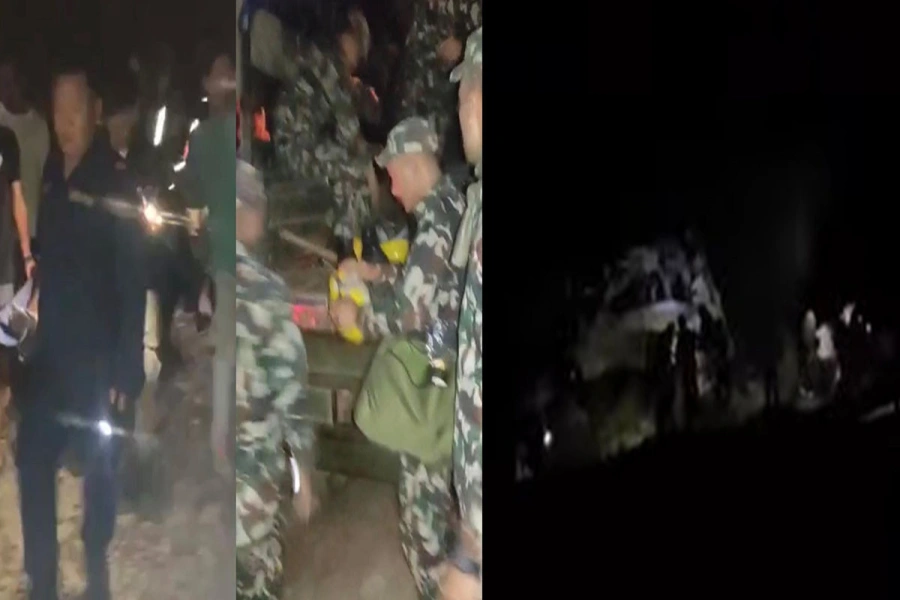
To press for their demands for postponement of elections, the breakaway Maoists have resorted to blocking highways, imposing bandas and torching vehicles used by candidates for canvassing. [break]

Republica
They have threatened to disrupt the elections at any cost and have asked for a fresh round of dialogue through the postponement of the scheduled polls. The electoral process has moved to a relatively advanced stage, where postponement is technically unfeasible.
Leaders of the major parties are rather focussed on their electoral campaigns, turning deaf ear to the Baidya faction’s demands. They have adopted a military approach to security, rather than an approach to accommodate political differences, which was the main spirit of the peace process.
The government security apparatus— including the army mobilized for the first time after the start of the peace process in 2006—is confident that elections can be held on schedule despite such threats. The Election Commission also seems to be comfortable with this approach.
Though election sans violence seems to be an increasingly difficult prospect, the question is not whether elections can be held under these circumstances. With a strong political commitment of the major parties and a robust security plan including the mobilization of the army, it may be possible to hold elections despite the threat of violence.
The main question is whether these elections will hold the country together and can result in a lasting and inclusive constitution that will reduce chances of relapse to conflict, when we are nearing the end of the fragile peace process.
Holding elections that can hold the nation together and produce a constitution that the first elected assembly could not deliver seems to be increasingly difficult under these circumstances. Doing so in a violence-free environment, the prerequisite of any fair polls, seems to be implausible now. While the candidates’ vehicles are being torched, highways blocked with fallen trees, and a week-long strike has been called by the boycotting parties before the elections, it is extremely unlikely that people will be voting in an environment free of fear and intimidation.
Any outcome of elections so held is least likely to produce a lasting solution to the political issues the country confronts.
In January 2010, I was in Iraq working for the United Nations with a special political mission to help the country stand back on its feet after the US-led invasion in 2003.
That mission’s mandate included assisting Iraq hold its periodic elections. Despite the threat of violence, Iraq held its second elections after the American invasion, hoping to resolve its remaining political differences shattered by a long insurgency and civil war. On the Election Day, 56 bombs went off in Iraq and dozens of people were killed. With the US security backup and Iraqi resolve, it was possible to hold elections under massive threats of disruption.
But the election did not resolve the country’s major problems, demonstrated by repeated serial bombings, ethnic strife and inability to resolve political differences even after the elections. A parliamentary election was held soon after the Arab Spring uprising in Egypt. But the government that came from the hurriedly held elections could not last for long. Egypt today stands on the verge of a civil war. Nepal obviously cannot afford to make similar mistakes.
There is no denying that an early election is a must to bring the derailed political process in Nepal back on track. But we cannot afford to hold elections that might cause a relapse of the domestic conflict. Indicators are that a low intensity conflict will continue in Nepal if the elections are held without bringing the breakaway Maoists into the fold.
The Baidya faction was not happy when the army integration process came to end, with the liquidation of a tiny fraction of the former rebel army into the national army, with the rest either disqualified or allowed to opt for rehabilitation. They have yet to give up the quest for a “people’s government” through capture of power through agitation.
Their boycotting and threat of disruption of elections is mainly the outcome of this mentality. They were cornered as the mainstream political parities refused to involve them in dialogue in the beginning and later when they reluctantly entered into negotiations, they refused to accept even a few of their minimum demands.
The coalition of 33 smaller parties led by CPN-Maoist had reduced their 17-point demand to two: Chairman Regmi’s resignation as the Chief Justice while he could continue as the Chairman of the interim election government and postponing elections by a few months. But the major five parities refused to cede to these demands when Regmi himself declined from the request to resign as the Chief Justice.
Regmis’s return to the Supreme Court as Chief Justice is not more important than holding elections that will be inclusive enough for a viable constitution. As everyone keeps repeating, these are elections for the Constituent Assembly Part II, not only for yet another parliament that will merely pave the way for the formation of a new government. Without the Baidya Maoists, even if the elections are held as scheduled, it is most unlikely to deliver a constitution that will be acceptable to all.
Experiences around the world have shown that elections are prone to violence. As a country emerging from a decade-long conflict, Nepal has relatively higher chances of electoral violence, even if all major parties participate.
The chances of electoral violence are extremely high as a former rebel faction has declared to disrupt elections and has already hinted that it will use all means at its disposal to do so. It will be wiser for the mainstream political parties not to give them a chance to disrupt elections.
Even if the Baidya Maoists are committed to boycotting the polls and even if they are asking for a renewed dialogue only to buy some time, they should be given one more chance to participate in the elections. The chance is worth taking even if that calls for postponing elections for a few weeks or months. Or the current government, the Election Commission and the leaders of the major political parties would be held accountable for holding elections without including all political actors and allowing a relapse of the conflict.
The author is former Permanent Representative of Nepal to the United Nations
Related story
Two arrested while trying to break ATM