POKHARA, Nov 5: The Beni-Jomsom section of the Kaligandaki Corridor remained obstructed for an extended period last month after floods and landslides severely damaged the road.
This created additional difficulties for traders transporting Chinese goods imported through the Korala border point in Mustang. With the road blocked for a prolonged period, traders were unable to bring some goods into the country on time, disrupting their businesses amid the natural disaster.
Now, snowfall has once again affected imports through the same border point. Heavy snowfall last week left thick layers of snow on the road, making it difficult to transport goods brought in through Korala to the market.
Heavy snowfall along the stretch between the Korala border point and the Nechung Customs Office, 14 kilometres away, has made transportation difficult. Locals said clearing the accumulated snow has also become a challenging task.
Tasi Nherbu Gurung, chairperson of Lomanthang Rural Municipality, said vehicles were finding it difficult to operate due to thick layers of snow on the road.
"The road has not been completely blocked to the extent that vehicles cannot move at all, but conditions are far from easy. The accumulated snow has made driving difficult," he said.
According to him, smaller vehicles are facing greater difficulties navigating the road. "We have been continuously clearing snow for the past four to five days, but conditions are still not easy," Chairperson Gurung said.
Six sections of Jomsom-Korala road completed

Following the floods in the Bhotekoshi-Trishuli river corridor and the closure of Tatopani border point, the Korala border point had become Nepal's only alternative trade route with China. However, he said the route has repeatedly faced disruptions due to natural disasters.
"At present, Korala is the only option for bringing Chinese goods into Nepal. Last month, however, floods and landslides blocked the Kaligandaki Corridor, leaving customs-cleared goods stranded in the Korala area for a long time. Now, snowfall has affected the route again," he said. "The road is not completely blocked at present, but vehicles are still unable to operate smoothly."
According to Gurung, the accumulated snow has not yet been completely cleared. He said the snow has turned into ice, making the road slippery and adding to the difficulties faced by vehicles.
"We clear the snow one day, but it snows again the next day. That is what has made things difficult," he said.
Gurung said security personnel and the local government had been continuously working to clear the snow. However, after their efforts proved insufficient, they sought bulldozer assistance from the Chinese side. A bulldozer provided by China helped clear the snow, but the work is still incomplete, he said.
According to him, the distance between the customs office and the Korala border point is 14 kilometres, of which a seven-kilometre stretch in the middle has become particularly difficult to navigate. He said the situation had worsened because drivers had continued operating vehicles recklessly soon after the snowfall, compacting the snow on the road.
"We had asked drivers not to operate vehicles until the snow was cleared, but no one listened. They drove through the snow regardless, compacting it under their vehicles. Now that snow has become slippery, creating further problems," Gurung said.
Small electric vehicles remain stranded at the Korala border point, and transporting them across the affected stretch has also become difficult, he said.
He warned that as temperatures continue to drop, imports could face even greater difficulties if weather conditions remain unchanged.
Mustang Assistant Chief District Officer Eknarayan Bhandari said that although driving in the upper region had become difficult following the snowfall, the road had not been completely blocked.
According to him, the road has been cleared to allow vehicles to pass, but slippery conditions continue to pose problems.
"Driving becomes particularly difficult when dust mixes with the snow," he said. "The initial few days after the snowfall were especially challenging. Vehicles are moving now, but conditions are still not easy."
Bhandari said authorities were planning to keep two bulldozers on standby in the upper region to clear snow and prevent disruptions to the road, ensuring that imports of Chinese goods would not be affected.
"If it snows, the road could become blocked. That is why we are planning to keep two bulldozers ready. As temperatures continue to fall, the possibility of snowfall also increases," he said. "There could be a need to mobilise equipment at any time."
He said preparations were necessary because any disruption to the road would completely halt Nepal's trade route with China.
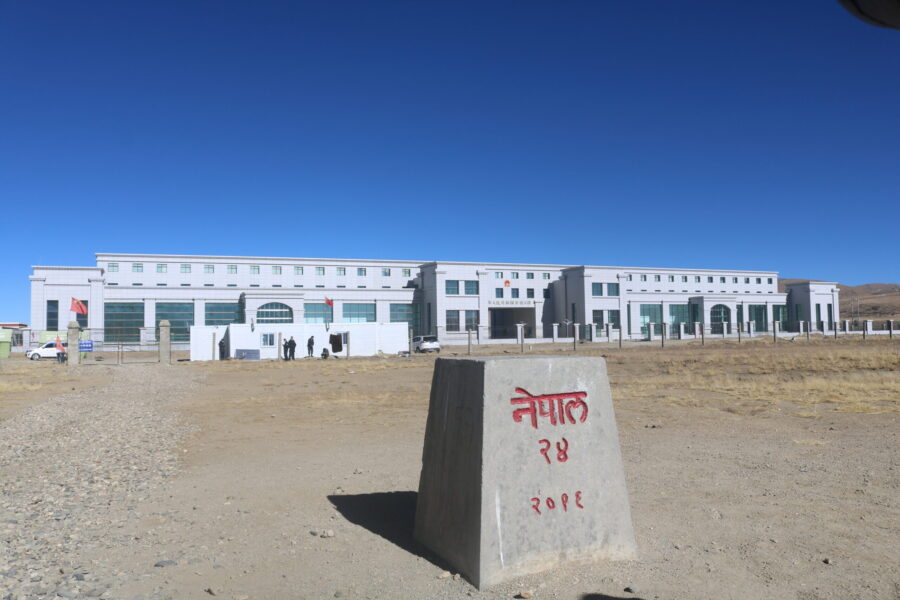
The customs office at the Korala border point in Mustang, which had remained neglected for a long time, has become increasingly busy in recent months. Despite limited resources, Korala has now emerged as Nepal's only alternative trade route connecting the country with China. Large container trucks have been entering Nepal through the border point almost daily.
Trade that previously passed through Rasuwagadhi and Tatopani was subsequently redirected through this route. Earlier, Korala had primarily served as an entry point for electric vehicles imported from China.
However, a wider range of goods, including daily consumer products, commercial supplies, electric vehicles and industrial materials, are now entering Nepal through the border point. This has increased activity at the customs office while also adding to traffic along the Kaligandaki Corridor.