

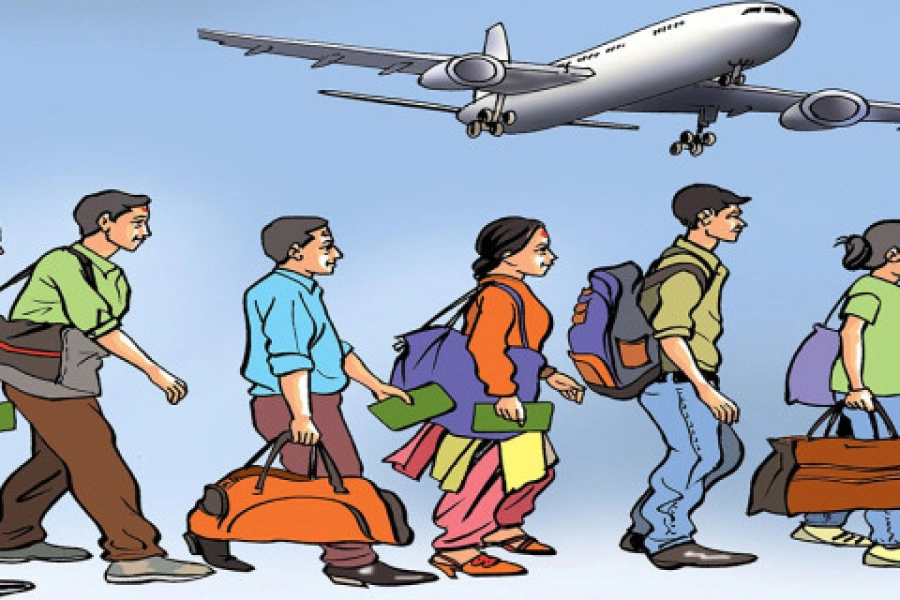
Arguably, we are the worst-performing economy in Asia. The Economy Survey data shows that the economy is expected to grow by 3.5 percent, almost one third of Indian growth rate, and almost one-fourth of China. Our economic growth and survival has now limited to a single variable, remittance. We annually export about 300,000 productive youths mainly to the Gulf countries and Malaysia and receive nearly Rs 230 billion in cash. This is why people are yet to realize the real pain of the economic crisis caused by a decade-long insurgency, misrule of the political parties and sheer lack of attention to economic issues. If we take remittance out from the economic equation, we would be a country exposed to a full-blown economic crisis. People would then know the true extent of inefficiency, corruption, instability, misrule and bickering of the political parties.
Let’s analyze how scary our main economic indicators are in these reports. First, the export sector, which is a determining driver in any economy, has been totally devastated. Exports have almost remained stagnant—if not declined moderately in real terms—in the past 10 years. During the same period, Bangladesh and Thailand saw exports increase by four-folds and India by over six-folds. The ratio of trade deficit in Nepal to the Gross Domestic Product (GDP) is one of the highest in Asia.
Increasing export opportunities are the only means to spur economic growth, create jobs, lift people out of poverty and increase living standards. This is also a key message we need to learn from the Asian Tigers, including South Korea, Singapore and Malaysia which were able to graduate into advanced economies through export-led growth. At the same time, we are quite aware of the bottlenecks that the export sector has run into since the late 1990s, and what it takes to remove these. But the agendas have been sitting on the sidelines for too long. Rule of law that got deteriorated with the rise of insurgency still seems fragile and has been the single-biggest contributor to displacing industrial base.
Infrastructure has been in a very poor state. There has virtually been no construction of major infrastructures such as highways, big hydropower plants—lifelines of economic growth—over the last decade. Besides, end of disturbances created by radicalized political unions who just want to benefit themselves without giving a hoot to the national economy does not seem to be in sight. And the political parties do not have any resolve to overcome these adversaries. This does not offer any optimism that the export sector would do well in the near future.
Second, fiscal deficit is 5 percent of GDP, which means that the country is spending far more than its means. It is strictly unacceptable and unsustainable to have such a deficit when development activities are in a standstill. If we do not curb this, it will eventually come to haunt us as has been proven from the experiences of many countries. In addition, Balance of Payments (BoP) is running into a whopping deficit for months. Averting BoP crisis seems to be another worry of the Nepali economy. The last resort to correct it will be devaluing the Nepali currency but that comes with a huge cost. It will invite hyper-inflation, spur capital-flight and erode confidence of investors and consumers from the government.
On top of these threatening economic indicators, our vital economics institutions have failed to function the way they should. Let’s just take one example: The monetary sector has an enormous task of encouraging economic growth but Nepal Rastra Bank (NRB) is almost dysfunctional vis-à-vis monetary performance. Exchange rate is a key component and challenge in monetary policy. However, we have handed over the job of exchange rate management to India. The central bank does not have any empirical research or logical justification whether or not fixed exchange rate arrangement with India is working well for Nepal. On top of that, inflation has climbed to double-digit. Either to hide their inefficiency or through sheer ignorance in analyzing inflation, the central bank officials always attribute supply-side constraints and escape from their prime responsibility. This is absolutely wrong. Almost half of price rises in Nepal tend to be a monetary phenomena. Whether it is in the best interests of the transition economy to curb inflation, thus slowing down growth, is debatable but digging out possible causes of inflation and finding out the true reasons for it is a responsibility that NRB must shoulder.
Along with these institutions, the market too is inefficient. Incompetent bureaucracy and weak regulatory bodies are just promoting ‘crony’ capitalism. The hallmark of prosperity and justifiable distribution of wealth is true capitalism. Nepali prices are relatively expensive when you compare the prices of commodities here with that of other developed countries where labor cost is high. This is because business and trading are done not on the basis of innovation and economic value, but on the basis of nepotism, association with political parties, and civil servants. So, they are powered to charge the prices that they want. This means there is no reward for innovation, smartness, and hard-work. In other words, there is no reward for investing money and using brains. In this era of global integration, both wealth and brain go where there is the possibility of highest return. That is why we are seeing exodus of educated youths to Western countries in search of a better future.
When we analyze our traumatic past, it leaves without any optimism to look forward positively. If the political parties do not craft a new idea of economic model putting economic agenda and consensus on the priority list, the government will undoubtedly have to face an economic disaster sooner rather than later.
krishregmi@lehigh.edu
Related story
Bomb targeting PM diffused















-1200x560-1779450784.webp)

