Good deeds overrun by bad elements are common scenarios that Kathmandu’s denizens get to see a lot amidst the unplanned urbanization and settlements of the city. All of it kind of does make it hard to notice good things going around. The case in point here is the parallel walkways and cycle tracks built by the Ministry of Tourism and Civil Aviation in cooperation with the Department of Roads (DoR) around the Sinamangal stretch.[break]
Starting at the Sinamangal junction, the concrete paved walkway currently stretches out till a little further than the other end of the Tribhuvan International Airport gate where it comes to an abrupt end.
“Due to a disagreement about moving the fences around the area currently used by the Royal Nepal Golf course, we had to stop the works for a while. But the debate has been resolved and we’ve resumed the construction,” says Rabi Shah, project manager of Tourism Infrastructure Development Project (TIDP).
The proposed plan of the Ministry is to build a 1.6km track starting from Sinamangal junction to Tilganga near the Pashupati area.
“This was our pilot project in the context of urban beautification that started around June last year, and with just 300m of construction left, it’ll soon be completed.”
The next project for TIDP, Shah informs, will be to build similar walkways on both sides of the road from Gaushala to Maitighar.
Meanwhile, the Sinamangal area is also the chosen pilot project for the Kathmandu Valley Ring Road Greenery Program. The memorandum of understanding (MoU) for the five-year program was signed about a year ago between the Federation of Contractors Association of Nepal (FCAN) and the Department of Roads with an objective to develop a greenbelt along with urban services and amenities around the Ring Road area.
Almost two years down the road, the DoR has not shown much implementation of the program. However, the Sinamangal stretch has seen a merger of different likeminded agencies coming together for the greenery program.
There was always greenery on both sides of the Ring Road when it was constructed by China in 1983. But with haphazard encroachment, and lack of maintenance and monitoring and traffic management, it has not been able to sustain the greenery in a desirable way.
“The Ring Road actually was built as a fast track for long-distance traveling vehicles. Instead it’s become like a gully as it’s been overrun with construction and haphazard encroachment,” says Nugal Vaidya, board member of FCAN. “So there’s a need to build service tracks for vehicles moving within the city as well as work for urban beautification with greenery programs.”
Taking the public private partnership (PPP) approach, FCAN took on the responsibility of motivating and coordinating the involvement of private sectors for the greenery program. Whereas the DoR, in line with different government agencies, were to work on an effective development and construction of different urban services and amenities, such as service tracks, pedestrian walkways, bicycle tracks, and bus stops, and parking areas.
“The limitation or drawback of greenery program is that it won’t sustain unless there’s a regular monitoring mechanism for traffic management and to penalize encroachment,” says Vaidya, “This is also where the government has to intervene and take actions to make the program sustainable.”
The greenery program is a long-term affair which is not concerned with just one-time plantation but nourishment and maintenance as well. In order to sustain the effort, it was felt important that community service agencies working for environmental preservation were also involved, and that was where the role of groups like Rotary came in.
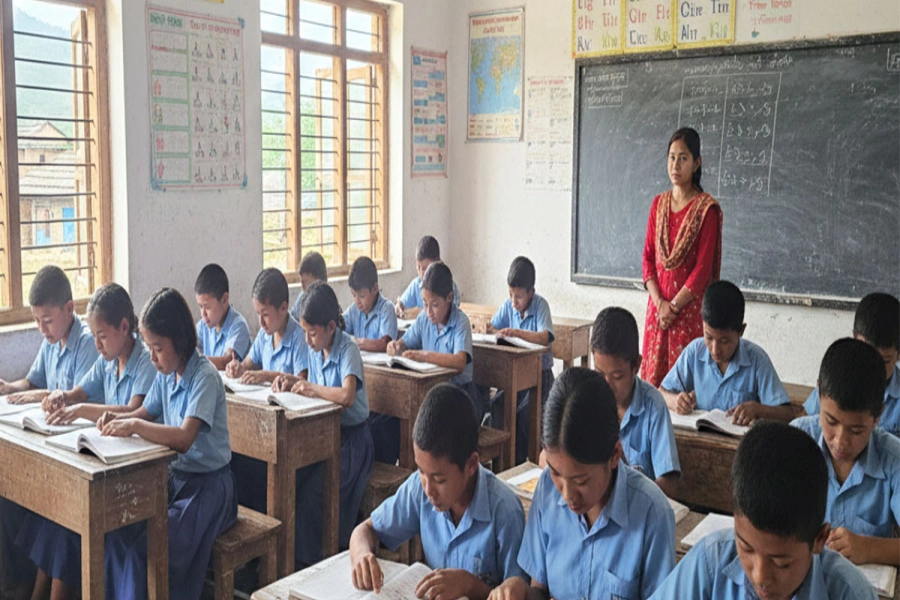
During June-July this year, different Interact Clubs of Nepal, as an initiative of Interact District Council of Rotary International District 3292 with their volunteer Interactors, started their plantation and clearing-out program at the Sinamangal walkway. With students from different schools involved in the campaign named as “Preserve Planet Earth,” the objective was to incorporate an environmental awareness theme of the greenery program into the educational system through their extracurricular activities.
Every Saturday, youngsters from schools and colleges of different Interact clubs came together to trim and clear out the bushes from the area for one to two hours.
“Initially, they weren’t too willing, but once they saw the transformation that their work could bring, it brought a sense of achievement and fueled their motivation,” says Jenny Vaidya, the current District Interact Committee Chair, who has been coordinating the cleaning program.
She shares that involving youth in the grassroots awareness programs helps in the realization of the importance of environmental preservation, and through them, it is implemented in the daily life culture of the society.
The World Peace Forum, along with local organizations, has also taken the initiative to build a Children Memorial Park alongside the Sinamangal track which will be inaugurated around next month.
“With the involvement of all these likeminded agencies and through a public participatory approach, the Sinamangal area is developing as a good example of the success of different agencies coming together for a good urban cause, and working to build services complimenting each other,” says Nugal Vaidya.
Amid the construction work and the greenery program waiting to follow along, the Sinamangal stretch awaits its ideal completion. But even before that, the lane is already showing signs of neglect and disconcert with the area’s denizens carelessly disposing of their garbage, turning it into a public urinal and even using the area for drugs abuse.
It’s crucial that good efforts are acknowledged, especially when they are as rare. The Sinamangal walkway is being claimed as a pilot project for many urban development plans and we have seen many of those stuck in limbos. But if this is what it claims to be, it is our social responsibility as citizens to not let the good efforts be overrun by our bad attitude.