HIRMINIYA, July 20: After Sushil Koirala was elected to parliament from Banke Constituency No. 2, he became a part of the Foreign Affairs and Human Rights Committee of the House. In 2001, this committee released a statement that read, "The damn constructed by India at the Banke district border at Laxmanpur and Kalkalwa did not have the consent of both parties; hence it should be demolished."
After Koirala and his team carried out a survey of flooded areas, the committee directed the government to do the needful.Fourteen years on, Koirala has become prime minister, but the plight of border area residents remains the same.
During his 2013 visit to New Delhi and Lucknow, Koirala had tried to bring the matter to the attention of Indian leaders. But two years after the visit, the problem not only persists, the number of flood-displaced is increasing.
Immediately after Koirala's return, the Indian authorities carried out a survey to build a road in the periphery of Santliya and Rupediya, which would cause more flooding on the Nepal side of the border. "While everyone was busy with the elections, the Indians slyly carried out their survey," informed CPN-UML former Banke-2 head Rajendra Burma. "A 30 meter wide, 2.5 meter high road is under construction. And the Indians are planning to raise the height to 5 meters."
With construction being speeded up in the border area next to Nepalgunj Sub-Municipality and only 10 to 300 meters from no-man's-land, 80 percent of the settlements in the area are under threat of severe flooding. Among the Nepali villages in jeopady are Katkuiya, Kalafanta, Laxmanpur, Narainapur, Matehiya, Gangapur, Fattepur, Betahani, Pipraha, Jaispur, Saigaun and Radhapur, which together have an estimated population of 96,811. Along with the displacement of many of these people, this construction also poses long-term danger for five other VDCs.
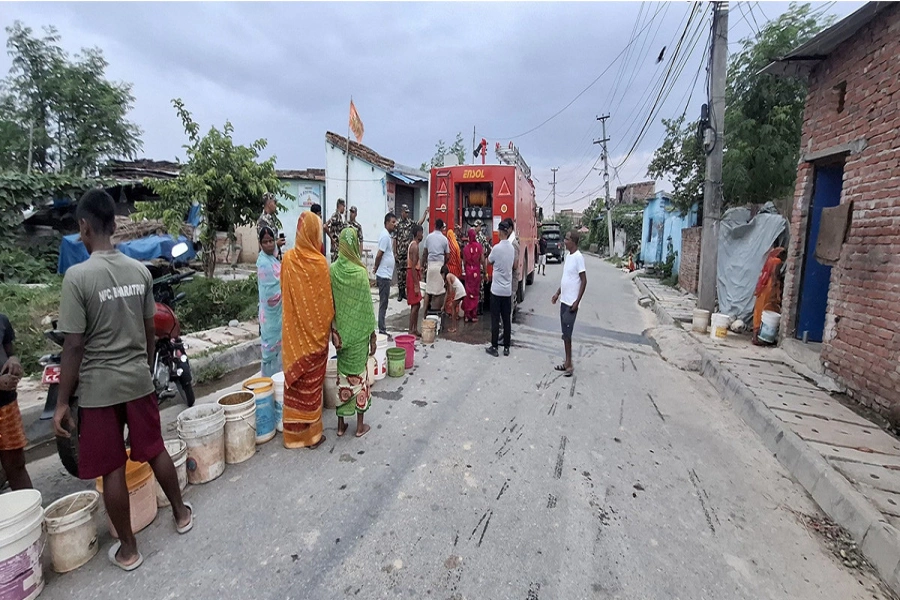
Citing reasons of internal security, India now is constructing 15 km of road in the border area of Banke, which is bound to disrupt the natural paths of the rivers. The disastrous effect of the construction was water-logging in Hirminiya VDC after the heavy rain Wednesday night.
"It's been seven generations since our ancestors began living here and flooding was something unheard of," said Ambika Prasad Murau, a local. "But this time not only did the land get flooded but even our fisheries have been destroyed." The story is the same for entire villages where many residents have lost their stores of food, their homes and their land.
When representatives of Republica visited the region on Friday, the water level had gone down, but acres of land was still under water. "It was only when Indian police used an excavator to open a culvert that the water level eased," said Sub-Inspector Jayadhan Singh Dhami of Hirminiya Police Office. But according to the locals, the culvert has been constructed by the Indians on higher ground, and even during minor rain there is flooding on the Nepal side.
Even before completion of the structures, thousands of locals who had settled on the banks of the Rapti have been displaced. The villages of Holiya, Gangapur, Matehiya, Betahani, Fattepur, Bankatti and Kamdi are affected by even a slight rise in the level of the Rapti, with Holiya being most affected. More than 500 households have been displaced and they are seeking shelter in the nearby jungle areas and in public spaces. Three hundred residents of Holiya-3 are living in the Jhora jungle area. "My family and I were displaced after our two bigha of land turned into a pool because of the flooding," said Shobharam Yadav of Holiya-4.
The Indian authorities have constructed the Laxmanpur dam just four kilometers from the border. Not only that, another barrage was constructed some 10 years back at Kalkaluwa and it disrupted the natural flow of the Gandheli and the Sutaiyaa. The problem created by Laxmanpur dam has been aggravated by the Kalkaluwa dam.
According to National Human Rights Commision spokesperson Mohana Ansari, 60,000 people in the region are at risk. Among them some have taken shelter in the jungle but the rest need to be relocated immediately.
The Indian side, which had promised to put in two culverts to undo the problem created by the Kalkaluwa barrage, has failed to keep its promise.
According to border expert Buddhi Narayan Shrestha, it is against international regulations to build structures that obstruct the natural flow of rivers in border areas. "The Nepalese administration has not looked into this matter with much seriousness" he commented.
While Nepal has not been able to put up much resistance against Indian activities, India has been impeding structural development activities on Nepal's side of the Rapti.
India had created obstructions to the Sicta Irrigation project, which was started in 2005 after four decades of delay. "The Indian side had protested, pointing out that the construction was only eight kilometers from the border and it would possibly change the water level in the Rapti," said Shrestha. "And because of that we even lost potential investors for the Sicta project."
Related story
Worth of stories