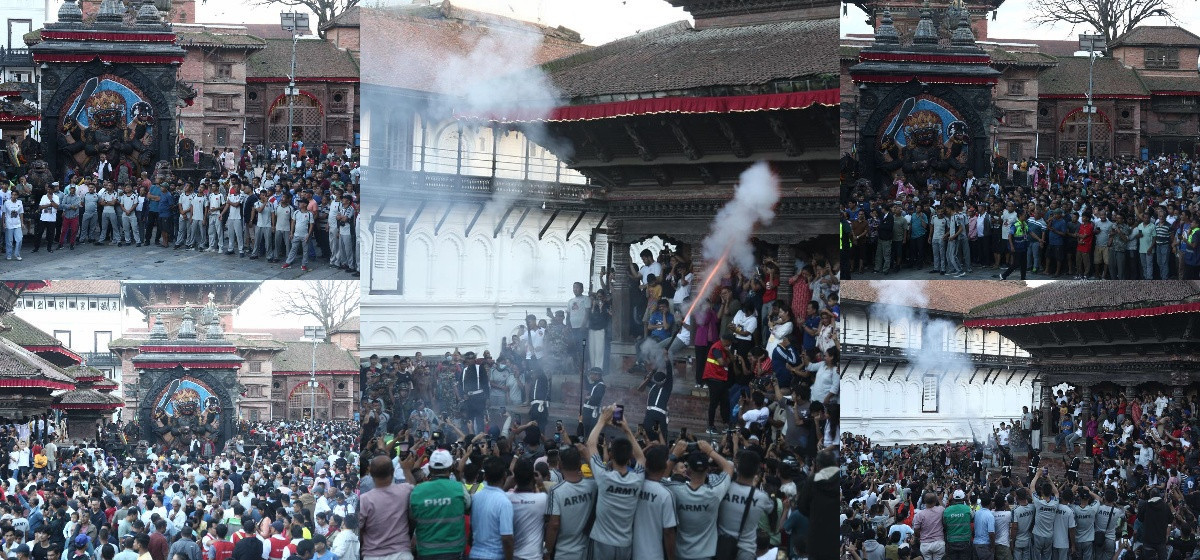
As hundreds of locals, mostly youth, pulled the chariot through historic settlements like Chikammugal, Jaishideval, Jyabahal, Lagan, Brahmatol, Hyumat Tol and Bhimsensthan. The living goddess Kumari, revered by the local Newar community as a mortal manifestation of the goddess Taleju, was accompanied by two other living gods, Ganesh and Bhairav. [break]
However, although their chariots were ahead of Kumari´s, Ganesh and Bhairav did not attract as many spectators as the living goddess. Thousands of spectators were jostling just to catch a glimpse of Kumari -- not Ganesh and Bhairav. They were completely overshadowed by the living goddess, whose chariot, despite being behind those of Ganesh and Bhairav, was the center of the whole festival.
"Not just this year," Uddhab Karmacharya, the chief priest of Taleju temple, located inside the Hanuman Dhoka Durbar, says. "It happens every year."
Karmacharya feels Ganesh and Bhairav have never been given as much importance as to Kumari. Except during Indra Jatra festival, Ganesh and Bhairav are never worshiped and no one cares about where they are.
Even during Indra Jatra -- the only occasion when the chariots of Ganesh and Bhairav are pulled through the inner parts of the city -- Ganesh and Bhairav do not get much attention. The head of the nation offers a gold coin to the goddess Kumari. But Ganesh and Bhairab are never entitled to such an honor.
"Disparity between facilities provided to the living goddess and the living gods is huge," says Karmacharya. "If such discrimination continues, hardly anyone will allow us to appoint their sons as living gods."
However, Om Dhaubhadel, a culture expert, views the overpowering persona of a female god in an essentially male-dominated society positively. "The Nepali society has always been patriarchal since the era of the Lichchhavi kings," says Dhaubhadel. "Preference to the goddess over the gods in a fundamentally male-dominated society is quite fascinating."
Dhaubhadel believes that giving more importance to Kumari than Ganesh and Bhairabh is a sign that the Nepali society has not completely forgotten its roots. "In ancient times, particularly before the Lichchhavi era, there were matriarchal societies in Nepal," he says. "Preference to Kumari over Ganesh and Bhairav reminds us of our ancient history."
However, caretakers of Ganesh and Bhairav are not happy about how these living gods are treated.
They say Ganesh and Bhairav should be given more respect, importance and facilities, even if not on a par with Kumari. "Ganesh and Bhairav receive less than one third of what Kumari is given," says a caretaker of the living god Ganesh, now embodied by Sambeg Shakya, an eight-year-old boy from Lagan, Kathmandu. "We do not ask for as much facilities for the gods as are given to Kumari. But what is being offered to the two gods is miserably insufficient."
The tradition of worshipping the living goddess Kumari dates back to the Malla era. The locals believe that Taleju Bhawani, an incarnation of the goddess Durga, enters into the bodies of pre-pubescent girls -- from Shakya clan in Kathmandu and from Bajracharya clan in Lalitpur and Bhaktapur districts -- to give bless them.
The living goddess Kumari of Kathmandu lives in Kumari Ghar in Basantapur Durbar Square. She does not get to mingle with other ordinary children. Until her menstruation begins, she lives an isolated life, giving blessings to the rulers and the commoners alike. Currently, Manita Shakya, an eight-year-old girl, is the living goddess Kumari of Kathmandu.
Traditions of worshiping Ganesh and Bhairav are also by and large same. When Manita was appointed as the living goddess, Sambeg Shakya and Rojan Shakya, both eight-year-old boys, were appointed as the living gods Ganesh and Bhairav, respectively. However, unlike Kumari, Ganesh and Bhairav have no separate houses to live in.
Bishwa Shakya, Sambeg´s maternal uncle, says they find it difficult to preserve the purities of children chosen as the living gods as they have to live in their own houses where they come in contact with normal people."
Caretakers of Ganesh and Bhairav have time and again asked Guthi Sansthan, a government body that oversees all social and religious trusts, to separate certain portions of Nepal Sanskrit University, which is adjacent to Kumari Ghar, for the living gods.
Jaya Ram Regmi, chief of Guthi Sansthan, says they cannot provide as much facilities to Ganesh and Bhairav as to Kumari as the latter is revered as the royal goddess. However, Regmi informs that they have realized that facilities given to Ganesh and Bhairav are not good enough. "We have recently hiked monthly allowances to Ganesh and Bhairav," says Regmi.
Culture expert Govinda Tondon, who is now serving as Member Secretary of Pashupatinath Area Development Trust (PADT), says tradition of worshiping Ganesh and Bhairav is an integral part of Hindu culture. "Kumari is just a mother figure," he says. "Only if there are Bhairav as father and Ganesh as child, the family of Kumari is complete." Tondon says it is hard to understand why Ganesh and Bhairav that form part of Kumari´s family are neglected.
Related story
Are you ready for Kumari Rath Jatra?