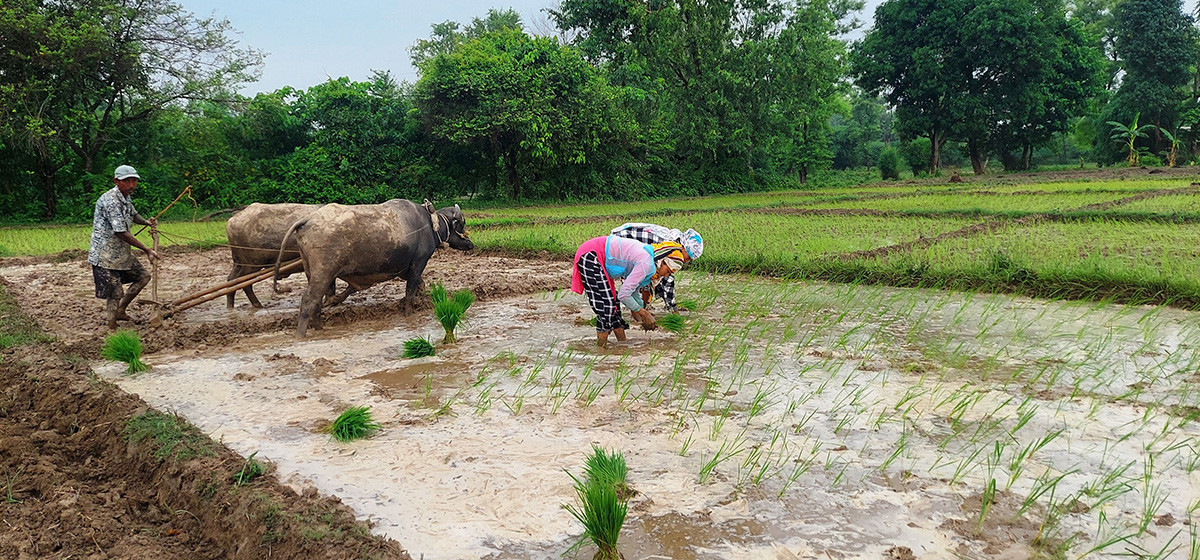
KANCHANPUR, June 20: Paddy plantation has reached 48 percent in Kanchanpur district so far this season, according to Dharma Saud, Assistant Crop Development Officer at the Agriculture Knowledge Centre (AKC), Kanchanpur.
Out of the total 48,496 hectares of cultivable land for paddy in the district, plantation has been completed on 23,278 hectares. With rainfall continuing, Saud expects around 80 percent of the planting to be completed within the next two weeks.
Plantation completed in 50% of paddy fields in 14 districts
The average paddy yield in the district stands at four metric tons per hectare. Farmers predominantly cultivate the Sawa Saryu-52 variety, followed by Radha-4, Sukha-1 and 2, and Bahuguni varieties. The availability of irrigation facilities has led to the expansion of Chaite Dhan (spring paddy), contributing to an increase in annual production.
Although rainfall was delayed this year, irrigation has enabled farmers to continue with the plantation. In areas covered by the Mahakali Irrigation Project, plantation began in the last week of May, while farmers in areas without canal access have used shallow and deep tube wells for irrigation since early June.
Municipalities such as Bhimdatta, Bedkot, Belauri, and Beldandi benefit from Mahakali irrigation canals. In other parts, farmers rely on privately installed or government-subsidized shallow and deep tube wells. Even farmers who depend on rainfall were able to proceed with planting due to overnight rains.
Farmer Bil Bahadur Chaudhary of Shuklaphanta Municipality–3 said he used shallow tube wells to irrigate his field in the absence of sufficient rainfall. “We received chemical fertilizer on time,” he said. “We installed shallow tube wells with subsidy support, and used them to irrigate the fields and transplant paddy.”
Despite higher costs, Chaudhary remains hopeful that timely plantation will lead to increased yields. The AKC and local governments have been providing subsidies on seeds, pesticides, and agricultural tools to encourage modern farming methods. Farmers are increasingly planting hybrid varieties, which yield more than traditional ones.