

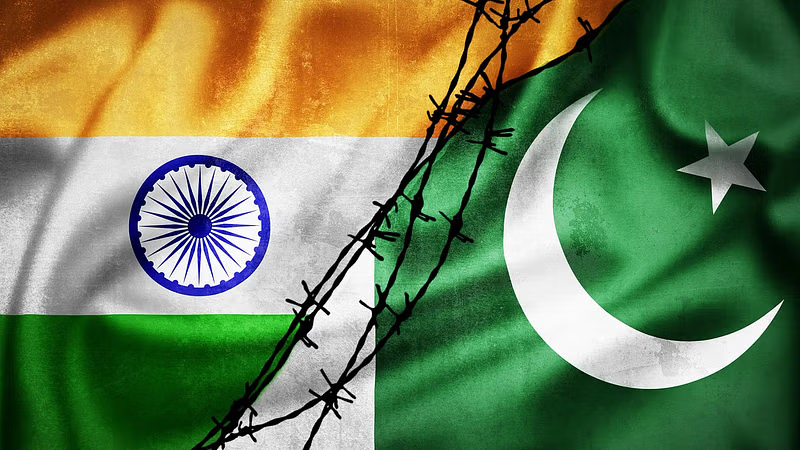
NEW DELHI, May 11: India and Pakistan announced a ceasefire on Saturday after days of deadly attacks and counter-attacks that killed more than 60 civilians on both sides.
The latest clashes follow an attack last month in the Indian-administered side of disputed Kashmir that killed 26 tourists, mostly Hindu men, which Delhi blamed on Islamabad. Pakistan rejects the charge.
Fighting erupted after New Delhi launched missile strikes on its arch-rival Wednesday, with waves of drone, jet fighter and artillery attacks reported over the next three days on both sides.
The nuclear-armed countries agreed Saturday to a full and immediate ceasefire.
The two sides have fought multiple conflicts -- ranging from skirmishes to all-out war -- since their bloody partition in 1947.
- 1947: Partition -
Two centuries of British rule ends on August 15, 1947 with the sub-continent divided into mainly Hindu India and Muslim-majority Pakistan.
The poorly prepared partition unleashes bloodshed that kills possibly more than a million people and displaces 15 million others.
Kashmir's monarch dithers on whether to submit to Indian or Pakistani rule.
After the suppression of an uprising against his rule, Pakistan-backed militants attack. He seeks India's help, precipitating an all-out war between the countries.
Fact check: Fake news spreading after India strikes Pakistan

A UN-backed, 770-kilometre (480-mile) ceasefire line in January 1949 divides Kashmir.
- 1965: Kashmir -
Pakistan launches a second war in August 1965 when it invades India-administered Kashmir.
Thousands are killed before a September ceasefire brokered by the Soviet Union and the United States.
- 1971: Bangladesh -
Pakistan deploys troops in 1971 to suppress an independence movement in what is now Bangladesh, which it had governed since 1947 as East Pakistan.
An estimated three million people are killed in the nine-month conflict and millions flee into India.
India invades, leading to the creation of the independent nation of Bangladesh.
- 1989-90: Kashmir -
An uprising breaks out in Kashmir in 1989 as grievances at Indian rule boil over. Tens of thousands of soldiers, rebels and civilians are killed in the following decades.
India accuses Pakistan of funding the rebels and aiding their weapons training.
- 1999: Kargil -
Pakistan-backed militants seize Indian military posts in the icy heights of the Kargil mountains.
Pakistan yields after severe pressure from Washington, alarmed by intelligence reports showing Islamabad had deployed part of its nuclear arsenal nearer to the conflict. At least 1,000 people are killed over 10 weeks.
- 2019: Kashmir -
A suicide attack on a convoy of Indian security forces kills 40 in Pulwama.
India, which is busy with campaigning for general elections, sends fighter jets which carry out air strikes on Pakistani territory to target an alleged militant training camp.
One Indian jet is shot down over Pakistani-controlled territory, with the captured pilot safely released within days back to India.
- 2025 -
On April 22, 26 tourists, mostly Hindu men, are killed by an attack by militants in Pahalgam, in Indian-administered Kashmir.
Delhi accuses Pakistan of backing the militants, a charge Islamabad denies, and threatens retaliation.
On May 7 India launches "Operation Sindoor" and missiles strike what New Delhi calls "terrorist camps" in Pakistan.
Pakistan's military says five Indian jets are downed across the border in the initial assault, but New Delhi does not respond to the claims.
Both sides accuse the other of sending over waves of armed drones, and there are fierce exchanges of artillery fire across their border as well as the Line of Control in Kashmir.
On Saturday Pakistan's military said three of its air bases were attacked, including one on the outskirts of the capital Islamabad.
It launches counter-attacks, which India says cause "limited damage".


_20230114102317.jpg)


-1784075952.webp)


