According to the law, any game that involves loss or gain of money is called gambling. In this sense, even playing cards is illegal, but drinking and gambling are common during the Festival of Lights that is Tihar.
Kauda can be played with a little money in a friendly atmosphere but it generally involves large stakes. Sometimes the game ends when a single player wins all the money while others have nothing left with them to bet. Yet that does not deter the defeated enthusiasts from playing the game again with hope of making fortune the next time.
The origin of the game is unknown but is said to be a part of the Hindu culture. Unlike the dice game – mentioned in the Mahabharata – which is popular in India, Kauda thrives in Nepal and is a unique feature of our culture.

The game is played with four players sitting in four directions, facing each other who throw the shells to test their fortune.
The four players get four seats called ‘khal’ or ‘dau’ respectively which are named as teeya (three), chauka (four), panja (five) and chakka (six).
When a player representing a particular dau throws the 16 shells, there is an outcome of 17 possible combinations depending on the position of the grooves of the shells. Out of the 17 results, five goes to chauka dau, the rest of the players get four each. If the player gets his designated result, he wins all the money that lies on the ground. If the result goes to some other dau, the thrower of the shells has to pay.
For instance, if the grooves of four shells face upwards and the rest face down, the result goes in the favor of the chauka dau. If five shells face upwards, then panja will win the bet. This goes on in a cyclic order until all the daus get their chance.
The chances of all the shells facing up or all facing down are very rare, and they represent the chauka dau. Therefore, chauka gets five chances while others get four.
Besides the players, unlimited number of people called Chyakhes also can bet money in the game on behalf of the four players. The player however reserves the rights to allow people to bet money. This ensures that both the parties are ready either to gain money or lose their fortune.
Chyakhes can bet their money anywhere they like except for the one who tosses the shells. That means there are three seats out of four where they can bet their money. If the shells show the seat where the money is placed, the money gets doubled. However, if the shells show the results in favor of the thrower, he collects all the money.
The most exciting part of the game is the Mar-taal, when a player wins a few consecutive bets. The losers double their original bets each time they lose. Thus the thrower of the shells collects money from the other three players; but in the end, he has to pay only to one player, although the amount he pays is multiplied by the number of times he has won.
*****
Likewise, Langur Burja is another game played in Tihar. It consists of six square dices, each dice having six signs, and a rectangular mat with corresponding signs to place the bets. The signs are named as Spade, Heart, Diamond, Club, Langur, and Burja.
Anyone can bet money in one or more of the figures. If any dice shows the sign where a person has bet his money, he gets his money multiplied by the number of dices that show the sign. If none of the dices shows the sign where the money is placed on, the money is taken by the thrower or the game master of the dices.
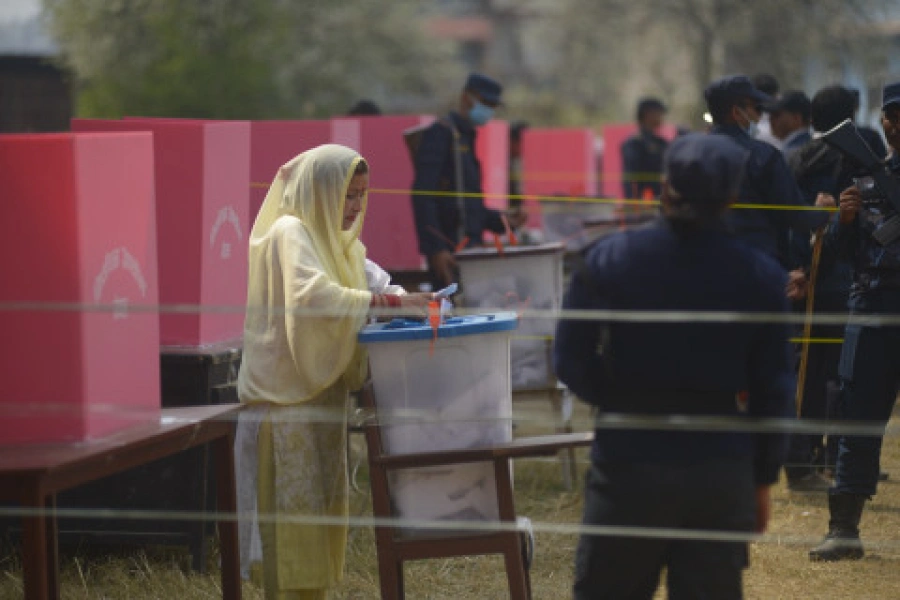
As people enjoy during the festival, police personnel remain busy round the clock to maintain law and order. It is during the festivals that more number of crimes is reported. Inspector Dadhiram Neupane of the Metropolitan Police Range, Kathmandu, said police have been taking actions against those involved in gambling.
The spirit of any festival is to celebrate and enjoy, but when it comes to gambling, it often leads to nasty situations. The tradition of playing Kauda and Langur Burja since time immemorial cannot be changed overnight, but the gambling atmosphere can be made better with low-stake games in which enjoyment is more than the risk of losing money.
Related story
Vipassana Diplomacy: A Path to Peaceful World Order- I