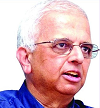
On a cloudy morning, while spring rain is drizzling sporadically, Hari Bamsha Acharya sits in a café owned by his son, discussing about his autobiography, which is to be launched this Saturday. As he waits for others to arrive, who have been delayed by the unexpected rain, he begins to retell the story of his life.
“I was born as a baby,” says Acharya in his peculiar style when he is asked to talk about his childhood. When the laughter dies down, he begins to go back to his memory lane once again.[break]
He was basically brought up by his sisters. Among five sisters, three were already married and he remembers the youngest two being with him after their parents died when Acharya was a young boy.
“I was a rather mischievous boy. I was very playful and naughty at times. When I look back now, I may have acted so because my sisters were like friends to me and I was a handful for them in absence of our parents’ guidance,” he says.
But no matter how naughty he was, he never crossed his limits. “I was aware that I should not fall for bad company or do something that would hurt my family’s reputation. I was always conscious that I should not let down my sisters,” he says.
Chandra Shekhar Karki
He remembers that people used to find him funny and liked to be around him. “First, I thought that may be they laugh because I was too thin then. But later I realized that it was my humor that attracted them towards me.”
And so, at the age of 13, he first took to the stage at a school cultural program and showcased his talent. After his friends and teachers praised him for his performance, he was encouraged to explore more and he decided to perform for larger crowds.
“In those times, there used to be ‘Dabu Pyakha’ in almost every block in the Kathmandu Valley. And I decided to take part in those performances as well.”
Then in 1976, he went to watch the “Gai Jatra Mahotsav” – the biggest platform for comedians – with the head of state and many high officials attending the program as audience. When he was closely looking at those performances, he realized that he could also perform similar shows. Therefore, the next year, in 1977, he registered his name for the performances. After a series of auditions, he was not only chosen as one of the finest performers but also won a gold medal for his performances the same year.
This continued for another three to four years. “It was a big boost for me. I also started to earn some money from different stage shows, and it was also a motivation regarding the poor financial condition of my family,” he says.
As Acharya looks back now, he believes that his mischievousness as a kid had also helped him a lot in his career. He has derived many characters from the person he used to be and has drawn inspiration to write scripts. He transferred all his playfulness into something constructive and his success stands as a witness to his efforts.
After an accidental performance with Madan Krishna Shrestha in 1980 for a program for the Rastra Bank, the duo, now popularly known as the ‘MaHa’ Duo, gave many excellent stage shows, acted in TV series and a few films. After his partnership with Shrestha, his life has been an open book.
“A team of two is always stronger than that of one,” says Acharya, whose team has been regarded as an example of true companionship and compassionate partnership that transcends their performances.
The MaHa partnership was successful not only in earning them fame but it also helped them earn their living. “When we first released the audio cassettes of our stage performances, they were such big hits that I was able to build a house from the profits earned,” he says.
And just when he was gaining popularity and his career was gradually soaring high, he fell in love.
“At that time, Meera lived near my house at Naxal. When I started liking her, I did not pursue her; in fact, I was actually very scared to talk to her. I was at my prime of youth and had the confidence to take anyone. But my knees used to go weak at the sight of this girl. And I realized that it was what people called love,” he says, as his eyes speak of more compassion when he utters the name of the love of his life.
At 25, he got married to Meera, who was seven years younger than him. They had two sons, Trilok and Mohit. He recounts his days with Meera as a golden period of his life when he lived in pure bliss.
But when she died two years ago, Acharya was left shattered. The untimely demise of his wife left him depressed and lonely. His close friends described the two as very close. Acharya could not bring himself together for a long time.
Keshab Thoker
Hari Bamsha Acharya with his first wife Meera in 2009.
But he was not the one to give up. As he had translated his mischievousness into something constructive, it was time to do the same with his grief. His family and friends were of great support in bringing him back to what he used to be, says Acharya.
“After Meera’s demise, I was unable to carry out my creative works. So I started pouring all my grief on paper and that’s how the book came into being,” he says.
The book, entitled ‘Cheena Harayeko Manchhe’ and dedicated to Meera, is the recollections of his life. Acharya says that readers can expect to know all the details of his personal life, career, and of course, the humor in between them.
“Moreover, readers will know that I have been a simple human being. I may have earned fame but my life is as ordinary as theirs,” he adds. The book also entails his decision to marry again after Meera’s passing away.
“Humans are social beings, after all,” says Acharya as he prepares to explain his decision to marry Ramila eight months ago. “If Ramila hadn’t come to my life, I would’ve have been able to cope with my loneliness. I would’ve been depressed and probably found wrong ways to bring myself out of it. But that doesn’t mean that I’ve forgotten Meera,” he clarifies.
He has also established Meera Care Centre, a social organization that will work for childhood growth and development in his hometown at Sankhu in Panauti in memory of his wife. He has also decided to donate a part of the money made from the book to help run the organization.
Published by FinePrint, his autobiography will be sold in both hardcover and paperback. The hardcover with his autograph on the cover will be sold at Rs 2,000 per copy and all the proceeds from the book will be donated to the organization. Acharya has already donated two ropanis of land for the same organization.
Now busy with the preparation of the book launch, which falls exactly on the day that marks the second death anniversary of Meera, he seems to have moved on with his life. But since the past two years, Acharya seems to have aged more than a decade. The drooping eyelids and wrinkles speak of his survival through his loss and heartache. Though his smile has the same old aura that brightens up everyone around him, one can still see the flash of wetness in his eyes when he thinks of Meera.
“Ramila is my companion now. She has made my life much easier. But Meera has become like a goddess to me; she’s always with me,” he says.
mail2asmita@gmail.com
Related story
Hari Bansha Acharya appointed as brand ambassador of BYD Nepal
copy_20220523144805.jpg)