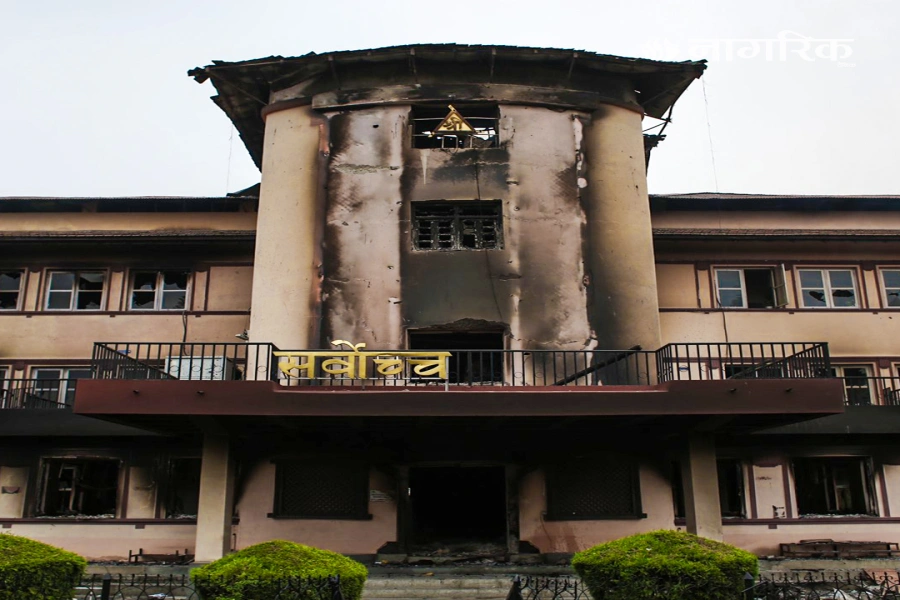
This growing trend raises two questions: Why are the government´s decisions being repeatedly challenged, and even struck down, by the court? And should the political leadership take moral responsibility for such faulty decisions? [break]
First, let´s take up some representative cases.
- February 15, 2012 --- SC directs government not to distribute citizenship by descent to the children of those acquiring citizenship by birth.
- January 31, 2012 --- SC stays government move on Information Classification.
- January 19, 2012 --- SC scraps government decision to legalize conflict-era land deals.
- January 11, 2012 --- SC directs government not to hike electricity tariff by more than five percent.
- January 10, 2012 --- SC directs government not to remove the bust of the late King Tribhuvan from Sahid Gate in Kathmandu
- December 27, 2011 --- SC rejects government´s review petition against the SC verdict that the latest CA extension would be the last.
- December 20, 2011 --- SC directs government not to go for group recruitment of Madhesis in the army.
- December 2, 2011--- SC stays the decision of Industry Minister Anil Jha to dismiss GMs at various public enterprises
- November 28, 2011 --- SC directs the government to have the BIPPA agreement with India endorsed through parliament.
- November 13, 2011 --- SC stays the government decision to pardon Maoist lawmaker Bal Krishna Dhungel.
CPN-UML lawmaker Agni Kharel argues that this is only natural when the government flouts the provisions set out in the constitution and the laws. "When the government fails to take decisions in line with provisions set out in the constitution and the laws such decisions end up at the courts, the CIAA and various parliamentary committees," he says. "This type of incidents are taking place as the government has failed to honor the laws."
Lawmaker of the main opposition Nepali Congress (NC) Radhe Shyam Adhikari said the problem has surfaced as the current government is taking all decisions just to prolong its stay in power, without caring about the legal provisions and the long-term implications such decisions will have for the country.
Adhikari referred to the acknowledgment by Deputy Prime Minister and Home Minister Bijaya Kumar Gachchhadar before a House committee that he took the decision to send the controversial circular to chief district officers on citizenship only under pressure from the United Madhesi Front though he knew that it would be struck down by the apex court.
"What I see as the biggest problem now is that the government is not following the principle of rule of law. The government mechanisms that exist to ensure checks and balance against executive powers are forced to take counter-decisions of this sort," Adhikari further said.
However, Maoist lawmaker Ekraj Bhandari begs to differ. Bhandari argues that the problem has arisen as political decisions taken by the government are taken to court, which interprets whether the decisions are right or wrong, based on the existing laws.
"Some decisions are made on the basis of political understanding reached in the past. Since such decisions are not based on existing laws it is only natural for the courts to issue the stay orders," he said while giving the reasons behind the growing instances of government decisions facing ire from the courts and other bodies.
Bhandari argued that such a situation has arisen also because of the tendency of those in government to take any decision that helps prolong their stay in power. "All the governments in the world try to defy the rules. That is why there are opposition parties, courts and other government bodies to ensure checks and balance," he further said.
Asked if the political leadership should take moral responsibility for such decisions, UML lawmaker Kharel argued that the minister concerned or the prime minister himself should take the responsibility for decisions that are taken in contravention of existing legal provisions. "But I can see that morality and the Maoists do not go together. That is what has created the problem," Kharel further said.
NC lawmaker Adhikari believes that the current government does not care about responsibility for such decisions. "No minister seems bothered about moral responsibility for the faulty decisions. Nothing could be more unfortunate than this with a government that is not accountable," he added.
Maoist lawmaker Bhandari, however, argued that laws should not bar the government from taking decisions if they are taken with good intentions. "We must take into account the political and other context behind such decisions," he added.
Related story
Joshi wins Apex Smile Festival award