

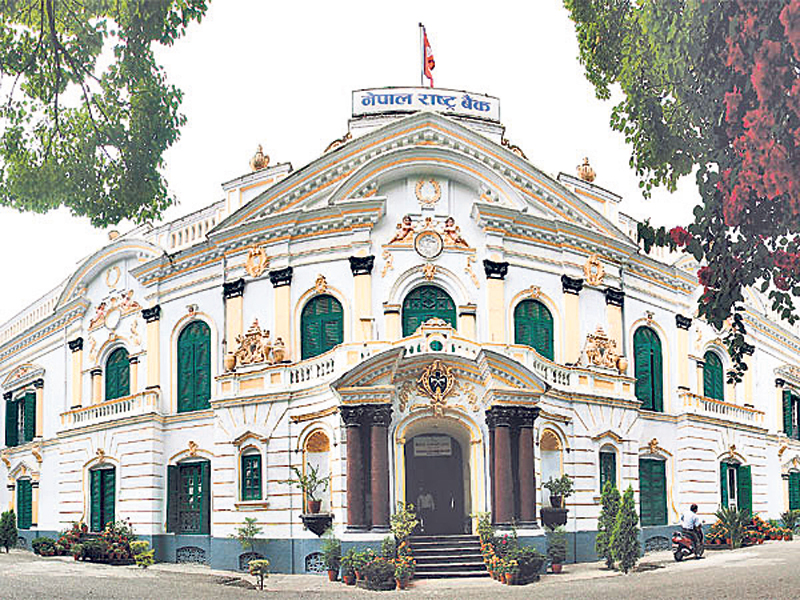
They have suggested the central bank to clearly refrain from pledging undue favor to the financial institutions (FIs) whose promoters and top managers are indulged in criminal activities.[break]
“Only the solvent financial institutions should be saved; insolvent ones should be liquidated. This is what the spirit of the current domestic financial architecture calls for,” said Nara Bahadur Thapa, NRB director.
If the current problem spread across the system, and if financial institutions with solvency problem have potential to spur systemic impact, he viewed that the situation should be handled by the government, and not the central bank.
“In such case, the government should intervene by either injecting capital or guaranteeing deposits,” said Thapa.
Given that the existing law of the country does not allow NRB to provide unlimited lending of last resort (LoLR), Thapa said Nepal should negotiate for the International Monetary Fund (IMF) program in case the financial distress continued and additional LoLR facility is needed.
“This will be inevitable to deal with the possible adverse impact of LoLR facility on international reserves and balance of payment,” Thapa stated.
Ashok Rana, president of Nepal Bankers Association, agreed that latest erosion of public confidence has the potential to land a lethal blow in the financial system as a whole, and suggested that the central bank treat the problem in line of what Thapa has recommended.
“Both the central bank and the government must be prepared for worse scenario, even though situation at present remains well in control of NRB,” said Rana, interacting with journalists on Wednesday.
Meanwhile, rattled by sudden drop in public confidence and liquidity crunch, development bankers and chief executives of finance companies on the day pleaded the commercial banks to provide them loans against good loans or assets to help avert possible crisis.
The central bank had opened such lending to the banks and financial institutions (BFIs) earlier this week in a bid to bail the cash-strapped financial institutions (FIs) out of the crisis. However, amid draining public confidence and low assets quality, bankers have so far shown little interest to lend under this new window.
“Deepening liquidity crunch in the category B and C financial institutions are not just a matter of concern of few players, as it can trigger serious risks to the financial system as a whole. Hence, commercial banks should step ahead to support them,” said Jhapat Bohara, president of Nepal Development Bankers´ Association (NDBA).
In the same note, Rajendra Man Shakya, president of Nepal Finance Companies Association, appealed to the bankers and the central bank to come to the fore to safeguard the financial system.
“It is true that some of the financial institutions had bad governance. But not all institutions are plagued by it,” said Shakya, and asked the central bank to takeover the management of fair FIs in case of crisis, so as to prevent a bank run.
Related story
Revised interest rate corridor system introduced














-1200x560-1779450784.webp)

