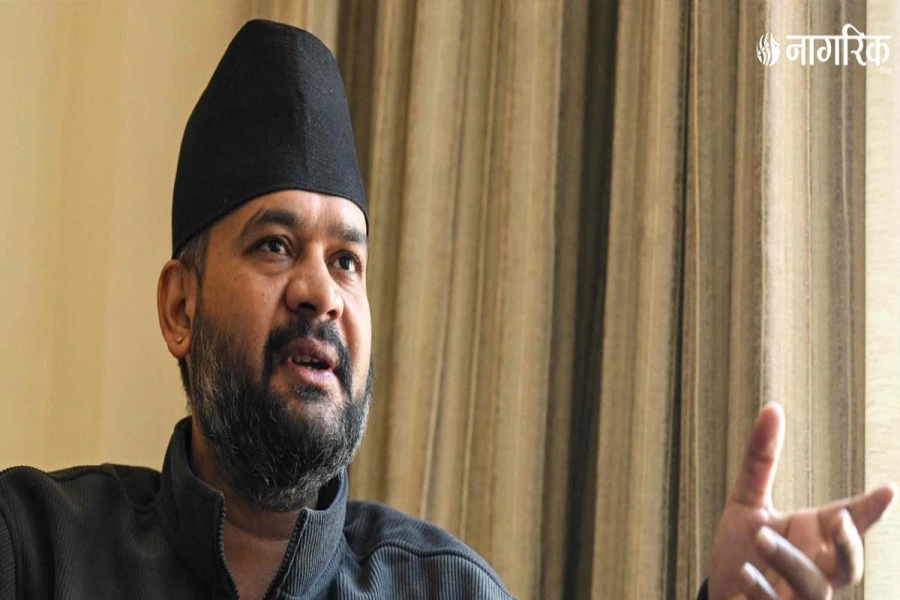
This provision means that only members of the largest community in the province will be given special preference for important posts like chief minister of the province, for two terms. The other communities will be deprived of this right and they will not be allowed to get such posts even by free competition. [break]
"In the case of provinces created on the basis of ethnic identity, it will be appropriate if the political parties during elections and formation of governments give preference to members of the largest community in the top leadership," said the Maoist-proposed provision that was passed by a majority in voting in the committee on Wednesday. Twenty-one members of the 43-member committee voted in favor of the provision. Nepali Congress (NC) and other lawmakers objected to the decision saying that 21 votes were not sufficient to constitute a majority of the committee as 42 members -- other than Narayan Man Bijukchhe of Nepal Workers and Peasants Party (NWPP) -- were present at the meeting. But committee Chairman Lokendra Bista Magar claimed the number was a majority as Pratibha Rana of Rastriya Prajatantra Party left the meeting just before the voting on the issue. According to CA regulations, provisions need to be endorsed by a two-thirds majority of CA members present during voting.
- NC, RPP, others for forwarding both models to CA
- Approves 14-state model with changes
- UML divided over political preference
- CA members from Madhes-based parties against model
Members from NC and other non-Maoist parties strongly objected to the provision saying that it was completely against the basic norms of democracy. UML members in the committee, however, were divided over the provision. While Shankar Pokharel, Sita Kumari Poudel and Ram Chandra Jha of CPN-UML stood against the special preferential right, Dr Mangal Siddhi Manandhar and Lucky Sherpa of the same party voted in favor. The UML party was also divided in another CA committee -- system of governance committee -- last week. Narahari Acharya, Nabindra Raj Joshi, Arjoo Deuba and Mohammad Aftab Alam of NC and members from other parties Sunil Prajapati, Chandra Dev Joshi, Nilam KC and Santa Bahadur Nepali objected to the preferential right provision.
The committee also passed a 14-province map for state restructuring under the federal model. Altogether 24 from UCPN (Maoist) and UML, among others, voted in favor of the model while 15 members from NC, RPP and fringe parties voted in favor of forwarding both models prepared by the subcommittee to the full House of the 601-member CA for discussion. Earlier, the five-member subcommittee formed by the committee prepared and put forth the two models-- one with 14 provinces and the other with six provinces -- before the committee.

Earlier proposed models.

New model.
The committee, however, made some changes in the 14-province model. In the new model, it has created two separate Himalayan provinces -- Jadan in the west and Sherpa in the east -- while earlier there was no separate province in the entire Himalayan range.
The new provinces are Limbu, Kirat, Madhes, Sunkoshi, Sherpa, Newa, Tamsaling, Narayani, Tamuwan, Magarat, Tharuhat, Jadan, Karnali and Khaptad. Of the 14 provinces, 10 were created on the basis of identity of community.
While creating two Madhes provinces -- Tharuhat in the west and Madhes in the east -- in the entire Tarai region, the committee has omitted two provinces -- Birat and West Madhes-- that were proposed by the subcommittee earlier. Chitwan and other adjoining districts have been included in Narayani province. Madhesi CA members expressed their objection to dividing Madhes into two provinces and to not including Chitwan and adjoining areas in one of the Madhes provinces.
thira@myrepublica.com
Related story
Desperate search for missing girls as nearly 80 dead in Texas f...





-1200x560-1774606010.webp)
-1200x560-1783685616.webp)