After digging a bore well 120 feet deep in the ground, Shri Dhar Pudasaini, owner of the company, said to Pokharel, "Now, you won´t have to worry about water for the next 15 years."[break]
However, just two years later, Pokharel could not extract water from the well. "My bore well dried up in rainy season," he said. At first he thought that the motor pump used to extract water from the well might have developed technical problems. So, he called Pudasaini to fix the motor.
But Pudasaini found that the motor was in good condition.
"The problem," he told Pokharel, "is that the water level in your bore well has gone done."

Pokharel could not believe what Pudasaini told him. "Didn´t you tell me that I would not have to worry about water for at least 15 years," asked Pokharel. "Yes, I did," replied Pudasaini. "But water level in your bore well has decreased much faster than anywhere else in the Kathmandu Valley."
Left with no other options, Pokharel inserted a new pipe 20 feet deeper into the bore well. "My bore well is now 140 feet deep," he said. "But I know I will have to dig deeper to get water very soon in future."
From his conversation with neighbors, Pokharel knew that it was not only his bore well that had dried up. Several other dug wells, deep bores and shallow tube wells in the neighborhood had also run out of water. The locals believe that excessive extraction of ground water by some Gothatar-based factories has caused the ground water in the area to recede.
They fear that if the exploitation of ground water continues in the same manner it may lead to land subsidence.
In Gothatar, four factories not very far from residential areas have been extracting thousands of liters of ground water for commercial purposes. While three of them sell water in tankers and plastic jars, one uses the water to wash and refine raw sand.

Gothatar is one of the six major areas inside the Kathmandu Valley, from where tanker operators have been extracting ground water for many years. Around 100 tankers have been selling ground water extracted from Gothatar every day. The sand refinery industry also extracts thousands of liters of water every day to wash raw sand collected from local rivers.
Pokharel is now leading a movement of the locals to force all water-sand industries to halt their operations. On March 12, around 100 locals encircled the VDC office of Gothatar to press their demand. "A bunch of businessmen should not be allowed to play with the lives of thousands of people," he said. "We just have a one-point demand that they should leave our village."
Even in the past, the locals had launched a series of protests demanding a ban on water-sand companies´ operations in Gothatar. On June 16, 2012, representatives of the locals and the water-sand companies signed a deal.
As per the deal, all water-sand companies would shut their factories within next six months if they were found causing depletion in the water level. Until then, none of the industries had acquired licenses.
However, in the next six months, water-sand factories managed to obtain licenses from the Kathmandu Valley Water Supply Management Board (KVWSMB). According to Bishnu Dahal, President of the Kathmandu Valley Drinking Water Tanker Entrepreneurs Association (KVDWTEA), a team led by Hari Dhakal, then chief of the KVWSMB, had inspected the ground water extraction sites in Gothatar VDC before issuing the licenses.
The Dhakal-led team found no correlation between ground water extraction and drying up of water sources in Gothatar, said Dahal.
"We go much deeper than the locals do to extract water for household purpose, therefore, it would be wrong to claim that the water sources are drying up because of us," said Dahal.
Dahal said they are ready to relocate their operations if correlation between extraction of ground water and drying up of water sources in Gothatar is established. "We are ready to shut down all our factories if our business affects the lives of the locals," he said.
However, the locals accuse that the owners of water-sand companies influenced the KVWSM to acquire licenses for extracting ground water.
"How can we believe that the KVWSM conducted a fair inspection before issuing licenses when so many people are facing multiple problems," Pokharel said.
According to him, multiple cracks developed in the house of Krishna Bahadur Darnal, a resident of Gothatar-9. "There is a strong possibility that land subsidence due to excessive extraction of ground water caused it," he said.
Yogendra Bam, spokesperson for the KVWSM, says licenses issued to Gothatar-based factories were just meant for regulating them. "We look into the environmental aspects only when somebody applies for a new ground water company," he said.
"As for the factories that were already operating before the ground water acts and regulations came into effect, we acted just to bring them under our jurisdiction by slapping them with fines and giving licenses."
According to Bam, the KVWSM will soon visit Gothatar-based factories and try to find out if they have indeed caused depletion of ground water. "If these industries have really caused depletion of ground water level, they should be closed down. We cannot ignore the problems facing locals saying that the companies are licensed," said Bam.
"But we need not be sentimental on such issues. We have to prove scientifically if industries are really the cause of ground water depletion."
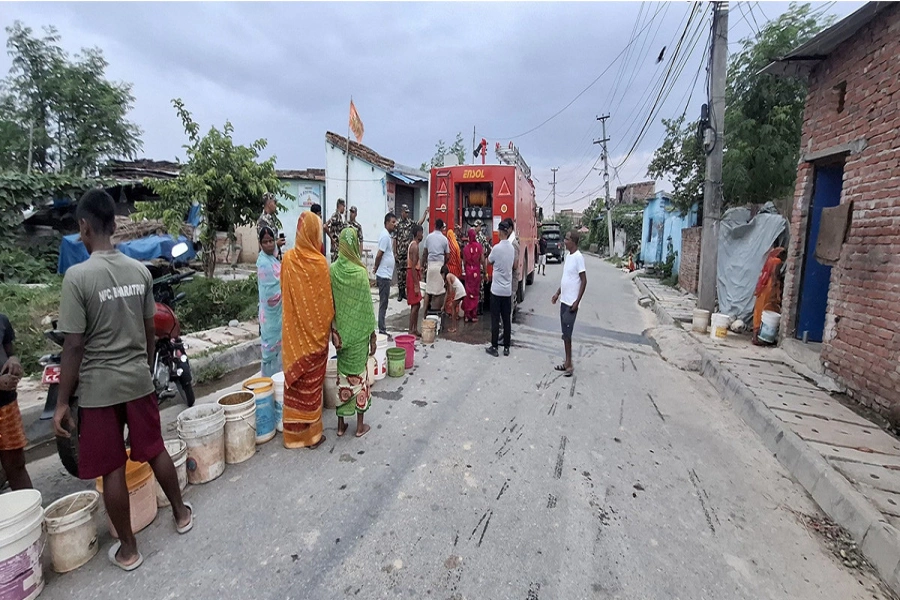
Story of Gothatar is just a tip of the iceberg. In recent years, as Kathmandu Upatyaka Khanepani Limited (KUKL) has failed to meet the increasing demand for drinking water, residents of the valley are forced to rely on water tankers. Today, over 700 tankers supply water every day in the valley and most of them use ground water, supposedly causing depletion of ground water.
Pudasaini, whose company provides technical support and equipments for digging deep bore wells, said, "As in Gothatar, people of other areas where there are water companies have also started to complain about drying up of their wells. If tanker operators continue to exploit ground water at this scale, all dug wells will dry up in future."
Related story
Declining underground water level triggers water shortage in Ta...