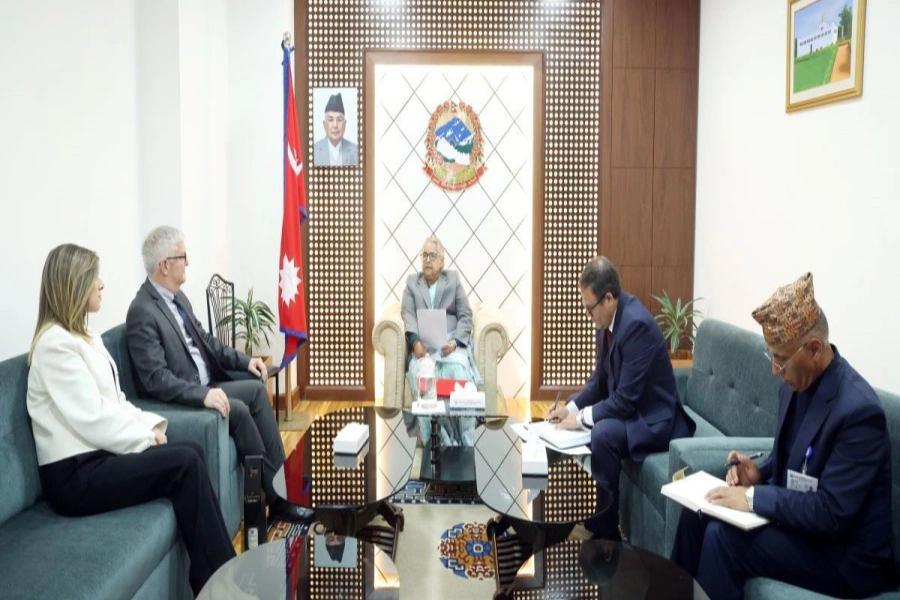
Finance Minister Barsha Man Pun disclosed the plans government while interacting with a delegation of Confederation of Nepalese Industries (CNI) on Friday. The bills that the government has tagged as crucial for making Investment Year successful are Industrial Enterprise Bill, Special Economic Zone Bill and Foreign Direct Investment Bill, among others.[break]
Likewise, it is also planning to enact Extradition Bill, Mutual Cooperation Bill and Bill to Control Organized Crime through ordinance mainly as the Financial Action Task Force (FATF), the global AML body, has warned of blacking Nepal if it did not enact those laws within its upcoming meeting, scheduled from June 18-22 in Rome.
“More than a dozen bills had already been tabled in the parliament when it was dissolved on May 28. Enactment of some of those bills are pretty crucial at this juncture. Hence, we are planning to enact them through ordinance,” said Pun.
Pun, however, clarified that the government would take a concrete decision to this connection only after holding talks with other political parties, particularly those outside the government like Nepali Congress and CPN UML.
“We will discuss the matter with all the major political actors, as we do not want to move ahead unilaterally. We will approach all the parties soon to start dialogues to this regard,” said Pun.
FM Pun said that Investment Year 2012/13 was long-announced program of the government. “The government has invested huge time and money while forming Investment Board (IB), interacting with domestic as well as international investors and donors. The stage was already set. So, it would be unwise to let go those efforts, particularly as it has reached a point of generating return for the country,” said Pun.
Under the Investment Year program, the government had announced it would bring in foreign investment of US$ 1 billion within the first six months of the fiscal year. To attain this goal, it has already handed over 14 large scale development projects to the IB to award them to foreign investors.
Likewise, IB has also been working jointly with the private sector bodies to design 50 financially viable projects to sell them to the overseas investors. The government has also been making preparations to host Nepal Investor Forum in September or October.
“Fundamentally, Investment Year is a program that was devised to bring in goods to the country by attracting foreign investment, developing infrastructure and creating jobs. Hence, we believe other parties will agree with us on enacting those bills,” said Pun.
During the interaction, acting President of CNI Hari Bhakta Sharma asked the government to lay down investment friendly environment by enacting various bills tabled in the now dissolved parliament.
He also urged the government to come up with common minimum economic program (CMEP) by brining major parties on board and formulate budget on consensus so that private sector would remain assured that facilities pledged to them will continue for longer span.
Among others, CNI delegation that met with the FM also asked the government to slash corporate tax by 5 percentage points, bringing it down to 10 percent for export-oriented industries, 15 percent for manufacturing industries and 20 percent for other industries.
They also asked the government to allow Nepalis to invest abroad. Responding to their requests, Pun said the government was opening outward investment but added the issue calls for wider consultations.
Related story
Stack of bills stalled in National Assembly