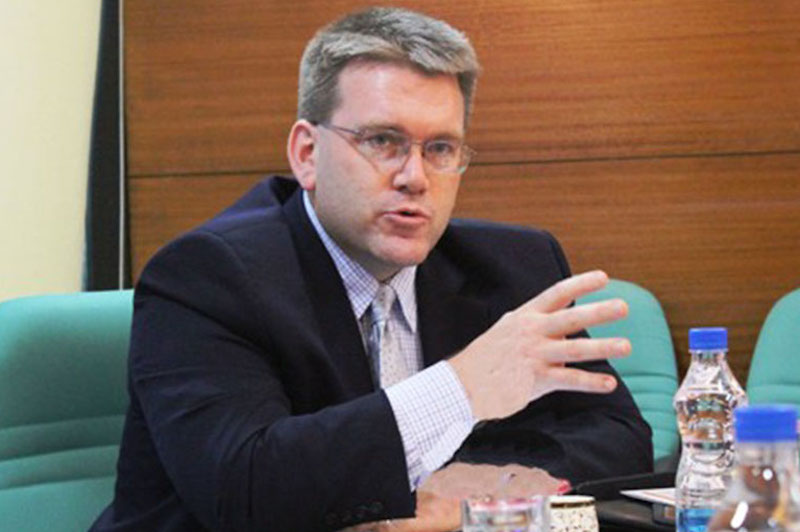
This begs the question: What made Nepal so attractive to these paedophiles? So attractive indeed that Haye, after being released on bail in June 2004, escaped and came back to Nepal where he was arrested a second time.
Here is a first answer: When they were running so-called “homes”, nobody seriously questioned their motivations, nobody monitored their behavior with the children, nobody established a gatekeeping mechanism to check the admission of children. They were considered “men of charity”, “saviors” of orphans, Bhagwan jastai manchhe. Because of a lack of systematic monitoring and a lack of knowledge about the risks of orphanages, their abuse and exploitation of children could go on for years.
Are these two men exceptions? The answer is a strong and resounding no. We’re not talking of occasional abuse but of a recurring pattern. How could paedophiles not be attracted by Nepal? This is a country that until recently was “promoting children’s homes” and planning to “increase the number of orphanages” (2005-2015 National Plan of Action for Children)? Terre des hommes has been receiving numerous complaints about potential paedophiles operating in or being associated with orphanages. One home I visited some time back was proudly displaying a big portrait of a known paedophile in their main room. When I asked who this person was, the director answered that he was a regular visitor and that he had been sponsoring the education of a boy for many years.
THINKING THE BOX
When I first landed at Tribhuvan airport four years ago, little did I know that Kathmandu Valley had one of the highest densities of orphanages in the world. Flying over the city before landing, the myriad of private houses looked like small matchboxes of different shapes, sizes and colours. This was the norm, I was told. Everybody here dreamed of building a house in Kathmandu Valley. People’s thoughts were concentrated on that goal. Call it “thinking the box”.
The analogy of boxes came back to mind a few months later, as we started investigating reports of abduction, sale and traffic in children in various contexts: We soon discovered that children were being recruited, transported, harboured and sometimes sold, not only for the purpose of sexual exploitation or labour—a well known phenomenon— but also for the purpose of institutionalization. Running an orphanage had become a lucrative activity for unscrupulous people. For some it was a cheap and effective way of building that coveted house in the valley. The process was simple: Rent a house, bring 20 children from rural districts, advertize the children on the internet, receive donations, buy land and then… build the box.
One home I visited some time back was proudly displaying a big portrait of a known paedophile in their main room. When I asked who this person was, the director answered that he was a regular visitor and that he had been sponsoring the education of a boy for many years.
In the worst case scenario, such institutions were part of a subtle and somewhat vicious form of child trafficking whereby children were used as cheap labour, forced to beg for the orphanage director, denied medical treatment, sexually abused and exploited, beaten to death or adopted internationally without the consent of their parents. In those all too frequent cases, the “boxes” housing the children were no better than a prison, a sweat shop or a brothel, albeit less conspicuously abusive.
NINETEENTH-CENTURY RESPONSE
In the last four years, I visited many orphanages across Nepal. In a large institution I saw endless lines of beds as in a dormitory. Two staff for 20 children. They were sitting quietly in their beds who looked more like cages, bouncing back and forth with their eyes fixed on their filthy mattresses. This brought the painful memories of camin spitals and other institutions in Romania where I had travelled shortly after the country opened up. Whether in Nepal or Eastern Europe, the bad smell, lack of care, and the empty glare of the children was a disgrace and a denial of humanity. This is what we, humanity would have done centuries ago to “solve the problem” of orphans. We should know better.
In the last 20 years, Westerners (usually with no experience in child care) have created hundreds of children’s homes and orphanages. Individual sponsorships have flourished. Travel agents and volunteer networks have been established to serve the market of volunteers who are willing to give (sometimes large sums of) money to “help the children of Nepal”. Posters have appeared on Thamel’s walls: “Come and live with orphans!”. Institutions have mushroomed into the hundreds with the pull factor created by inter-country adoption. We’ve created a large zoo in which children are in little boxes for visitors to watch and feed, and feel good about themselves.
But where did all the resources go? How many times do water filters need to be replaced in orphanages? Why do we continue to see orphanage directors driving around in lavish vehicles and buying real estate? Are donors checking whether land and property bought with their contributions are registered under the organization’s name or under one person’s name?
We often hear that orphanages are established with good intentions. This is of course true for some, and our friends who run transit centres and genuine facilities will recognize themselves. We admire their work. They believe in families, not orphanages.
But “good intentions” are not sufficient and intentions are not what children need. These intentions are hard to assess in most cases and far from reality for numerous institutions. What makes orphanages obsolete in Nepal, as anywhere else in the world, is that they serve some of the darkest interests of adults.
Last month we learned that an orphanage director was requesting girls to massage her pelvic area during her periods. Call this whatever you want, child abuse or inappropriate conduct, what is clear is that the children are traumatized. Who really checks the conduct of orphanage staff and directors? Who will answer for these crimes?
Geoffrey John Prigge had a very personal interest in Nepali children. The Australian judge who convicted him of sexual abuse offence while in Nepal found him guilty of five charges related to indecent touching and attempted acts of indecency involving three Nepali boys aged 13 and 14.
Jean-Jacques Haye, a 61-year-old French national, was sentenced to 10 years imprisonment by a French Criminal Court, charged with rape and sexual abuse of Nepali children. The abuses were committed between 1985 and 2001 inside the home known as “Children of Chauni”. Six young men, at the time small children, went to France to testify against the abuse.
Terre des hommes and UNICEF conducted a study (“Adopting the Rights of the Child: A Study on Intercountry Adoption and its Influence on Child Protection in Nepal”) in 2008. We came across cases of child abuse and potential sexual exploitation in child care centers. Interviews with children revealed a high prevalence of child abuse. Although children and centre staff are likely to underreport instances of abuse, 7 percent of children interviewed reported physical abuse and 15 percent reporting scolding and verbal abuse.
Interviews with centre staff revealed that practices such as “hitting”, “isolating” and “locking children inside the toilet” were taking place. During the study, researchers were told about a case of sexual abuse that had allegedly taken place in a child centre in the Kathmandu Valley. According to a child centre staff, foreigners had offered to take the children on an excursion. Later the staff learned from the children that the “foreigners had sexually abused them and even videotaped them performing sexual acts.”
A child in a centre in the Kathmandu Valley reported the following: “The caretakers hit me and all the other children often. The worst is when they hit the disabled boy; they hit him the most. They also shout at us for no reason. They make all of us work. We have to wash our clothes and we have to work in the kitchen, washing the dishes, cutting vegetables and sweeping the floor. The helpers just watch us when we work. They don’t take good care of us even when we are sick. For lunch, we get either biscuits or Wai Wai noodles, which are not enough for us, so we stay hungry. When foreigners visit the centre, the caretakers treat them very nicely but keep the presents, like shampoo, cream, etc, that the foreigners bring for us.”
The news came as an earthquake in the world of child care: Naxal’s Bal Mandir, the oldest orphanage in Nepal, was taken over by an Australian NGO. Following months of negotiations between Nepal Children’s Organization and Mitrataa Foundation, it was announced that the management of the largest institution in the country, currently hosting 250 children, was shifted to foreign management, from May 1 and for a five-year term. Volunteers found the children in desperate condition, some of them suffering from acute malnutrition. The children had not been enrolled in schools due to lack of funds. This didn’t come as a surprise to those who knew about the old Bal Mandir.
A change of guard at Bal Mandir raises a set of questions: Are all these children orphans? Did they really need to be institutionalized in the first place? Can the prospect of a “good education” wash away the trauma of family separation? Are there ways to keep children in their own families and can we find alternatives in communities? Why does Nepal maintain large institutions while the rest of the world is closing them down?
Burned alive
In the last few days, several untoward events reminded us of the gravity of the situation. At the beginning of June, an eye witness reported that in an orphanage in Kathmandu, the main caretaker was using torture to “discipline” the children. She was seen holding a candle over a 10-month girl and pouring wax on her as a punishment for wetting her pants. This was not an isolated incident.
The situation was even worse (I should say nightmarish) in another institution. According to a Central Child Welfare Board official who visited the home, the orphanage was “far below standards”. The institution was closed down on March 20 and all the children rescued. Picture this: 21 children were crammed together in one bedroom with no separation between boys and girls. They were not being fed regularly, were living in squalid conditions and their profiles were falsified. Worse is yet to come: The director was routinely beating children with a metal stick. One child had died six months ago and another one mysteriously disappeared. As a punishment, one child she was beaten with a metal rod and nettles and kept in isolation (on the terrace upstairs) for two weeks. The director did not give the child any food, but the other children managed to bring her food and water secretly. The child was taken to the hospital by a visitor and died on the same day. Her name was Sangita. The surviving children are still having nightmares about the horror they witnessed in this home and are seriously traumatized. They have nightmares that the orphanage director will take them to Pashupati and burn them alive. They say that this is what happened to one child some years back because the home could not afford medical treatment.
Similarly, a 12-year-old child died mysteriously in Jorpati in a child care home. Although she was admitted as an orphan, it was found that both her father and mother were alive. She had been institutionalized five years ago through a fake village development committee recommendation letter from Ramechhap District stating that she had no father. The orphanage was running illegally. In another large orphanage, a young man entered the premises at night and molested adolescent girls who were hearing and speech impaired. They were able to alert orphanage staff by making loud sounds such as banging on their beds
All these cases are symptomatic of a larger problem. We estimate that at least 4,000 children live in substandard institutions across Nepal. In terms of numbers and seriousness of child rights violations, we are in fact facing a major child protection crisis. In 2008, Tdh estimated the number of children in residential care to reach 15,000 throughout the country. There were at least 440 private institutions, many of whom were being run by businessmen as a side activity. According to CCWB, this figure has not changed and it is still the official one. To get a true picture of institutional care, however, one should add illegal institutions, boarding schools, faith-based institutions, as well as “correction homes”. The rate of institutionalization in Kathmandu is higher than that of Cambodia (193 per 100,000 children aged 0-17) or even China (27). A large number of unregulated orphanages are a recipe for disaster for children but also for society at large.
We’re sorry for the tragedy of childhoods lost
“We come together today to offer our nation´s apology, to say that we are sorry. Sorry that as children you were taken from your families and placed in institutions where so often you were abused. Sorry for the physical suffering, the emotional starvation, and the cold absence of love, of tenderness, of care. Sorry for the tragedy, the absolute tragedy, of childhoods lost” These words of contrition were those of the Australian Prime Minister in 2009. Mr Rudd offered the nation’s apology to the hundreds of thousands of children who were separated from their families and institutionalized in Australia. Many children were placed in religious institutions, where they were abused or neglected. The homes attracted paedophiles: Many children said they were sexually abused. Others have described miserable, lonely lives, during which birthdays and festivals went unmarked, and they never received any affection.
We trust that one day the suffering of children in institutions will be recognized in Nepal as well. We, child rights advocates, are sorry for the tragedy of childhoods lost. We look up to countries like Australia, and many others, which have completely reversed the situation in a few decades, to help us. Australia has closed all its orphanages. There are no “orphans” in the country – only children placed in foster care and then adopted domestically.
We have hope. Less than a year ago, there was almost no recognition of the risks inherent to institutionalization of children in Nepal. The 2005-2015 National Plan of Action for Children was openly “promoting children’s homes” and recommending an “increase in the number of orphanages”.
Today the situation has changed. Institutions are no longer immune because they would be protected by the Queen Mother or some politicians. The Mala project has put in place 41 verified foster families in the four Mid-Western districts and have placed 27 children in their care. There will be many more foster family placements in the years to come, in many more districts.
From time immemorial the preferred way to care for and protect orphans was to send them to the extended family. Kinship care remains one of the primary responses – it needs to be strengthened and made safe. The challenge is to ensure that this is in the child’s best interest and that child labour is eliminated from this form of care.
Where consciousness goes, energy and resources will follow. As this is a complex and resource-intensive process, de-institutionalization will help bring more resources into the country. It doesn’t mean simply emptying boxes: It will require a conscious effort to develop modern and effective child care services.
It is probably as easy to carry out de-institutionalization as it is to pronounce the 22-letter word. All those engaged in the process will know that it is an arduous and time-consuming endeavour. But the concept is straight forward. It basically means opening the boxes. It means support to other forms of care and the establishment of a gatekeeping mechanism. It means investing in competent and compassionate staff who will leave no stone unturned to return the children to their families or provide family-based alternative care.
A few individuals and organizations have taken a head start: Tdh, Hope for Himalayan Kids, Next Generation Nepal, The Himalayan Innovative Society and Umbrella Foundation. We are greatly encouraged by the inclusion of de-institutionalization as a topic of discussion with the government, particularly the Central Child Welfare Board and the Ministry of Women, Children and Social Welfare. The National Plan of Action has been corrected. Several organizations have approached Tdh with requests for assistance and an informal working group has been set up. We have created a list of organizations that promote family preservation, family-based alternative care and de-institutionalization– if you feel you should be on this list, contact nawjeet@tdhnepal.org.
One new resource might come in handy: Tdh teamed up with Hope for Himalayan Kids and in particular Deborah McArthur, to produce a practical manual on how to reduce the number of children in institutions and promote family-based care. It’s called 10 Steps Forward to Deinstitutionalization. The book can be obtained (free of charge) by writing to info@tdhnepal.org.
A Humli proverb sums it all: “It is better to sit beside the river than to be a bird of cage.” We hope for less and less “cages” and a lot more little birds flying around – and above all, little birds learning how to fly with their families.
Writer is the Country Director of Terre des hommes,* the largest Swiss children’s aid organization operating outside Switzerland
joseph.aguettant@tdh.ch
* Corrected.
Related story
Worth of stories