


Saturday, 27 July 2024 09:54 AM

OR
Login using
Even 744 are too many. Around 300 local units are viable in the long run
Published On: April 6, 2017 12:30 AM NPT By: Mahabir Paudyal | @mahabirpaudyal
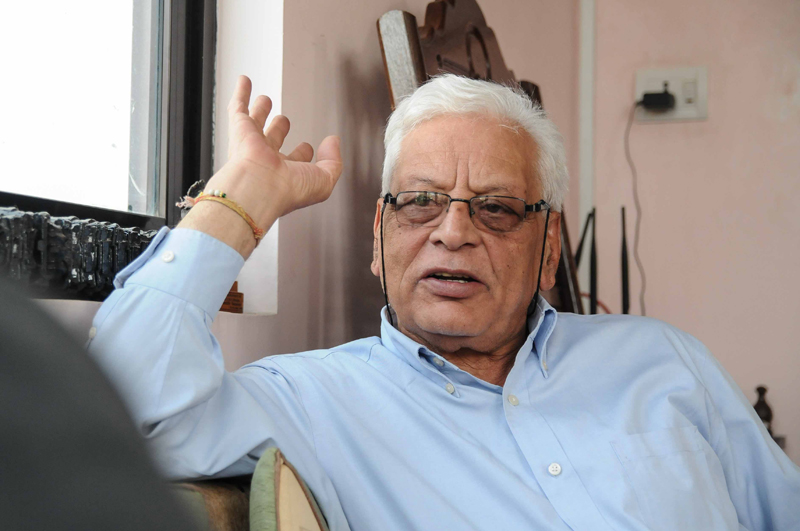
Shyam Krishna Bhurtel served as a member of Local Level Restructuring Commission and has worked as an expert in Nepal’s recent efforts in decentralization. He was also involved in preparing the Local Self Governance Act (1999). Mahabir Paudyal caught up with veteran local government expert to discuss the prospects and challenges of local governance after the May 14 local election.
How will local governments formed after May 14 election be different to local governments of the past?
The new constitution has conferred extensive roles, powers and responsibilities on local units. It has clearly defined powers of federal, provincial and local governments. Services to be provided to people at their doorsteps have been assigned to local governments. All three levels of governments will have their own legislative, executive and judiciary. Earlier, development works and service delivery of local bodies would be executed through National Planning Commission and concerned ministries and budget would be allocated accordingly. This won’t happen now. All the development and service delivery related functions earlier carried out by District Development Committee (DDC) will shift to nagarpalika (municipality) and gaun palika (rural municipality).
Earlier, development projects would be allocated based on budget estimation of the government and the DDC. Local bodies would demand budget for a local project after completing 14 steps of planning. But now on, local governments will themselves make plans, frame laws on health, education facilities, infrastructure development; they will also present their budget estimates and negotiate with the federal government. Since local government provides around 60 percent of all services to the people, the federal government will have to allocate enough resources.
Local government under old structure would be liable to carry out works as per the center’s instructions and resources. The local government under the new set up does not have that liberty. It must formulate plans on its own, frame laws on its own, identify resources on its own and only then can it negotiate with the federal government. Earlier local government would work only if the government provided them budget. It won’t have that liberty from now on. Thus while the powers of the local government have been greatly increased, so have its responsibilities. There are vast differences in the structure, organization, powers and responsibilities of local governments prior to and after May 14 election.
But shouldn’t local governments be able to generate their own resources? Is it healthy for them to rely so heavily on the center?
Most local governments we will have after May 14 won’t be able to take up financial burdens on their own, even though they will be responsible for generating resources for local development and governance activities. Nor will it be compulsory for them to manage on their own. Local governance will primary be the liability of the state. Federal and provincial governments will be responsible for managing budgets and grants for local governments. And this won’t be Nepal-specific. In many countries, including in the US and Europe, local governments are not self-sustaining. They are supported by the federal government.
The constitution has listed 22 specific powers for local governments. How will they be able to cope with this additional responsibility?
Yes, local government has been given huge responsibilities. Mark it, each local government will be autonomous. So in a way we will have 744 mini Nepals within Nepal, each with its own legislative, executive and judicial bodies. Some powers of the local government overlap with provincial and federal governments.
Let us, for example, take what a local government can do in education. Federal government sets curriculum and determines quality of examination. But local government can decide which medium (English, Maithili, Bhojpuri, Tamang or Nepali) to teach in. Or it can devise additional curriculum of language, technical and computer education. In that sense, local government will have role in devising school curriculum. Federal government is liable to provide free and compulsory education to its citizens but local government determines the content of education. Local government decides if some schools are to be merged or added and how to manage human resources for those schools. It can decide what kind of special education to provide to marginalized and derived communities. The same rule applies in health and other services.
Local government will ensure inclusion and proportional representation as well. It may be difficult for the federal government to ensure representation of all ethnic and deprived communities at the federal level. But local government can do so with ease. For example, Majhis may not be able to get their voices heard by the federal government but they can do so through the local governments, for they have easy access to those governments. Thus if we can have local government as envisaged by the constitution, and if we can make them truly functional, we can set an example for the rest of the world. Nowhere in the world will there be more powerful local government. It will open a flood of opportunities for development and governance at local level.
One of the disputed issues today is whether to increase the number of local units from the current 744. What is your view?
I would say even 744 local units are too many. We need to decrease this number as we mature with this system. We won’t be able to sustain more than 300 local units. Fewer and larger local units will be more beneficial to local people than many smaller units. Local governments will have to build development infrastructure such as small hydropower, for example. It will be easy to do so if they have sizable demography and geography. Inter-local level coordination will be vital for such works. For example, if Kathmandu is to develop metro rail system, it will have to establish coordination with local units in places as far as Dhulikhel, Panauti and Nuwakot. As development works gain momentum, their areas of coverage also expand and, finally, many local level units will merge. If public transport system of a local unit expands, it connects other areas as well and with it access and proximity among local units will also increase. This is why I say we can have as few as 300 local units.
If so why are Madheshi forces asking for more local units in Madhesh?
Madheshi forces want local units to be controlled by provincial governments. There are such provisions in other countries. But the kind of set up Madheshi forces are demanding is similar to that of India, where local level units have been given no or nominal powers. In some Indian states, they have not been able to hold local elections for more than a decade.
The debate of whether local units should be put under provinces or federal government has to do with whether to continue with feudal set up whereby few political elites of provinces concentrate all powers in their hands, or whether to truly empower the local people. Madheshi forces seem to be guided by the former idea. If you increase the number of local units, they will get smaller in size. And it will be easier for local elites to control smaller units. They seem to fear that stronger and more efficient leadership capable of challenging or even replacing provincial leadership can emerge from local level. This is wrong thinking. Otherwise, why is there such a hue and cry in certain districts of Madhesh while the rest of the country is comfortable with 744 units?
Leaders that will be chosen in villages and municipalities this time will be far more powerful than those we used to have under the old set up. A mayor or village chief serves three powerful functions. He will be like prime minister of his village/municipality and speaker of village/municipal assembly. Deputy mayor and deputy village chief will serve as head of local judiciary as well. They will also have the right to elect president and members of National Assembly. But Madheshi forces are talking about disenfranchising mayor, deputy mayor, village chief and deputy chief from these powers.
Madheshi forces say that the global practice is to keep local units under provinces and not under the central government. What is the practice elsewhere?
I think they are being selective. Madheshi forces seem to be talking about traditionalist federal system whereby local governments are under provinces. There are such systems in the US, Canada and Australia. But in recent times even Canada and Australia are debating whether such provisions should be changed.
It is not true that local governments are under federal government in every federal country. They are not in Brazil, South Africa and Germany. If you keep local governments under provinces, there is a chance of provinces capturing vital resources, much like DDCs used to do, giving little to local governments. This is what many states in India practice. But this is wrong. Only when local governments become resourceful and functional can the provincial and federal government also become strong.
Political parties are finalizing candidates for village chiefs and mayors. What is your recommendation?
They should choose their candidates wisely. The candidates for local election should be able to manage local affairs, to effectively govern, to coordinate with other local governments, to devise development plans and effectively negotiate with the federal government for budget. If they choose candidates with old local bodies in mind, they might field wrong candidates. They need to field young and energetic candidates with vision. Political parties need to train their prospective candidates on responsibilities they have to carry out once they are elected. Some political leaders come to ask me if they are the right candidates. I tell them of the responsibilities, as listed in the constitution. Then they confide to me they might not be able to work as per the constitution. Many aspirants still seem unaware of what they will have to do if elected as mayor or village chief. They need to be better educated.
How can local governments contribute to better governance and development?
One good thing about local government is that it will be stable. Once elected, it will work for five years. Even if government at the center changes every nine months, it will have little impact on governance if the local government keeps functioning. Even if things go wrong at the center and at the province, local government will be able to continue to work on good governance and development. But there are risks as well. For example, a local government head may misappropriate funds or politicize development and service delivery. We cannot suspend him, nor remove him through no-confidence motion, as happens in federal parliament. Even an irresponsible government head will remain in power for five years. There should be a strong interventionist mechanism for such cases. One bad mayor or village chief can render the whole local government system dysfunctional. This is why parties must choose the right candidates.
Do you find our political parties committed to make local government work?
Honestly, political parities seem to be working to put future elected local bodies in crisis. First sign of this is the current effort to increase the number of local units. When you have too many units, they won’t be sustainable and you get the excuse to dissolve them. Second, they are talking about curtailing their powers by keeping them under provincial governments. Third, there is a conspiracy to bar local leaders from electing members of National Assembly and President. This is against the spirit of the constitution. If you prevent locally elected leaders from becoming members of electoral college that elects the President and National Assembly, they will remain detached from the center. Current provision makes even the president and upper house accountable to local units. They are trying to remove this provision. But if you remove this provision, it will be easy for the federal parliament to curtail powers of local bodies through constitution amendment. I see a kind of conspiracy to sabotage local level units even before we have elected them. This is a plot to weaken local democracy and reestablish control of few political elites over local units. Everyone should speak against this.
You May Like This

One year since local elections, local units still struggling with manpower crunch
RUPANDEHI, Aug 4: One year after the election of local representatives, most of the local units in rural areas are still... Read More...
Local polls in newly created local units in 7 days: EC Yadav
BIRATNAGAR, May 23: Chief Election Commissioner Ayodhee Prasad Yadav has said that the arrangement will be made to hold local... Read More...
Commisison warns against too many local units
KATHMANDU, Sept 12: The commission formed to fix the number and boundaries of the local bodies has said that increasing the... Read More...
NRB unveils monetary policy
20 hours ago

NRB set to issue monetary policy today
22 hours ago

Girl found unconscious at Gwarko guest house dies
23 hours ago
Heavy rainfall likely in Bagmati and Sudurpaschim provinces
22 minutes ago
Bangladesh protest leaders taken from hospital by police
24 minutes ago
Challenges Confronting the New Coalition
59 minutes ago
NEB to publish Grade 12 results next week
12 hours ago
Just In
- Heavy rainfall likely in Bagmati and Sudurpaschim provinces
- Bangladesh protest leaders taken from hospital by police
- Challenges Confronting the New Coalition
- NRB introduces cautiously flexible measures to address ongoing slowdown in various economic sectors
- Forced Covid-19 cremations: is it too late for redemption?
- NRB to provide collateral-free loans to foreign employment seekers
- NEB to publish Grade 12 results next week
- Body handover begins; Relatives remain dissatisfied with insurance, compensation amount
Leave A Comment