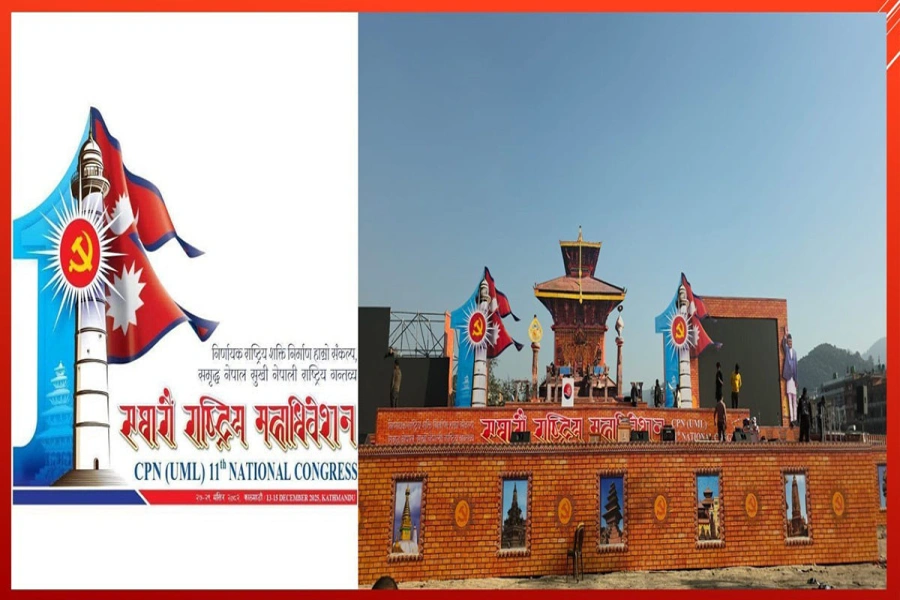
The 11th General Convention of the CPN-UML began in Bhaktapur on Saturday as a major political event, drawing tens of thousands of party leaders and cadres from across the country. The convention is expected to elect a new leadership at a time when pressure has been mounting within the party for the top leadership to make way for a younger generation. In the wake of the recent Gen Z–led movement, which increasingly targeted traditional mainstream parties, established political forces have struggled to make their presence and activities visible. Among the parties that were targeted and suffered significant damage during the unrest, the UML has been the first major force to regroup and reassert itself. By convening its general convention without delay, the UML has projected resilience and organisational vitality at a time of political uncertainty. Notably, the UML itself was one of the central targets of the movement carried out in the name of Gen Z. The government displaced in the aftermath of the upheaval was led by UML chairperson KP Oli, with the Nepali Congress (NC)—the largest party in Parliament—also part of that coalition.
PM Deuba’s defining moment

Yet while the UML moved swiftly to organise its convention, the NC, despite being due for its own regular general convention, remained indecisive for a prolonged period. The UML’s proactive engagement as a living political organisation is worthy of reflection by other parties. Constitutionally, the party was not compelled to hold its general convention at this time. However, considering the post–Gen Z movement context and the questions raised about mainstream politics, the party opted for an early convention. This decision also came amid sustained pressure on Chairperson Oli from within party ranks to step aside. Looking at recent developments, the prospect of a leadership change within the UML appears limited. Nevertheless, given that opposition to Oli is stronger outside the party than within, any leadership transition could carry symbolic importance for the party’s public image. Whether the UML chooses renewal or continuity is a matter that ultimately concerns its leaders and cadres most. Still, the convention has generated wider national interest, reflecting the party’s continued relevance in Nepali politics.
At present, Nepal’s older mainstream parties—particularly the NC and the UML—are frequently portrayed as the “villains” of contemporary politics. As social media–driven narratives increasingly shape public opinion, often at the expense of critical reading and historical understanding, it is important not to disregard the role these parties played in guiding the country from feudal stagnation towards a modern political order. The irony is that a generation vocal in its dissent appears largely disconnected from history. Against this backdrop, UML leaders face a dual responsibility: selecting capable leadership for the party while also ensuring that the broader political system does not slide towards anarchic authoritarianism. Convention representatives who have travelled from across the country to exercise their franchise must reflect carefully on the kind of leadership capable of responding to the aspirations and anxieties of the Gen Z generation. With a leadership contest between KP Oli and Senior Vice-Chairman Ishwar Pokharel now set, delegates must vote judiciously—not only to revitalise the party but also to help steer Nepal’s increasingly uncertain political course in a more stable and democratic direction.