After failing to manage intra-party disputes over policy on state restructuring, the UML leaders chose to convene a two-day national conclave earlier this month and subsequently held a central committee meeting, with the objective of forging consensus among CC members on what is arguably the most debated issue before the country.[break]
But the outcome was just the opposite. At least five divergent views emerged at the conclusion of the CC meeting and these were officially registered at the party secretariat.
Divergence developed over the seven-province model that was endorsed by the CC meeting. The model proposing delineation of provinces on the basis of multiple ethnic identity and with mixed names was prepared by the standing committee and subsequently tabled for endorsement at a meeting of the all-powerful CC.
Though endorsement of the proposal was announced at the CC meeting on June 19 at 10 p.m. when many CC members had already left, thinking the discussions would continue until the next day, it was opposed by a significant number right there and then.
Some members recorded their differing views by voice while some others officially registered notes of dissent.
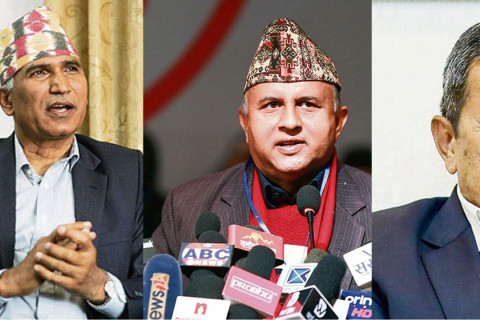
A group of influential leaders within the party, including Bhim Rawal, Raghuji Pant, Beduram Bhusal, Mahendra Pandey and Guru Baral, strongly opposed the standing committee´s proposal, saying the nomenclature of proposed provinces was not just faulty but objectionable. They fiercely opposed the idea of naming provinces after the identities of some specific ethnic communities.
They demanded that the provinces be given neutral names such as Bagmati, Janakpur and Gautam Buddha. The group also suggested going for a referendum to decide grave issues such as the naming of provinces, if need be.
Another group of CC members also, including Surendra Pandey, Gokarna Bista, Arun Nepal and Bisham Lal Danuwar among others, recorded notes of dissent against the seven-province model.
They objected to the proposal, saying the model could neither address the concerns of dissident leaders from Madhesi, ethnic and indigenous communities nor win the confidence of those who are lobbying for neutral names. They are for provinces with mixed names-- one ethnic identity name and one neutral name, such as Bagmati-Newa.
Pandey termed the leaders´ proposal impractical. "As per this model there will be at least three official languages in a province," Pandey said. "It will be problematic in practice because citizens in the province concerned will need to learn at least three languages." Such an impractical proposal might lead to the failure of the federal setup, he opined.
Yet another group, including Pushpa Kandel and Karna Thapa, registered notes of dissent demanding that the party revisit its stance on going for federalism in the first place.
Though only Kandel had officially registered his view against federalism at the party´s general convention in 2009, the number of members lobbying against federalism is on the increase in the UML.
"It is true the number of CC members standing against federalism at all has increased significantly in our party in recent days," said Rajan Bhattarai, a youth leader in the party. "They have started to argue that the notion of transforming the country into a federal model has itself proved a failure."
Similarly, another group led by party Vice-chairman Ashok Rai has launched a strong protest against the party leadership for not being ready to delineate and name the provinces on the basis of single-ethnic identity.
However, party leaders claimed that registering of notes of dissent by various groups would not create any problem in implementing the party´s official position. Party Secretary Shankar Pokharel said it is usual practice in the UML for members to register differing views.
"The members who have recorded dissent views have not challenged the party´s formal stance and have wholeheartedly announced adherence to the official line," said Pokharel. According to him, the party´s latest decision has also calmed the anger of dissidents among ethnic and Madhesi leaders. "They have publicly said that the party´s latest decision is a progressive one even though they are not fully satisfied," he said.
Bhattarai, the youth leader, said the party leadership had set out its official position as a compromise between two extreme views -- of those lobbying to form provinces solely in terms of ethnic identity and those arguing that ethnic identity shouldn´t be a basis at all. "Coming up with a proposal satisfying each and every member is just wishful thinking," he said.
Related story
Reject or not to reject: CPN-UML in a Hamletian dilemma over fe...