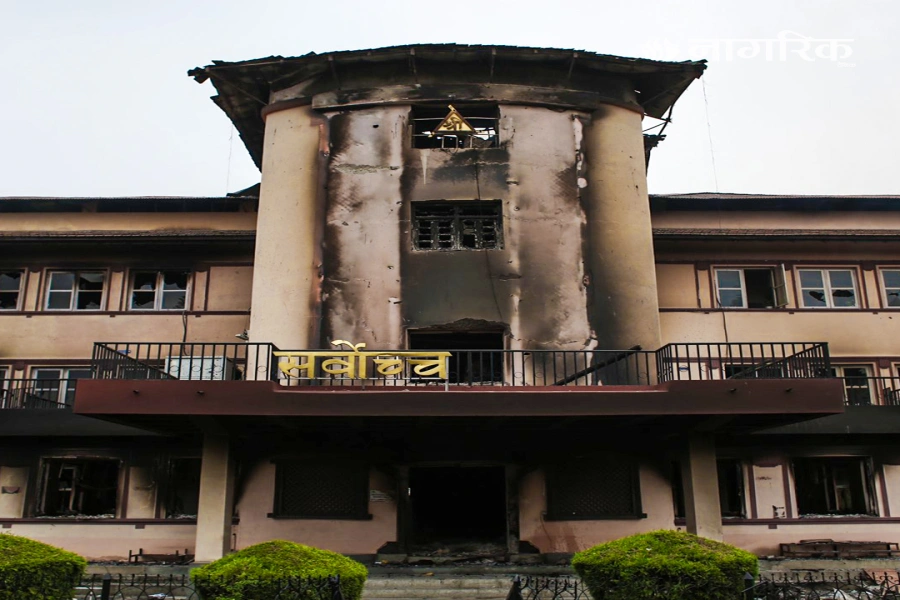
The devastating earthquakes last year killed about 9,000 people and completely destroyed over 650,000 houses, and thousands more have been partially damaged. Thousands of displaced people are taking shelters under makeshift tents, battling a series of troubles: heavy rains, snowfall, landslides, road blockage, and the economic blockade. The temporary shelters built from materials provided by I/NGOs are thinning out. This after a year when we should be preparing for first annual commemoration of those who lost their lives in the deadly earthquakes.National Reconstruction Authority (NRA) announced cash incentive of Rs 200,000 to each affected family in order to rebuild their destroyed homes. It was to start from Dolakha district and the grant was to be distributed in three installments. But the initiative could not take off. What kind of houses are the victims supposed to build with Rs 200,000?
The price of building materials has soared after the economic blockade. Even so, there is shortage of those materials. Elderly citizens, people with disabilities, single women, and people living below poverty line are not in position to build houses on their own. Transporting building materials up to the hills is as challenging.
Reconstruction is progressing at snail's pace, while we are running out of time. Monsoon looms for earthquake victims. The world is waiting to see Nepal making progress in reconstruction. They hope to see earthquake victims get quake-resistant shelters. In this situation, Nepal can learn from experiences of Sri Lanka, Indonesia, Pakistan and the Philippines.
Thousands of lives and assets were lost in these countries by tsunami, flood and hurricanes. But they could rebuild most shelters within a year and ensure timely rehabilitation, livelihood, and food security to victims, apart from raising massive awareness on disaster mitigation.
Donor communities and I/NGOs are also willing to support Nepal in rebuilding. But Nepal has failed to properly utilize available financial resources for reconstruction.
The countries discussed above were successful as there was no political interference in emergency and reconstruction processes. Governments of Sri Lanka and Indonesia bound I/NGOs and donors with strict rules, but also allowed them to rebuild through fast track approach tsunami disaster zones within a specific timeframe. These countries did not hesitate to provide visas to donor representatives or foreigners who wanted to support in the difficult times.
Local governments worked in closely with all stakeholders, donors and I/NGOs including UN agencies. UNOCHA had a crucial role in managing three Ws (Who? Where? What?), which worked perfectly and duplication was avoided. It also helped with transparency and accountability. Cluster leads such as Shelter, Livelihood, WASH and Protection were active at both district and national levels. Cluster coordination helped to accelerate reconstruction.
Nepal should have declared extreme emergency for three to six months, like those countries. Then we should have started reconstruction of permanent shelters without delay. The countries discussed above announced emergency to support affected communities with basic humanitarian needs such as food and medical facilities. But they also completed damage assessment to strategically take ahead reconstruction. District authorities had been given powers to launch reconstruction in coordination with I/NGOs and private companies.
With support of experienced I/NGOs, district governments developed effective project monitoring tools, evaluation systems and grants/financial compliance whereas central government focused on resettlement, time-line and resource mobilization. These governments welcomed all humanitarian and development agencies willing to support reconstruction, within one to three years under special provision to work in the disaster zone. The agencies were sent back with hearty thanks when their jobs were completed. These countries followed one door policy for reconstruction. Unfortunately, this is not the case in Nepal.
These countries could get good funds for reconstruction because they had assured donors that funds would go to victims and would be spent on rebuilding. Since there are serious emergencies around the world, the funds may be diverted to other places if reconstruction is further delayed.
In these countries the cost of building a permanent shelter was around Rs 600,000. I/NGOs and private sector covered up the cost. Governments filled in the gaps, where necessary. Victims in Nepal are confused whether they can construct permanent shelters with Rs 200,000.
If our government had properly studied resources of I/NGOs and private sector and given them permission to work on fast track on reconstruction, Nepali quake victims would not be languishing in makeshift tents today. It would reduce government's reconstruction burden as well.
The author is an aid worker associated with post-quake reconstruction in Nepal
Related story
Kathmandu Road Division Office starts blacktopping road demolis...


-1767250672.webp)