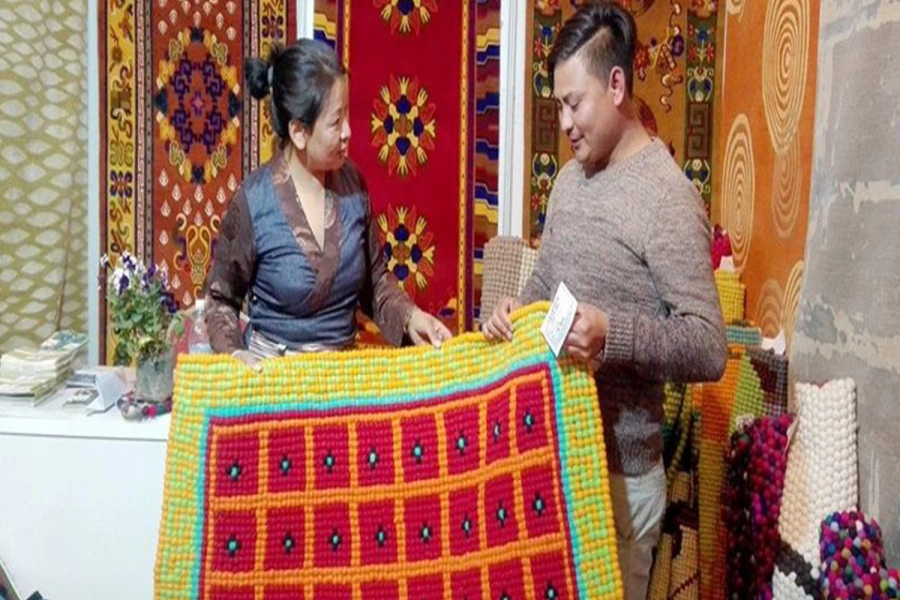
KATHMANDU, Jan 25: The carpet industry, one of the few goods produced domestically for export, is emerging as a bright spot in Nepal’s import-dependent economy. The U.S. market accounts for the largest share of exports. According to the Customs Department, carpet exports reached Rs 5.69 billion in the first six months of the current fiscal year, with Rs 3.11 billion going to the U.S., indicating strong demand for Nepali carpets there.
Business owners say handcrafted, high-quality, and eco-friendly carpets have boosted Nepal’s popularity in the U.S. Alongside the U.S., Nepali carpets are exported to over 50 countries, including Australia, Austria, Belgium, Brazil, Canada, China, France, Germany, Italy, Japan, Korea, the Netherlands, Norway, Qatar, Russia, Taiwan, Turkey, the U.K., and Dubai. Production centers include Kathmandu, Sarlahi, Makwanpur, Dhading, and Sindhupalchok districts, employing around 200,000 people, with significant participation of women.
Carpets worth Rs 4 billion exported in four months of current F...

Although once Nepal’s top export item, the carpet industry had declined in recent years but is now recovering. Exports rose from Rs 6.15 billion in FY 2076/77 to Rs 12.25 billion in FY 2079/80 and around Rs 13 billion in FY 2080/81. With government support, production could grow further. Currently, carpets use wool from Himalayan sheep, allo, sisnu, and synthetic yarn, though raw materials still need to be imported from China, New Zealand, and India.
Challenges include labor shortages, lack of modern technology, and weak market promotion, limiting production. While about 200 carpet factories are registered with the federation, around 800 operate across the country. Hand-weaving remains time-intensive but adds value and employment.
Carpets rank second among Nepal’s export items. Unlike soybean oil, which adds limited value, carpets contribute up to 80% value addition. Online design orders and direct exports are increasing, but market diversification is crucial. The industry also generates alternative rural employment and could boost incomes if raw material production expands in high-altitude regions.
Though a 5% export subsidy exists, delayed payments and weak policy implementation have affected private sector enthusiasm. With skilled labor, raw material self-reliance, effective government-private collaboration, and market promotion, the carpet industry could become a major driver of Nepal’s sustainable economic growth. Its handcrafted, eco-friendly carpets have already earned a global reputation for quality and originality.