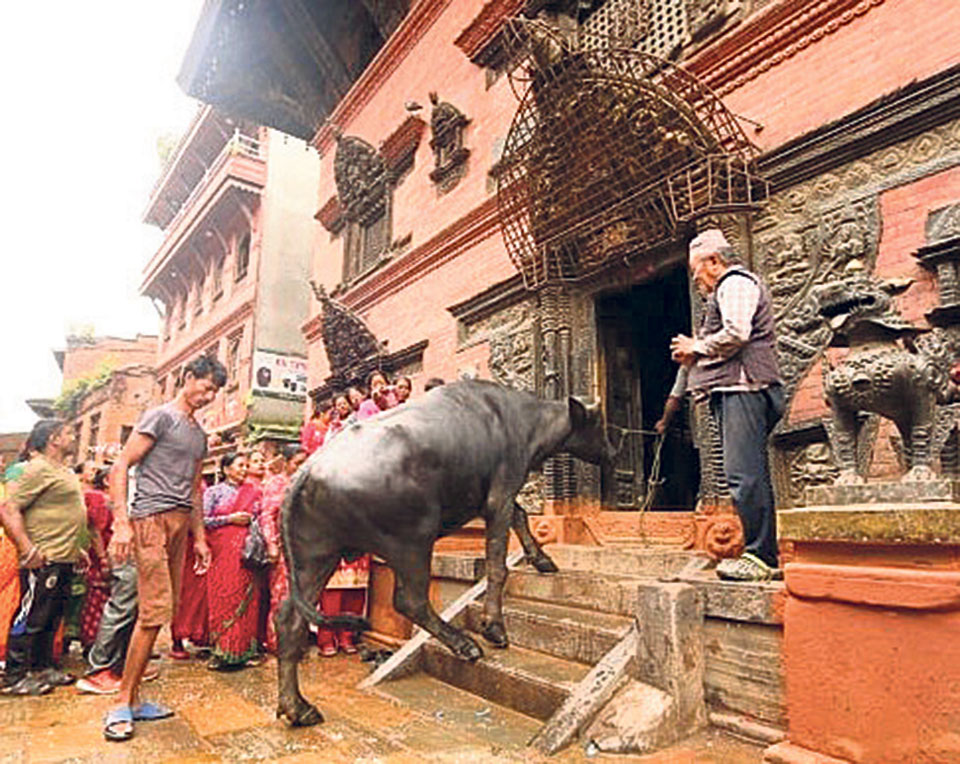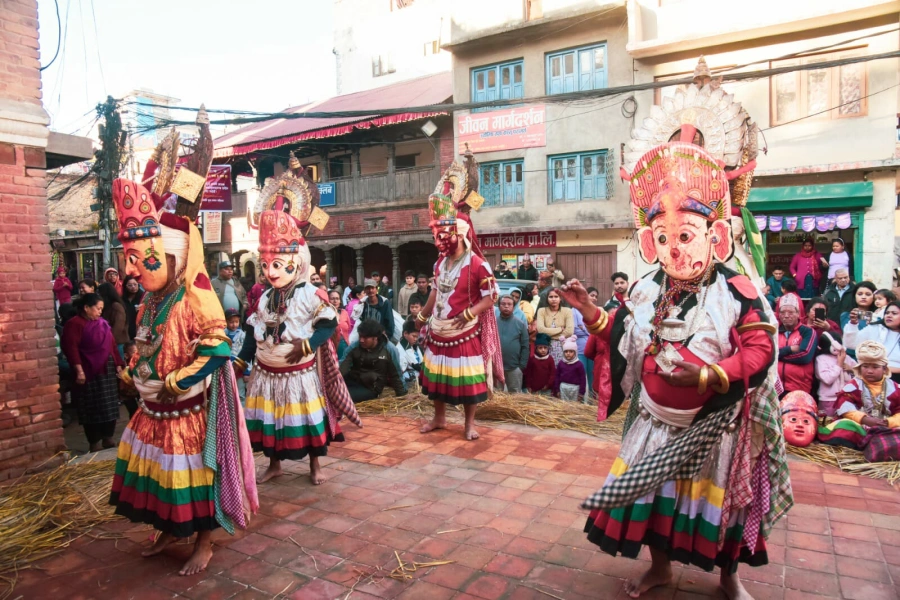
KATHMANDU, Nov 30: The centuries-old Navadurga (Nyalakegu) festival commenced this week at Jayabageshwari in the Pashupati area, marking the first major performance following Bala Chaturdashi.
Traditionally, the festival’s inaugural dance is performed at the Jayabageshwari courtyard on the ninth and tenth days after Bala Chaturdashi, before the troupe travels to various locations throughout the season.
Widely known as the Navadurga Jatra, the ritual is a preservation of Bhaktapur’s ancient civilization and is regarded as one of Nepal’s longest continuous festivals.
Jayabageshwari Ward-8 Chair and Metropolitan Heritage and Tourism Committee Coordinator Ashaman Sangat said the long-standing tradition of bringing festival processions from Bhaktapur and Lalitpur to Kathmandu represents a powerful example of “cultural harmony and mutual goodwill.” He added that while the ward provides financial assistance for the jatra every year, it is not enough on its own, and contributions from devotees and support from Jayabageshwari Youth Club help sustain the event.
According to Sangat, the Navadurga festival is conducted regularly for eleven consecutive years, while the twelfth year features the Harisiddhi Naach brought from Lalitpur in place of the Navadurga rituals.
This year, the Navadurga deity troupe from Bhaktapur arrived in Jayabageshwari and met the Pashupati-area deity groups as part of the formal ritual sequence. At Jayabageshwari, the main temple priest offered worship to Navadurga and made offerings of water and prasad to Bhairav.
The festival’s customary performances include dances at Pashupati’s main courtyard, a ritual visit to Guhyeshwari, the mu baa lakegu jatra at the southern Shiva Mandir square, and the formal puja conducted with support from the Pashupati Area Development Trust. These rituals concluded yesterday.
With these rites completed, Jayabageshwari also hosted the season’s first kha juyegu (ritual overnight stay) ceremony.
Bramhayeni Jatra kicks off with thousands flocking the Bramhaye...
Today’s performances will feature the dances of Barahi, Mahakali and others, with the “fish-hunting dance” of Shweta Bhairav expected to draw major attention.
Origins and Deity Lineage
Historical accounts state that when King Anandadeva founded Bhaktapur, he established eight forms of the Ashta Matrikas in eight directions and Bhairav at the center. The collective embodiment of these goddess forms constitutes the core of Navadurga Bhawani. Across the eight-month masked and four-month maskless calendar, 13 masked deities participate: Bhairav, Mahakali, Barahi, Kumari, Ganesh, Brahmayani, Maheshwari, Vaishnavi, Indrayani, Dumm, Simm, Shweta Bhairav and Mahadev.
Three types of musicians—Dhooma Pomi, Datima Pomi (Mahalaxmi) and Jhima Pomi—and the Nakin priest accompany the deity troupe as central characters.
According to Narayanman Banmala, adviser to the Navadurga Deity Festival and Temple Management Committee, the festival’s origin lies in Bhaktapur, where it is celebrated in 23 localities. Beyond Bhaktapur, it is performed in Kathmandu’s Jayabageshwari, Tokha, Sangla, Chapali, Tupek and Gokarna; every 12 years in Hadigaun; and also in Sankhu, and in Kavre’s Sanga, Nala, Dhulikhel, Shrikhandapur, Banepa and Panauti.
A statue of Mahalaxmi, known colloquially as Sifa Dyo, is placed at the forefront of the procession. All dances are performed in her honor.
Dance Sequences and Highlights
The festival opens with the principal Bhairav dance featuring all deity participants and retelling the myth of Bhairav’s destruction of demonic forces to restore balance to human life.
According to committee secretary Laxmi Prasad Banmala, the second sequence introduces Mahakali alongside Bhairav, depicting their divine union and intimate symbolism. The Kumari (Saraswati) dance, known as Kumari Tulegu, portrays the goddess’s emotional lament at being offered the maha-patra bhog only at the end.
Subsequent performances include full Ganesh’s Mangala Siddhi, followed by Brahmayani, Maheshwari, Kumari, and Vaishnavi’s paddy-planting dance—marking the end of Day One.
On Day Two, Barahi’s dance is performed early in the morning to symbolize prosperity and harvest.
Another major attraction is the Simm-Dumm dance. Young boys who played smaller deity roles the previous day assume the forms of Simm and Dumm. The dance depicts married life, shared responsibilities and lighthearted moments—highlighted when Dumm “catches fish” to amuse Simm and playfully interacts with devotees, making this one of the festival’s most lively sequences.
The Mahakali dance is among the most significant, featuring the dramatic entry of Shweta Bhairav. According to legend, Mahakali pursued and destroyed the demon “Mur” across the three realms—heaven, earth and the underworld. Even after slaying the demon, her uncontrollable fury created widespread terror—a story retold through powerful choreography.
The Music
Three traditional instruments define the Navadurga dance:
Khin — the principal drum played to the dhintal rhythm, regarded as the form of Nandi Mahakal.
Ta — honored as Chandi Narayan, used during mantra-based dance sequences.
Kya — worshipped as Bhringi Mahakal, and played exclusively during Navadurga performances.
With this year’s rituals underway, the Navadurga festival has once again transformed Jayabageshwari into one of Kathmandu Valley’s most vibrant centers of living heritage.