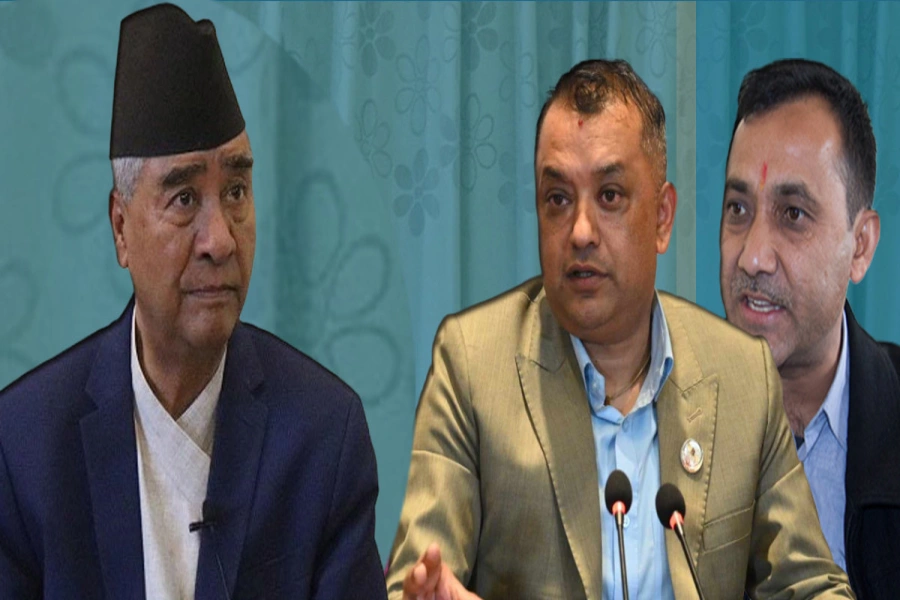
The new chief of National Reconstruction Authority, Sushil Gyewali, has over 20 years of experience in urban planning. In his previous capacity he was the executive director of the Town Development Fund.
Related story
Devt partners call for realistic budget; Fin Min Paudel pledges...

Biswas Baral and Thira L Bhusal caught up the veteran bureaucrat on Wednesday. In his first in-depth interview, Gyewali answers some of the common criticisms related to the slow pace of post-quake reconstruction.
There is a widespread perception that virtually no reconstruction-related work has been done, either before or after the formation of the National Reconstruction Authority.This is not just perception, it is a fact. It is true that reconstruction-related works have not started. The first tranche of 50,000 rupees of the promised 200,000 rupees has not reached the hands of earthquake victims who lost their homes. I would also like to clarify that relief and rescue works don't fall within the authority's ambit.
So could you tell our readers what is it that the reconstruction authority will actually do?
I was coming to that. Our job is to undertake reconstruction works in the districts designated earthquake-affected by the government and to work at rehabilitating affected families. We will rebuild all kinds of physical infrastructures: individual homes, government offices, schools, health posts, roads, electricity-related infrastructures, etc.
But don't you think it is already too late? Shouldn't this work have started immediately after the earthquakes?
Undoubtedly, we have started late. The reasons behind past delays are commonly understood and I don't want to go there. After I became the authority's CEO a month ago, we had to establish the authority from the scratch. So there was a challenge before us to come up with a proper structure, the requisite manpower and to work out our funding channels. Having said that, I also understand the concern that the earthquake victims who are shivering out in the cold need immediate help. It is a tragedy that we cannot get them immediate help.
I would like to say something about how we work. We had the option of creating completely new structures, bottom-up, and directly help earthquake victims rebuild their homes. But we realized that a lot of time would be wasted just to set up these structures. Another option was coordinating with existing departments and ministries and establishing special units within those bodies. This latter approach would be both faster and we would also be able to benefit from the experience of their existing manpower and from their institutional memory. So we decided that we would rather focus on developing an overall policy framework for these special units and undertake reconstruction works through the same units. This is the framework with which we are now operating.
When will earthquake victims be able to get tangible benefit?
In a way, reconstruction efforts are underway. For instance various ministries have already contracted out work for big infrastructure projects. For smaller infrastructures and for rebuilding individual homes, we must honor past commitments made to our donors. It was on the basis of these commitments that the donors pledged around four billion dollars during the donor meet in Kathmandu last year. It is due to those commitments to the international community that we are not in a place to immediately send money to earthquake victims.
For instance, before we can send money to individuals, there has to be a detailed survey of damaged households. Yes, we conducted a rapid assessment yesterday, on the basis of which the Post Disaster Need Assessment, PDNA, was formulated. But this is not enough to honor our commitment to donors, especially the World Bank, which is leading the community of donors helping post-quake Nepal. Nepal's second commitment was that such money would only go through banking channels.
But what will earthquake victims do with the money if they don't have access to building material and skilled manpower?
True. Unless they have access to requisite building material and skilled manpower, just getting the money is of little use. So all three Ms: money, material and manpower have to be simultaneously arranged. Moreover, we are not just looking to rebuild damaged infrastructure, we are now also looking to build more resilient homes and offices. For this we need skilled manpower.
Talking of skilled manpower, is it true that instead of utilizing engineers in various government agencies for survey purpose you are instead employing private engineers, at considerable cost to national exchequer?
What you have to understand is that even before the formation of the new government (of KP Sharma Oli), there was a cabinet decision to give the United Nations Office of Project Services, UNOPS, the mandate to survey damaged areas. It is on this basis that UNOPS then delegated the task to Health Research and Social Development Forum, HERD, an NGO. HERD then started hiring engineers for detailed survey works. Let me also clarify that these engineers have been hired only for the purpose of surveys.
Could you elaborate on these surveys?
We have been trying to collect real-time data on damaged homes. We have distributed tablets to engineers to take six different kinds of photos which will help us map out the damaged areas. This will give us an accurate picture of the kind of reconstruction that is possible. Reconstruction works start the moment the survey of a cluster area is complete. My target is to finish all survey-related works by the first anniversary of the earthquake on April 25th, 2015. We would like to complete it earlier. But this may not be possible with our limited manpower and resources. You have to remember that this is the first time such a detailed survey with the use of latest IT tools is being undertaken in Nepal. So I am deploying all the available manpower, both in private and public sectors, to expedite the process. In sum, I would say that we have a learning-by-doing, pragmatic approach.
Who will pay for the private engineers?
The money does not come from the government. It comes from the World Bank and UNOPS.
Listening to you it appears that reconstruction is by its nature a lengthy process. Would you say Nepalis have been unrealistic to expect quick results?
I see this issue a little differently. More important for me is whether we are doing the right thing or not. When we distributed 10-15 thousand rupees to victim families in the immediate aftermath of the earthquake, there were accusations that many of those getting the money were not even earthquake victims. There were other complaints as well. This hints at the importance of proper verification of quake victims. This was also the reason the World Bank and the UN insisted on it.
Can earthquake victims then expect a roof over their heads by next monsoon?
Let us be realistic. We need to rebuild around 500,000 homes. If we set aside just one mason skilled in safe building for a house, it will take him two months to rebuild it. We thus need around half a million skilled manpower. Do we have this kind of manpower? Can we ensure that construction material will reach each and every household, when we are in the middle of a fuel crisis? And can we arrange for skilled engineers in each and every village development committee affected by earthquake? The magnitude of the task is staggering. So we would also do well to be aware of our limits.
Japan took nearly four years to rebuild after the 2011 tsunami. Look at post-quake reconstruction efforts in India after the 2001 Gujarat earthquake, which also took four to five years. Yes, we realize the gravity of the matter. Thousands upon thousands of earthquake victims are still battling the elements. We would like to get them help at the earliest. We are still working with various government departments and ministries as well as with our donors to arrange temporary shelters for them. But if we are looking to resettle them long term, we first need to be realistic about our limited means. So, realistically, we won't be able to arrange roofs for each and every family by the coming monsoon.
But there is also a dilemma. On one hand the government is asking people not to rebuild their homes in haste, but on the other, as you say, the whole rebuilding project could take next four-five years.
We could have done a lot in the first nine months. We didn't. So there is pressure on the reconstruction authority to hurry things up. As its CEO, I also feel this pressure and I am not in a position to ask earthquake victims to keep waiting for help. But like I said, I am also realistic. I have to tell people the way things are, about our limitations, about why it's unrealistic to expect overnight results. So I would like to take this opportunity to point out that this great endeavor to rebuild Nepal will be possible only if people from every sector of the society contribute to it. I also firmly believe that for faster results there has to be direct ownership and participation of earthquake victims.
Are you suggesting that earthquake victims have to undertake the task of rebuilding their destroyed homes on their own?
Not on their own. Yes, it is up to individual home owners to rebuild their homes. It is their property. What the government, the authority and our donors can do is offer them ancillary help: for instance by providing them the promised 200,000 rupees in seed money; skilled manpower; and a cheap market for reconstruction material; these are the things we can do. The rest will have to be done by individual home owners, of course with the help of their neighbors and local community. We have a great culture of helping one another in our villages. This culture will have to be revived.
Will the authority also support such community-led initiatives?
Yes, we will. People can come together under the banner of the local community user groups. To encourage such initiatives we have increased the threshold of direct government transfer to such user groups from six million rupees to 20 million rupees. This is being done so that people don't have to wait for the government or for the authority to rebuild their communities. Let us ensure that people have access to right technology and that there is proper oversight over these funds, but let us then trust them to do the right thing for their community. Such community-led initiatives will also be helpful in creating gainful employment opportunities at local level.
Can you give us your short-term, medium-term and long-term plans?
As I have already said, we have set April 25th, the first anniversary date, as our milestone, by which time we hope to complete all survey-related tasks, at the latest. We will also finalize our national reconstruction policy by the same date. We are extremely encouraged by the kind of positive feedback our plans have received from the donor community. Our long-term focus is not just reconstruction, in the sense of building back lost infrastructure. We will also be looking to build more resilient and better public infrastructures. For instance we are looking to develop the whole area around Ranipokhari in Kathmandu. While rebuilding homes in rural areas, we will also ensure that people also have access to drinking water, toilets and roads. But the estimated budget of seven billion (US dollars) won't be enough for this. It is for this reason we are coming up with five-year National Reconstruction and Rehabilitation Plan.