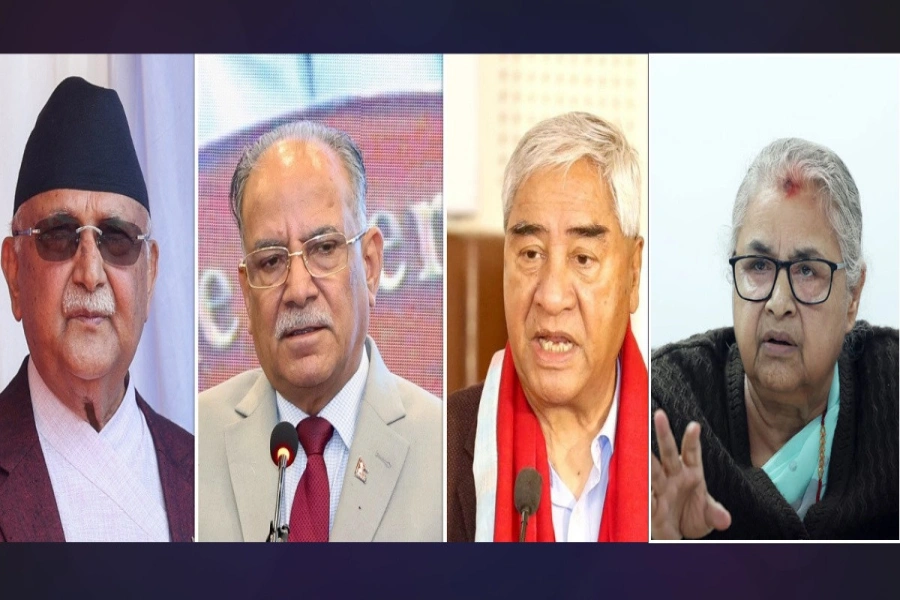
The ongoing Indian economic blockade of Nepal has nothing to do with Madhesh and everything to do with China. The feeling in New Delhi is that Messrs Oli and Dahal felt emboldened to bring a constitution without India's stamp of approval after assurance of maximum support for the new charter from the Middle Kingdom. This, in India's reckoning, represented a grave breach of trust as the Nepali political establishment was well aware of Indian sensitivities over the unwanted presence of any third actor in its traditional backyard.India has been almost paranoid about minimizing Chinese influence in the SAARC region after its humiliating loss in the 1962 Indo-China war. This mindset of Indian rulers, whereby they consider themselves perpetually under seize of a rising China, has changed little in the last 50 years, even though China today is India's biggest trade partner. The antagonism is largely a factor of geography. The two countries share over 4,000-km-long border, including the hotly contested 800-km McMohan Line that separates Tibet from India. China in fact does not even recognize the McMohan Line settled between the British colonists and independent Tibet in 1914.
The Indian paranoia is such that even innocuous gestures that remotely signal warming ties between China and one of the countries under the traditional Indian 'sphere of influence' can entail the harshest of responses from New Delhi. In 2012 Jigme Thinley, the first democratically elected prime minister of Bhutan, dared shake hands with then-Chinese Prime Minister Wen Jiabao on the sidelines of the Rio Conference on Sustainable Development. Thinley had to pay for it—and how.
To corner Thinley, India cut its fuel subsidy to the tiny kingdom on the eve of its 2013 general elections. Opponents, egged on by India, blamed Thinley for inflicting hardship on Bhutanese people, which in turn led to a humiliation loss of his party. Replacing him as prime minister was India's trusted hand, Tshering Tobgay. Now the same crude instruments of coercive diplomacy are being applied in Nepal. It's no coincidence that India considers Bhutan and Nepal at the heart of its sphere of influence.
Of course, in modern international diplomacy, abstract concepts like morality and right and wrong are meaningless. Lord Palmerston's famous dictum about the English foreign policy in the 19th-century—"England has no eternal friends, England has no perpetual enemies, England has only eternal and perpetual interests"—is these days the de facto foreign policy stand of all sovereign states. So it would be foolish to believe India is really worried about Madheshis. They are mere pawns in its great game. But, here, we would also do well to remember that what applies to India also applies to China.
China is now itself engaged in a duplicitous game of creating artificial islands on the South China Sea so that it can lay claim to more of the Indian Ocean. The ultimate aim is to boot out the Americans—who have been responsible for maritime security of South-East Asia and East Asia since the end of the Second World War—from the South China Sea, which China considers as falling under its sphere of influence. In the landmass of South Asia, too, China is looking to provide strong counterweight to India.
Whenever India's relation sours with one of its neighbors, China is quick to jump in. This is the reason for the recent spate of bilateral trade and fuel agreements with Nepal that have followed the Indian blockade. Farther afield, Pakistan has always been a staunch Chinese ally. Now China is casting its net wider. It is now a major investor in the Maldives. After the ouster of pro-India President Mohamed Nasheed and coming to power of Abdulla Yameen—who recently told India to stop meddling in his country—the Chinese have expressed their desire to establish military bases in the island state.
In Sri Lanka, India was reassured with the victory of Sirisena Maithripala in the presidential election earlier this year. Maithripala had replaced Mahinda Rajapaksa who during his 10 years in power had blindly welcomed Chinese investment. The result is that 70 percent of the country's infrastructure projects are financed by Chinese debt. But much to India's consternation, Maithripala, head of the indebted Lankan government, is now seeking favorable terms for the repayment of loans to its single biggest creditor. As a quid pro quo, Sri Lanka is now thinking of allowing Chinese naval ships to dock on its shores, in the process again stoking the old Indian fears of Chinese encirclement.
But India would have had far less to worry about had it been keen about strengthening SAARC and serious about its role as the leader of South Asia.
It is largely due to India's cool attitude to meaningful regional cooperation that the idea of SAARC has never taken off. Thirty years after SAARC's establishment, intra-regional trade is barely five percent of the total trade of eight member countries. The regional free trade agreement has been in limbo for over a decade. If India wants to be acknowledged as the undisputed leader in the region, there is no option to enacting a version of the Gujral Doctrine, with India—which accounts for 70 percent of SAARC area and population—taking the initiative for greater regional cooperation. That would also be the best way to minimize Chinese influence.
But for this to happen India should first be ready to revisit its old Nehruvian mindset whereby it feels the needs to project hard power even against small states like Bhutan and Nepal. It should rather encourage greater movement of goods and people in the region through quick implementation of SAFTA, which would offer the strongest evidence of India's claim to leadership of the region. Most importantly, India should ditch its obsession with China and feel more confident about its soft power as the biggest democracy in the world.
Fear of China is making India act in all kinds of irrational ways, the most recent manifestation of which is its economic blockade of Nepal. Such acts smack of desperation that is unfitting for a growing global power. They are also counterproductive; notice how India has inadvertently pushed Nepal into China's waiting arms.
The onus is on India to counter the growing perception in the region that a dictatorship that deals with all countries, big or small, on strictly business terms is preferable to a lecturing democracy that seldom practices what it preaches.
biswasbaral@gmail.com
Related story
Motorhead’s Lemmy was supposed to be on Josh Homme’s new ‘Deser...