ROLPA, Feb 10: The country has repeatedly overhauled its governance system in the name of radical change. From the autocratic Rana regime to the Panchayat system, multi-party democracy, and finally the republic, different political frameworks have ruled.
Yet, despite leaders claiming an unparalleled role in every transition and loudly championing inclusivity, the lives of ordinary citizens have barely improved. While many households struggle just to keep their fires burning, state officials are busy showcasing glossy images of development projects.
Political parties that claim seniority and legitimacy—like the Nepali Congress (NC), the old communist party CPN-UML, the Nepali Communist Party (NCP) that emerged after a decade of armed conflict, and the Rastriya Swatantra Party (RSP), claiming intellectual leadership—have all shown disappointing results in nominating women candidates.
Male-female ratio at birth widening

In many constituencies, women have been deliberately pitted against “influential” men, reduced to numbers for quota fulfillment rather than genuine political participation. Women, who make up over half the population, are consistently sidelined, undermining true leadership. While parties often boast about a 33 percent quota, in reality, women are pushed to the margins. Proportional representation has become a tool to meet numbers rather than nurture talent.
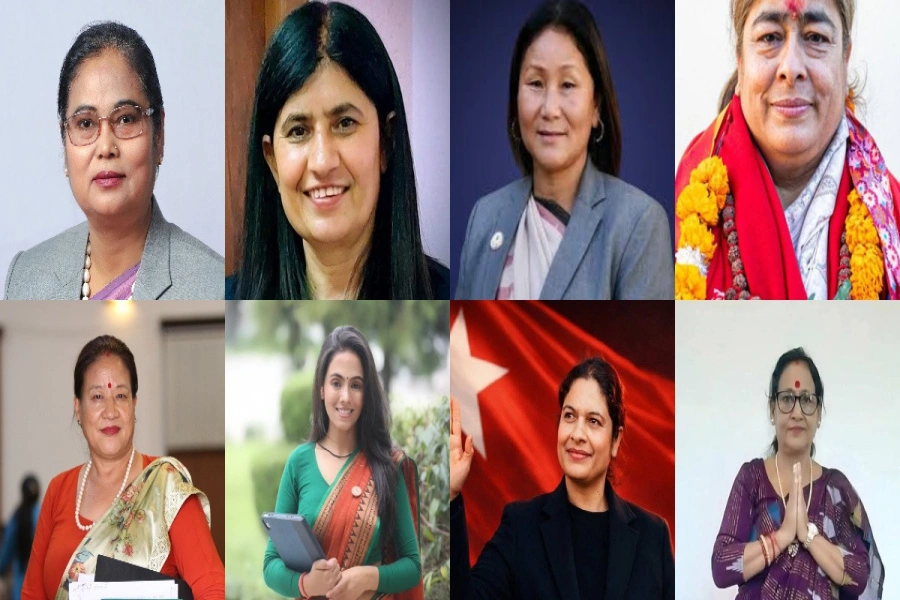
Across 165 constituencies, NC has fielded only 11 women candidates—most forced to face “influential” male rivals. Kusum Thapa Magar in Rukum East is up against NCP Coordinator Pushpa Kamal Dahal; Meena Kharel in Chitwan–2 faces RSP Chair Rabi Lamichhane; and Mandhara Chimariya in Jhapa–5 competes against both CPN-UML Chair KP Sharma Oli and RSP senior leader Balendra Shah. In Jhapa–2, former Speaker Devraj Ghimire faces NC’s Sarita Prasain; in Siraha–4, Chandrakala Kumari Yadav competes against three former ministers. In Mahottari–2, NC leader Kiran Yadav contests against Sharat Singh Bhandari, a seasoned politician who has served as minister multiple times.
Other parties also lag in female representation. UML has fielded just 12 women, RSP 16 women among 163 candidates, NCP 11 women among 164, and the Rastriya Prajatantra Party (RPP) has nominated women in only nine of 163 constituencies.
High-profile contests include Sunsari–3, where Bhagwati Chaudhary of CPN-UML vies for the fourth time against Bijay Gachhadar, and Tanahun–1, where Bhagwati Neupane faces RSP’s Swarnim Wagle. RSP’s Indira Rana in Jhapa–2 competes against former Speaker Devraj Ghimire. In Jumla, Binita Kathayat of RSP contests RPP’s Gyanendra Shahi, while Sobita Gautam faces former Bharatpur Metropolitan City Mayor Renu Dahal.
In Sarlahi–4, Rinki Kumari Sah of Aam Janata Party (AJP) takes on NC President Gagan Thapa and RSP’s Amaresh Kumar Singh. In Rautahat–3, NCP’s Poonam Devi is set against six competitors from different parties, including UML, NC, RPP, Janata Samajbadi Party (JSP) Nepal, and Janamat Party.
In Kathmandu–5, NCP lawyer Kalpana Sharma faces NC General Secretary Pradip Paudel and former UML Senior Vice-Chair Ishwar Pokhrel. In Kanchanpur–1, NCP’s Bina Magar competes against UML’s Tara Lama Tamang and NC’s Gopi Prasad Upadhyay. In Manang–1, NCP’s Yashoda Subedi contests NC’s Tek Bahadur Gurung, while Dharma Shila Chapagain of NCP in Jhapa–2 faces NC’s Sarita Prasain, UML’s Devraj Ghimire, and RSP’s Indira Rana Magar.
In Sankhuwasabha, NCP’s Sarita Thapa Khadka takes on NC’s Deepak Kumar Shrestha and UML’s Arjun Kumar Karki. In Saptari–4, Rubi Kumari Karn of NCP is up against UML’s Ganga Prasad Chaudhary, NC’s Teju Lal Chaudhary, and JSP Nepal’s Babi Singh.
Overall, many “influential” women in major parties remain outside the electoral arena. Out of 3,088 male candidates in direct elections, only 388 are women—including 157 independents. With a voter base of 18,903,689, women make up 9,240,131 voters. The slogan that women who run households can also run the country will only become a reality when political parties stop sidelining women and create an environment that gives them real opportunities to participate.


-1200x560-1774606010.webp)