KATHMANDU, Feb 4: Experts from the government, private sector, academia and civil society on Tuesday underscored that Nepal stands at a critical juncture where the choices it makes now on artificial intelligence (AI) will determine whether the technology narrows long-standing inequalities or widens them further.
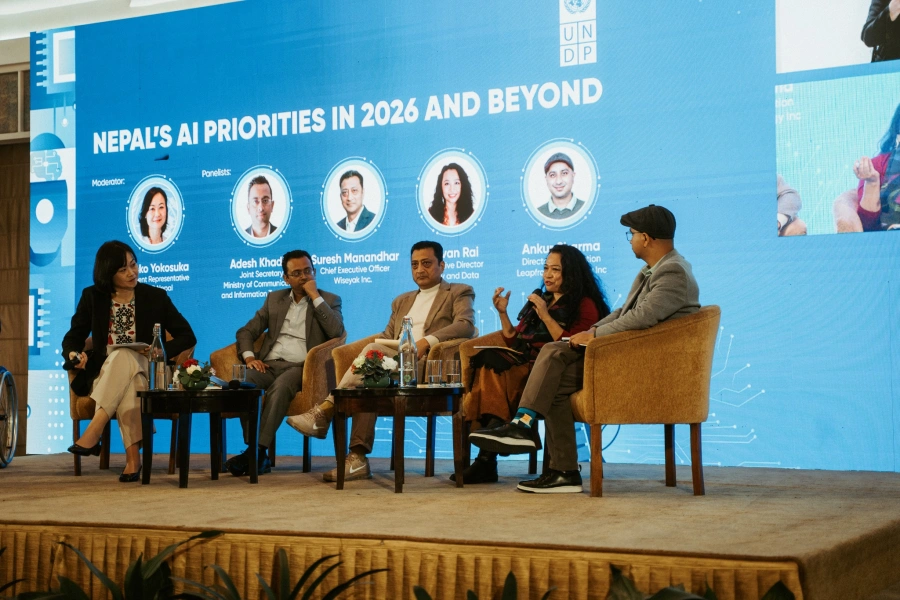
Speaking at a panel discussion on “Nepal's AI Priorities in 2026 and Beyond”, moderated by UNDP Resident Representative to Nepal Kyoko Yokosuka, panellists stressed that AI adoption must be guided by human development goals, inclusive policies and nationally anchored systems, rather than the passive consumption of global technologies.
Opening the discussion, Yokosuka said the UNDP’s regional AI report warns that AI could exacerbate inequality both between and within countries if not governed well. “Now is the crucial moment for countries like Nepal to decide whether AI becomes a partner for human development or a force that deepens existing divides,” she said, emphasising the need for inclusive, equity-centred and rights-based AI governance.
The event also marked the launch of UNDP’s regional AI report, The Next Great Divergence.

Experts stress cooperation for inclusive development

Addressing the panel, Adesh Khadka, Joint Secretary at the Ministry of Communication and Information Technology, said the government is consciously designing AI policy to reduce, not reinforce, the digital divide. He highlighted plans to establish AI centres of excellence in the provinces, starting from the Far West, to ensure innovation is not concentrated only in Kathmandu.
“If deployed properly, AI can help overcome barriers of language, literacy and cost,” Khadka said, noting that voice-based and local-language tools could significantly improve access to public services. However, he cautioned that citizens without digital access, identification or connectivity risk being left behind, making inclusive infrastructure and data governance critical.
Suresh Manandhar, CEO and Chief Scientist of Wiseyak Inc., said Nepal has strong potential to use AI in sectors such as healthcare, education and government service delivery. He pointed to AI applications in medical imaging, diagnostics and rural health as areas where Nepal could both serve its population and develop regional solutions.
He argued that the government could become a “model user” of AI by deploying AI-driven public services that are accessible 24/7 in local and mixed languages. “Language is central to inclusion in Nepal, where people rarely speak ‘pure’ Nepali. AI systems must handle Nepali–English or Nepali–Hindi mixes,” he said.
Manandhar also warned against over-reliance on global big-tech platforms, calling for nationally developed, open-source AI foundations, local data infrastructure and affordable computing capacity to protect data sovereignty and retain talent.
Ankur Sharma, Director of Innovation at Leapfrog Technology Inc., said AI is already transforming content creation, research and IT services in Nepal, but high barriers to entry remain a major risk. “The challenge is not just using AI, but developing with AI,” he said, stressing the urgency of large-scale upskilling and reskilling.
He warned that entry-level jobs could shrink as routine tasks become automated, making the early integration of domain expertise, critical thinking and AI literacy essential within the education system.
Dovan Rai, Executive Director of Body and Data, highlighted the importance of interdisciplinary and community-driven AI development. She said generative AI has lowered technical barriers, enabling people with domain knowledge—rather than only AI engineers—to build solutions closer to community needs.
However, Rai cautioned that new forms of digital divide are emerging, not only in access to devices, but also in critical digital literacy and guidance. “Without ethical frameworks, social values and digital citizenship, we risk losing both inclusion and sovereignty,” she said, calling for stronger involvement of civil society in AI governance.
Panellists broadly agreed that Nepal’s immediate priorities should include translating AI policy into funded action plans, building public-sector capacity, investing in local data and computing infrastructure, strengthening AI education at multiple levels, and fostering collaboration among government, industry, academia and civil society.
Concluding the session, Yokosuka said the discussion showed that AI is no longer a distant future for Nepal. “What matters now is not whether Nepal adopts AI, but how and in whose interest,” she said, adding that Nepal has clear choices and agency to shape AI as a tool for inclusive and sustainable human development.