There are a close to three million apps currently available in app marketplace, but one app that could possibly save Nepal from becoming a failed state is yet to exist.
Anyone on Facebook can see that online-wallas love photo applications. On average, 350 million photos are uploaded on Facebook on daily basis. Instagram, a mobile photo sharing app was recently purchased by Facebook for one billion dollars for its smart user interface and filters. A while back, people were in love with an image recognition app that could guess someone's age from a photograph. Now, another web application has captivated the imagination of the Internet-goers. Isitnude.com boasts its algorithm can detect nudity in a photograph. Users can paste a photo's URL or upload a picture from a local drive and get them instantly evaluated for nudity. It was hard to believe.Immediately after reading about the app, I downloaded a few pictures from the Internet and tested them on isitnude.com to see if the site's technology did what it said it would. To my surprise, the test results were quite impressive. The app responded to a nude picture with a message that read "Nude – R, you might want to be careful where you post this." Similarly, the response to a non-nude picture was "Not nude- G, you can probably post this."
The site's technology was incredible, but right then I could not figure out where it could prove useful. Soon, I realized that the companies and individuals looking to filter out objectionable content on their applications to maintain child friendliness would find the technology extremely valuable. Similarly, parents would also love to be able to install such a feature on browsers, so that children are not exposed to a pornographic content.
The other day while I was sipping coffee at home, a brilliant idea struck me—the mobile app (Corruptogram) that could instantly tell if someone in a picture is corrupt or not (or likely to be corrupt or not). The idea is rather far-fetched, but I am confident we will get to use such an application in our life time. I floated the idea among progressives, and the response was quite encouraging. Like me, many believed least developed countries like Nepal could benefit from Corruptogram, because there is a direct correlation between corruption and poverty.
It remains to be seen whether Nepalis will find Corruptogram useful, but the country as a whole would certainly benefit. In Nepal, people usually do not vote for competent and visionary candidates. Instead, they vote for the candidates standing up from the political party of their liking. In a sense, candidates still get votes, even if they are too incompetent and corrupt to develop their respective constituency or the country for that matter. In short, they vote for the party and not for the candidates. That could be the main reason why successive government has not been able to propel the country towards the new heights of prosperity like China and India. Unfortunately, the most devastating effect of this socioeconomic failure has been on youth—more than 1800 young people leave the country daily, looking for better opportunities elsewhere- a national crisis that is poised to destroy the nation's future.
Corruption has become so widespread in developing countries that even international development agencies have started to show deep concerns. In 2013, at an event hosted by the World Bank's anti-corruption investigative arm, the World Bank's Group President Jim Yong Kim said, "In developing countries, corruption is the public enemy number one. We will never tolerate corruption, and I pledge to do all in our power to build upon our strong fight against it."
Nepal slipped four points (from 126th to 130th) in Transparency International's Corruption Perception Index 2015. This shows how poorly Nepal is dealing with this menace. Corruption will continue to flourish until several factors contributing to it are uprooted. Nepali society's sick obsession with material gains is one such factor. I am for capitalism, but the nation has become so materialistic that there is constant competition to try and hoard the newest and best things even when not needed. Second, the political parties have been siphoning off resources allocated for socioeconomic development to sustain their political parties.
We need to have zero tolerance towards corruption. It can be reduced if the government is serious about uprooting it. Targeting bureaucrats, businessmen, and heads of security agencies as escape goats for cheap popularity and with intention of diverting people's attention from deepening economic crisis and government's incompetency won't help. Political parties are the main culprits behind industrial scale corruption.
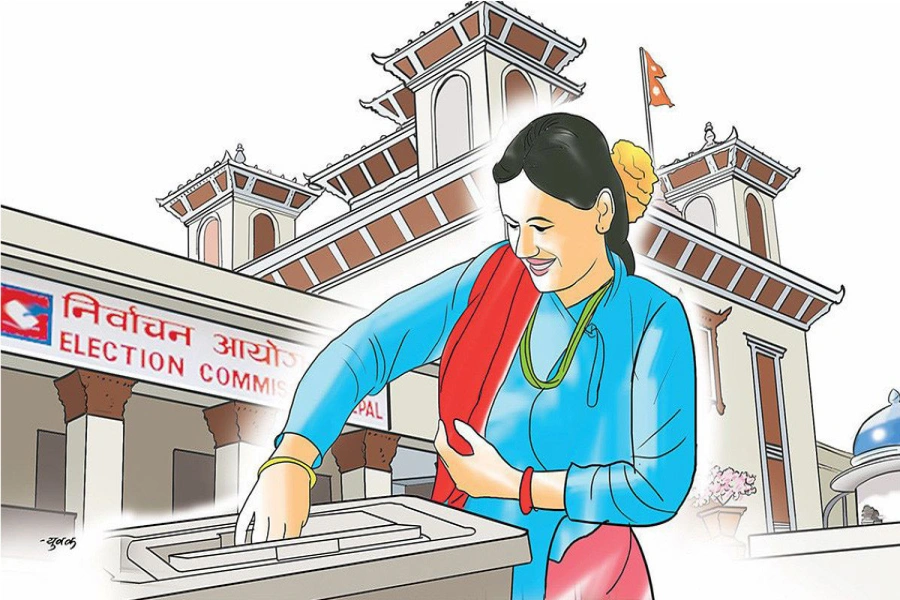
How do we move from a system whose core value is amassing wealth at all cost. A truly transformative change is possible only if the society as a whole fundamentally re-thinks its values. In Nepal, citizens love to blame politicians for everything that is not workable. However, in a democratic society, citizens should be reminded that they also have civil duties. Nepali citizens are conscious about their rights, but not duties. One of the most important duties is to vote for competent political candidates, so that when they take office, they are capable of developing and executing far reaching policies, plans, and programs that are deemed necessary for country's development. Honestly, Nepal's derailed social economic development can be brought back on track if and when Nepal we stop voting for morally bankrupt politicians.
In the next general election, if citizens are too busy with their soap operas to research on potential candidates standing for election, the Corruptogram photo app will come in handy, if they are serious about voting for competent candidates. If citizens want more options, the app could also be tailored to measure competency, leadership qualities, and integrity.
We find it hard to believe that there are competent politicians in Nepal. The fact of the matter is there are, but they are far and few between. We need to vote for them. It seems only Silicon Valley can help Nepal with Corruptogram. One can hope from Google, Apple, Facebook, Amazon, and Microsoft. I hope they are listening.
The writer was a fellow at the Center for Electronic Governance, United Nations University—International Institute for Software Technology
Related story
What's keeping you sane?