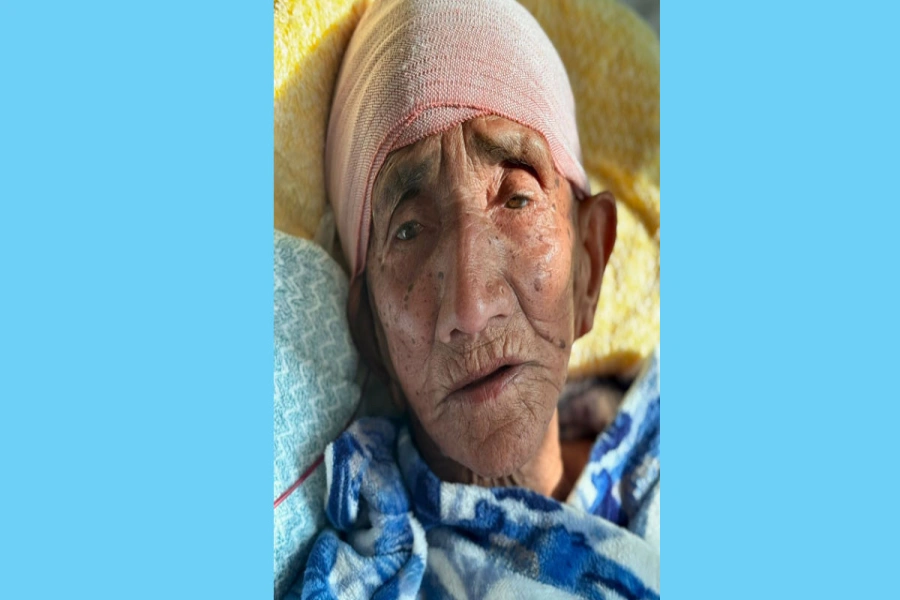
The dry spell of monsoon over the past two months had been a huge blow to his livelihood when most of his maize crops failed. Now he worries if his rice farm will suffer a similar disaster. The delayed monsoon has ruined his family.[break]
“All our maize farms failed after investing a lot of money and I managed to harvest only few kgs of maize this year. Now I´ve put all my savings on my rice plantation,” says 43-year old Indra Bahadur, speaking to My Republica in the remote Supar village of Shaktikhor VDC.
Cultivating a farm, whether for rice or maize, is not cheap during such times in Nepal which is becoming too expensive for the poorest, a majority of whom are our rural farmers.

The cost of hiring a tractor to plough a farm is Rs 1,200 per hour compared to Rs 300 just four years ago. The price of seeds has doubled over the period. Most of the Chepang farmers who have less lands lease in extra land plots at a cost of Rs 1500 per katha. Hiring a laborer costs Rs 400 per day to carry the cow manure to fertilize the farms.
In addition, they pay Rs 600 per day to the agricultural laborers to help in planting. With virtually no sign of irrigation system in place, thanks to the callous governments over the past decades till now, the farmers usually hire laborers to water their farms and costs at least Rs 1,000 per bigha.
“The hardship was even worse this year for farmers. This government or any political leader has not said one word to heal our pain even after all our crops failed,” says Padma Kanta Poudel, 60 year old farmer in Jutpani VDC.
Until now, the weather had been their last hope but this year´s dry monsoon left many farmers literally ´shell-shocked,´ even in Chitwan, one of the country´s most fertile areas.
Padma Kanta´s farms produced 20 quintals of maize last year and this time his harvests were barely a quintal. His huge size farm counted for nothing and his investment of nearly Rs 40,000 was completely washed away.
As a farmer, he knows the pain of his fellow farmers. He is more worried about the Chepangs. “You should go and meet the Chepang farmers. I don´t know how they will survive in the coming months,” explaining that he is lucky to have sons employed in the army and government office and he can depend on them for support. But for extremely poor Chepang farmers like Indra Bahadur, who were not prepared for such unpredictable monsoon, they don´t have any plan B.
Their only option for immediate relief is to get labour job, which is also hard to find when there are many farmers looking for jobs in a limited labour market of their VDCs. Finding work in a neighboring VDC is a long walk from their homes. It takes over three to four hours to reach the nearest VDC from Shaktikhor.
“It´s really difficult to even find labour jobs nowadays. All we can do is depend on our local money lenders or the shop owners to buy food on credit,” says farmer Ram Bahadur Chepang from Kolag village, which takes four hours of walk to Milan Bajar where he travels everyday in search of job. Ram Bahadur also got ruined and desperately for a job to support his three children and wife.
Since the interest rates for loans are too high and he doesn´t want to risk losing his farm and goats as repayment, Ram Bahadur buys food on credit which cost much higher than when paid in cash. “I am worried if I can earn enough money to pay back.”
Milan Bajar is the main trading and market centre controlled mostly by high castes. The motorable road ends here while there is none for most of the Chepang villages connecting the most remote VDCs and the worst is Kaule, which remains the farthest and virtually out of government radar.
For the Chepang community, times have changed drastically for them. They can no longer be forest dependent and don´t want to be recognized as ´wildlings´ wandering about the forest dressed in scant clothes and hunting bats for food and living in caves.
“We are no more a tourist attraction,” says Baburam Chepang, 60 year old health worker. He explains how foreign tourists often come looking for primitive looking ´bat hunting´ and ´wild fruit´ eating Chepang tribe. The fact that Chepangs are still a tourist attraction is an insult for the community because now they are struggling to redefine their identity in a dignified way that they deserve unlike portrayed in the media.
“Recently, a group of tourists came to my village and asked me where are the real Chepangs. I told them here we are standing right in front of you. They weren´t impressed,” muses Baburam.
“We can´t blame the foreigners because that is how we are still portrayed in the media,” says Manju Chepang, a local Chepang rights activist from Nepal Chepang Association. She explains that it was the stereotyping of their community that makes the government to treat them as charity case but failed to establish a system to empower them so that they could be part of the decision making process and the state machinery.
Until now there is not even a single Chepang who is in a senior position in the government´s bureaucracy or department. Only two Chepangs made it to the Constituent Assembly. Only one Chepang has completed a Master´s Degree. The Nepal Chepang Association estimates their population of nearly 100,000 in six districts of Makwanpur, Chitwan, Dhading, Gorkha, Lamjung and Tanahu.
Over four decades have passed ever since the Praja Development Program was created by late King Birendra when he visited Chepang villages in 1977. Since then, he gave them a new title ´Praja´ the king´s subjects but his vision of uplifting the Chepangs has been limited to vocational training for unskilled jobs, goat rearing, micro loans and small income generation projects even after the Ministry of Local Development took over the program in 2003.
The new generation of Chepangs want more than charity from the government but an opportunity for greater political rights and participation in the government.
One of the worst cases of state-manipulated excluded groups, the Chepangs were listed as ´masinya matwali´ (enslaveable alcohol drinkers) in the Muluki Ain 1854 and established their exclusion and discrimination for generations leaving them no rights to land ownership and education and even professional jobs. Although the new Muluki Ain of 1963 removed such discrimination, the state neglect continued and the new generation is struggling to establish themselves to be on equal footing socially, politically and economically as other ethnic groups.
“We were always capable of many things. Many in my grandfather´s generation changed their surnames to Magars and Gurungs to join the army. I restored my Chepang surname only a few years back,” says Baburam.
“We have been fighting for our greater rights for a long time and yet the government has responded with small development programmes rather than empowering us by giving opportunities to be part of the political and government system,” says Laxman Chepang, a member of the Nepal Chepang Association.
Laxman believes that the country needs a new system that will address grievances of the most marginalized communities and federalism was their last hope. But the problem is that the debate on federalism never reached the ordinary people and even before they understood what it really meant, the definition of federalism was perceived as creating ethnic divisions in society. It is a subject that even the most ordinary Chepangs are afraid to speak of especially after the ´Akhanda Chitwan´ movement.
“The mention of federalism nowadays makes everyone nervous because it has become such a sensitive issue because nobody really knows clearly what form the federal state will take,” says Rabi Thapa, a hotel owner in Shaktikhor.
“I have understood it very well because I can read and I am curious but most of my fellow Chepangs really don´t understand what it means,” says Surya Bahadur Chepang, a high school student who has read a lot about federalism articles by Madhesi writers.
“We need a change but that cannot be done without cooperation of the high caste and they are very nervous about federalism because they have also not been educated about it,” says another student Anu Chepang. “They think it is just a Maobadi agenda.”
But not all Chepangs agree. “I have heard of Tamasaling and Tharuwat. If they get it, then we want our own state also,” says 42-year old farmer Santa Bahadur, who explained that such situation will happen as all ethnic groups will be asking for their own state. “This will destroy our country. I don´t want to be enemies with my Brahmin friends or the Magars or Gurungs because we all live in the same neighborhood,” he adds.
It seems clearly that pro federalists have done such a poor job of educating even the most marginalized communities about what federalism really means. Their ideological debates and intellectual discussions in the cities have yet to reach the most common citizens. Their ideologies may not matter much for the people but they want to understand the specifics, the nuts and bolts of a federal system.
Simply derogating the high castes doesn´t help to justify federalism, many Chepangs told us.
“The reality is that the issue of federalism will not go away easily but we have to sit down and reach a compromise between both the anti and pro federalists because we are the ones suffering right now constantly afraid what will happen next,” says Rabi.
Related story
UML Kaski demands dismissal of corruption tainted Minister Adhi...