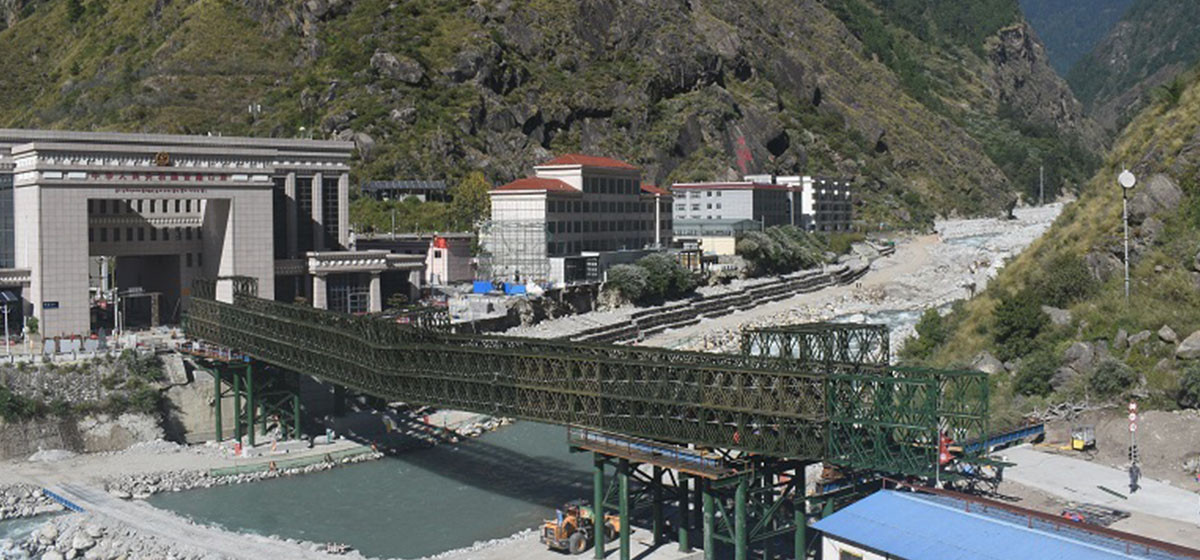
Nepal is bordered to the north by the People´s Republic of China and to the south, east, and west by the Republic of India. Nepal shares about 1,850 km border with the latter, of which, 1,700 km is open and spongy. Nepal enjoys a deep cultural, educational and economic links with her southern neighbour. Her southern belt, called Tarai, which is largely populated with Hindus, has for centuries enjoyed close matrimonial relations with Bihar and Uttar Pradesh of India, as they are mainly dominated by the Hindu-Caucasians. However, lately, a shift has been noticed in this pattern of marriage system as matrimony among the Tarai groups is growing for various socio-economic and security reasons. On the other hand, China, that flanks Nepal on the north, with its autonomous region of Tibet, shares more than 1,415 km border. This part of the region of Nepal has been populated mainly by Mongolian stock which enjoys cultures and lifestyles akin to Tibetans.
Disputes and Challenges
Despite close physical proximity and other socio-economic and cultural linkages, Nepal faces a number of challenges with her friends. She confronts security issues with India like smuggling of illegal arms and ammunitions, movement of fake currencies and extremists, apart from cross-border operation of criminal outfits. This is largely owing to the open and spongy border. The major dispute with India, nonetheless, is about the tri-junction area in Kalapani, which has a strategic value for Nepal. It involves around 75 sq km of area where China, India and Nepal meet.
Likewise, even if Nepal enjoys regulated border, poaching of wildlife parts and trafficking of small arms are also issues with her northern neighbour. However, in the case of China, too, the main disagreement is about territory, particularly about a missing No. 57 pillar, erected with shared assent in Rasua district. If China declines to subscribe to a small land-locked neighbour’s view, Nepal may lose 30 hectares of Hill lands. In addition, although Nepal sticks to the “One China” policy, China’s constant anxiety over refugees and their deviant behaviour on Nepali soil has been another big challenge for the country.
Shifting Policy Paradigm
Even after the Second World War, Nepal continued espousing its foreign policy devised by late Prithvi Narayan Shah that country is “a yam between two boulders”. While during the Cold War, chessboard diplomacy was in vogue, Nepal largely pursued this policy vis-à-vis her two immediate neighbours who were demographic and military giants. They were also competing powers in the region and were divided into hostile Sino-American and Indo-Russian camps. This regional reality of 1980s, created by the necessities of the Cold War, was appropriately defined by the first democratically elected Prime Minister and democratic leader BP Koirala. He referred to Cold War vehemence and Nepal’s situation as, “a man sleeping [resting] between two standing elephants.” His contention was that one can’t sleep while standing elephants are on either side. It was a departure from 18th Century policy.
Cold War witnessed intense political metamorphosis in the Asian region, as elsewhere in the world. But, Nepal’s foreign policy largely remained unchanged even at the end of Cold War. However, in the post-Cold war scenario, which witnessed ushering in of democracies across the world coupled with rapid globalisation, Nepal’s conventional foreign policy has drastically changed. Foreign policy shift became imminent also because of her next-door neighbours’ soaring wealth and power and their new aspirations as global players.
India and China’s meteoric rise has generated immense hope and optimism in the region. Surrounded by two economic giants, Nepal is now all prepared and eager to seize the opportunity. Thus, scholars and political elites have already begun dubbing contemporary Nepal’s position as a nation sandwiched between two gold-mines rather than two boulders. Former Prime Minister late GP Koirala upheld this view and wanted to develop Nepal as transit route for her close friends. Incumbent Prime Minister Dr. Baburam Bhattarai, of late, has also said that Nepal should be a vibrant bridge between the South Asian region and China rather than the traditional buffer state. Indeed, these are the manifestations of Nepal’s shifting foreign policy paradigm in accordance with the country’s long cherished desire.
To sum up, despite Nepal enjoying warm and cordial relationship with her immediate neighbours, she faces a few serious challenges. Both neighbors, each a military and economic giant, has ticklish issues with its small and frail friends—some related to border while some others (such as refugees, counterfeiting, organised crimes and movements of extremists) also concern international community. To resolve these concerns, Nepal needs to be a little bold, pragmatic but cautious as well since the neighbours’ goodwill and cooperation is a must for her overall development. Her socioeconomic fortunes, which fundamentally depend on tourism sector and harnessing of huge fresh water resources, ultimately rest in the sincere help of India and China.
Now, time has come for Nepal has to accept her mea culpa that she has been unable to assure her neighbours that her overall affluence rests in their security and prosperity. Success on this front, given China and India’s regional and intra-regional blue-print to connect neighbours and share prosperity in the region through synergistic measures, shall transform Nepal’s challenges into enormous opportunities; it will also offer amicable solutions for most of the impending disputes with her next-door neighbours.
The author is Nepali ambassador to the UK
Related story
Walk in the clouds: World’s longest pedestrian suspension bridg...